
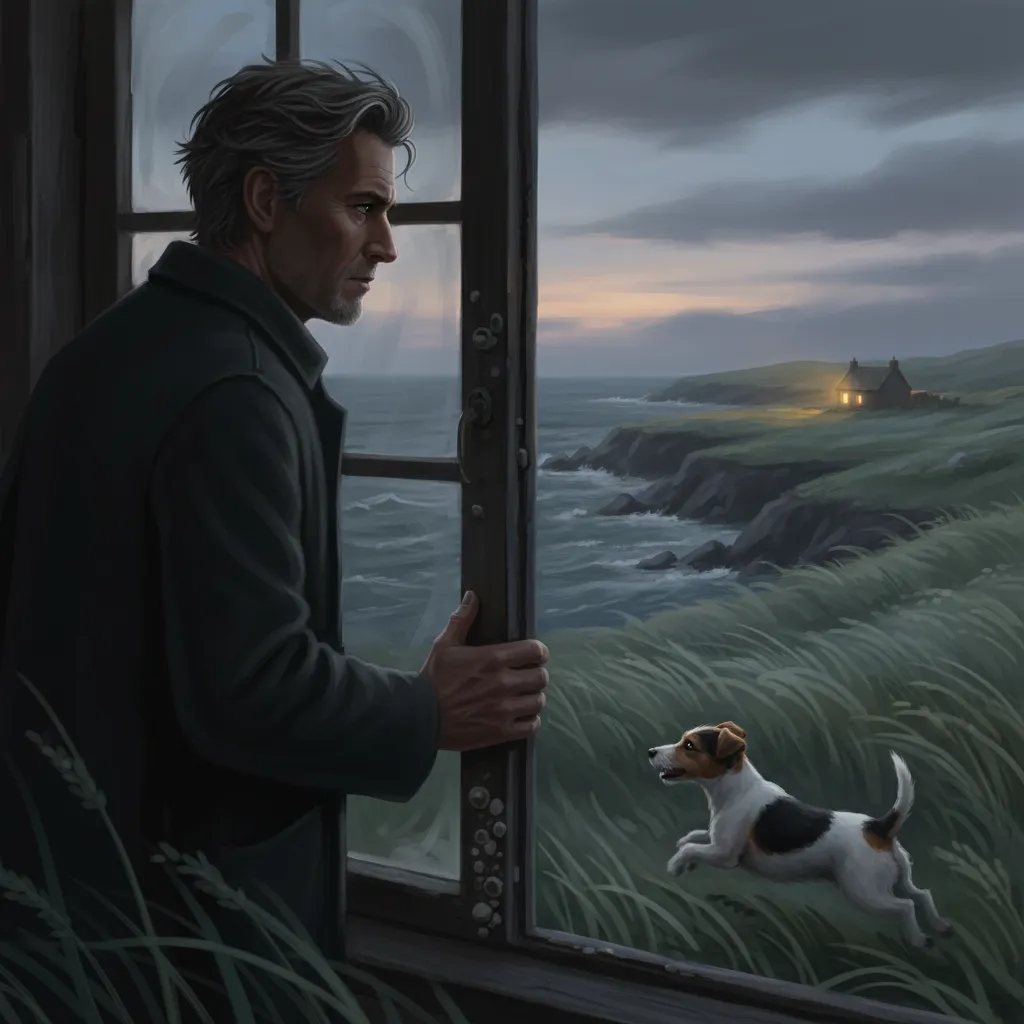
He pulled a sweatshirt over his t-shirt and went out. The cold air burned his lungs. He didn't run; he walked with the fast, economical stride of a man who knows that haste wastes energy he might yet need.
The dog was already at the very edge, interested in a seagull screaming from a ledge.
"Hey!" Elias called, but the wind carried his voice away.
The dog turned, wagged its stump of a tail, and took a step forward, toward the slippery edge.
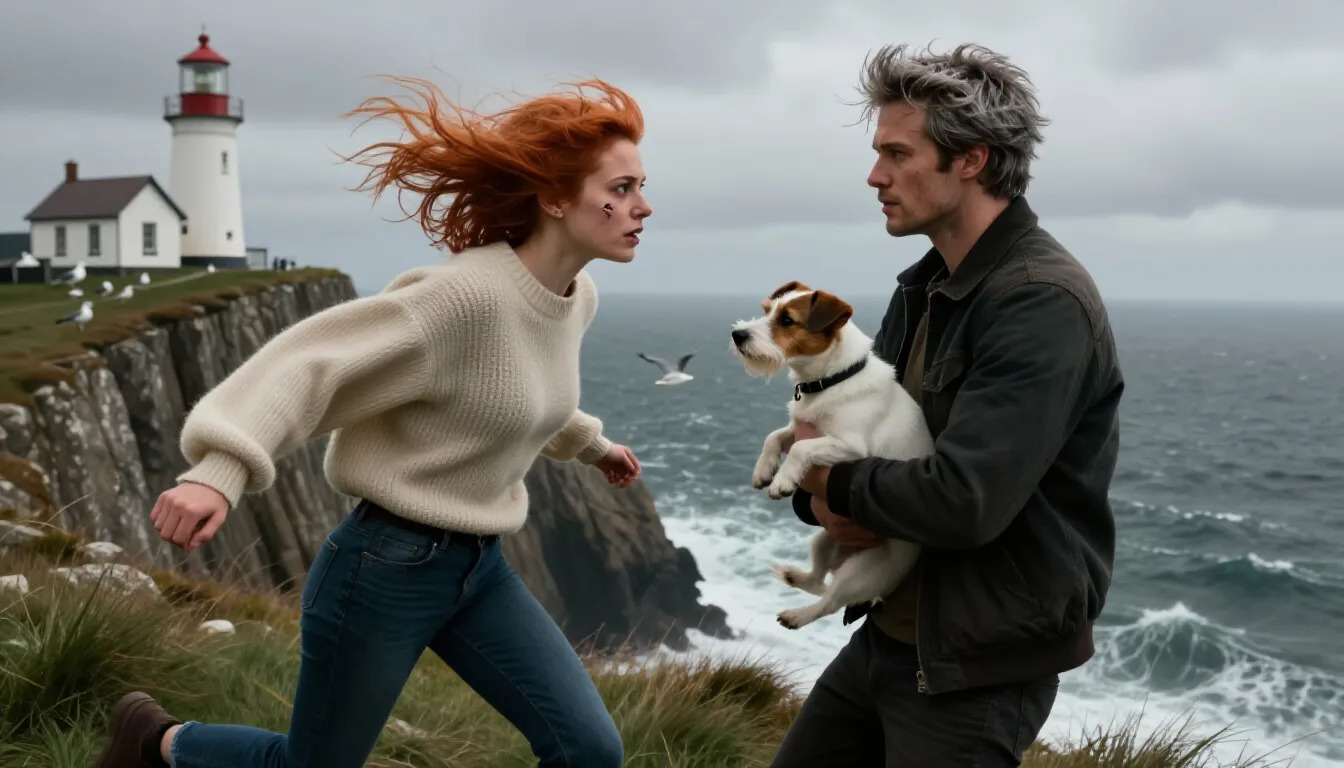
At that moment, she ran out of the cottage. In jeans and a huge sweater thrown over her shoulders. Copper hair, gathered in a messy bun, flying in the wind.
"Fenix! Damn it! Come back!"
The dog obeyed. For a second. Then it darted toward the edge again. Elias was already there. He didn't try to catch the dog—it was too fast and skittish. He intercepted its trajectory, blocking the path to the drop with his body. The Jack Russell crashed into his legs, yelped in surprise, and sat down.
"Thank you," the woman said, running up, out of breath. "He... he hates enclosed spaces. Howled the entire drive here."
"His name is Fenix?" Elias picked up the dog, feeling its trembling heartbeat under its fur.
"After the bird that rises from the ashes," she said, and her voice held a bitter irony. "So far, he only falls off of everything."
He handed her the dog. Only now did he really look at her. Not just her face—everything. Young, but not youthful. Sharp cheekbones, a wide mouth. And eyes—the color of the sea in weather like this, grey-green, with flecks of gold. And the scar. A thin, white thread on her upper lip.
But his gaze, against his will, slipped lower. To her neck, long and strong, where a pulse beat. To the collar of her stretched-out sweater, which had slipped, revealing a sharp collarbone and the beginning of a smooth shoulder curve. The wind pressed the thick sweater fabric against her torso, and for a moment it outlined a high, firm line of breast and a thin waist cutting sharply inward beneath it. It was an instant, fleeting impression, but it was enough.
Something jerked in his gut—not alarm, but a thick, warm thud, familiar and long-forgotten. His blood seemed to rush from his head for a second, rushing somewhere downward, leaving behind a faint ringing in his ears and a sudden dryness in his mouth.
He sharply forced his eyes back up to her face, catching her gaze. She was looking at him not with fear, but assessingly—as if she had seen the fleeting route of his eyes over her body and registered its conclusion. In the corner of her mouth, that same scarred one, a barely noticeable muscle twitched. Not a smile. Something like... recognition.
"Elias Holt," he forced out, and his voice came out raspier than he intended. "Head of the rescue station. Your neighbor."
"Lira," she said, holding Fenix close, who was now licking her chin. Her movements were fluid, but there was a springy strength in them. "Thank you, again. He seems to think a leash is an insult."
"The tide will be high tonight, and the beach down there disappears," he said, nodding toward the cliff. "He's small. A wave could wash him away."
She looked there, then back at him. Her gaze was direct, assessing, without a hint of coquetry.
"I'll keep that in mind. I won't let him out again."
"That's not the point," he felt an irritation familiar from dealing with tourists who ignored rules. "The point is you need to reinforce the fence, not rely on obedience."
"I'll reinforce the fence," she parried. "As for obedience... I'm not counting on it much."
She turned and left, carrying the grumbling Fenix under her arm. Elias remained standing, feeling the cold wind seep under his sweatshirt. He returned home, to the tea that had now gone cold. Tried to immerse himself in the reports again, but his gaze kept returning to the window opposite. After a while, she came out with a garbage bag. Among the scraps of paper and packaging, he noticed a broken wooden mat from a large picture frame. A shard of glass glinted for a moment and disappeared into the bag.
As she turns to go back inside, the wind snaps at the open mouth of the trash bag, flipping a piece of torn paper into the air. It’s a photograph, ripped cleanly in half. It flutters for a moment before catching against the thorny branch of a gorse bush. Elias’s gaze, trained for debris on the water, locks onto it. The image shows the lower half of a group: legs clustered around a picnic blanket, the edge of a wicker basket, a woman’s hand resting on a man’s knee. The tear cuts right through them.
He watches her shoulders tense as she sees it caught there. She doesn’t retrieve it. She just looks at the torn photo for a long second, her face still, then she turns and walks back into the cottage, letting the door close firmly behind her. The paper trembles on the branch. Elias can make out the scalloped edge of the blanket, a smudge of green grass, the casual intimacy of the touch now severed. He thinks of the broken frame mat, the glass. Not an accident during the move. A deliberate dismantling.
The cold of the window pane finally seeps through to his skin. He steps back, but the measured rhythm of his morning is gone. The numbers on the marine forecast blur. He makes a fresh pot of tea, the ritual movements automatic, but his mind keeps returning to the sharp line of that tear, and the way she left the evidence hanging in the wind. He drinks the tea standing at the counter, his body angled toward the window. The light in her cottage stays on.
Outside, the sky bruises towards evening, the promised storm gathering itself at the horizon. The generator’s hum feels louder. He tries to note the rising barometric pressure on his chart, but his pen hesitates. For three years, his world has been defined by predictable vectors: wind speed, tide schedules, the lonely sweep of his light. Now there is a new coordinate, a fixed point in the cottage opposite, broadcasting a different kind of signal—one of silent fracture.
When he looks up again, the torn photograph is gone from the bush. The wind has taken it, or she has. The cliff edge is empty, just grey rock meeting heaving grey sea. But the cottage window holds a warm, defiant square of yellow light against the gathering dark, and Elias finds he is holding his breath, listening for a sound he knows he won’t hear: the low, anxious hum of another kind of silence.