
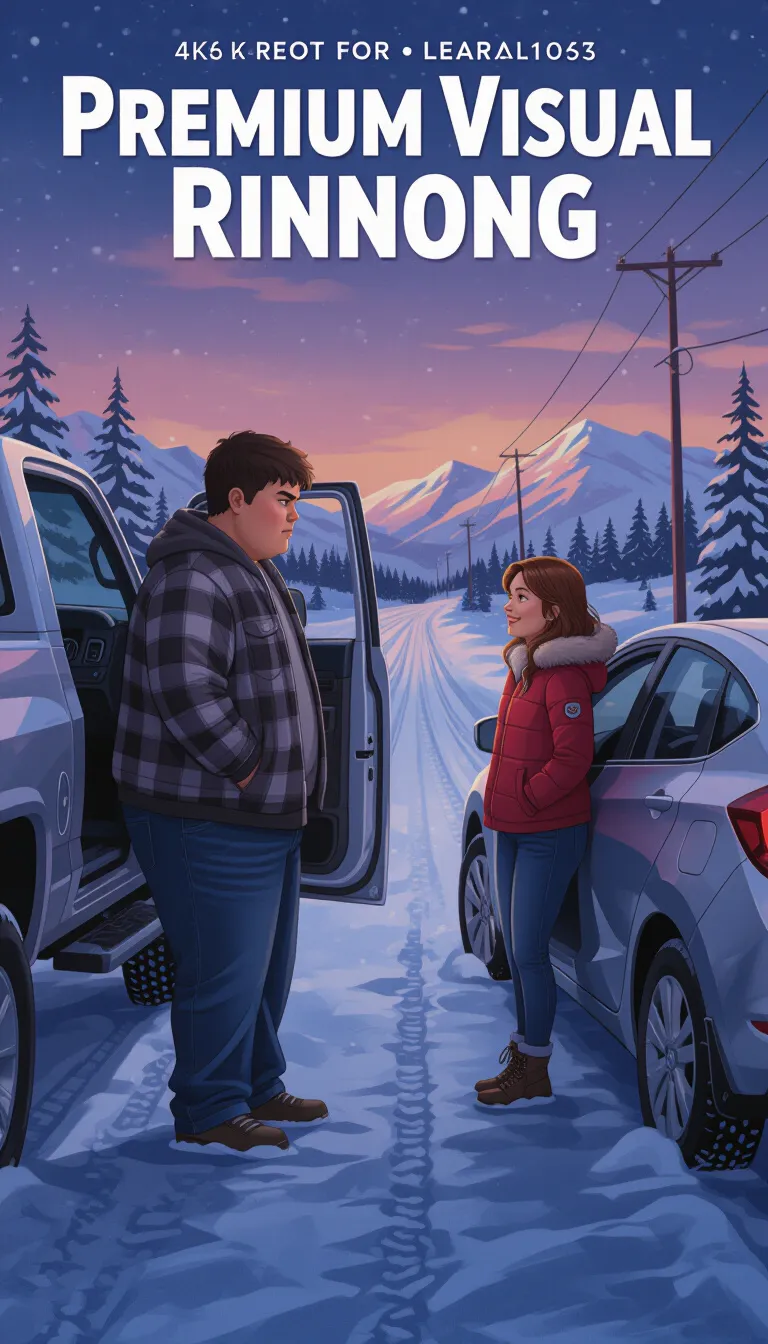
The tires of his Chevy half ton crunched to a stop on the frozen gravel shoulder, the headlights cutting through the dark night. A silver Honda Civic, hood-deep in a snowbank, nose pointed toward the woods like it had given up. Ryan didn't see that car there last night, and the vehicle wasn't tagged. In this cold weather the only option was to make sure someone wasn’t in trouble.
Ryan turned off his brights and pulled over to the side of the road he got out of the truck. The snow compacting under his Bunny Boots. He saw no footprints leading away.
The driver's side door opened with a metallic creak that echoed in the frozen silence. A boot emerged, then another—pink, faux-fur-lined things, utterly unsuited for winter. Riley Jones unfolded herself from the car, her puffy white coat making her look like a marshmallow against the darkening spruce. She hugged herself, her breath pluming in frantic little clouds.
Ryan stood by his truck, the cold seeping through his Carhart jacket. He didn’t move closer. He just watched her struggle for a second, her movements jerky with cold or panic. Ryan recognizied her. She was in his history class last year. The one who always had her hand up.
“Are you okay?” His voice came out rougher than he intended, carried away by the wind.
She turned, her eyes wide. They were the color of the spruce tips in summer. For a second, she just stared, and Ryan felt the familiar, heavy weight of being looked at as The fat kid, The quiet kid. The kid whose dad died.
Then her face broke into a recognition so bright it was physical. “Oh! It’s Ryan, right?”
He nodded, the motion stiff. “Yeah.” She knew his name. He wasn’t sure why that felt like a small, warm stone in his chest.
“I’m so glad you came along,” she said, her words tumbling out in a rush of steam. “It’s getting seriously cold and I didn’t know what I was gonna do. My phone has zero bars. Zero.”
“It’s the only thing to do,” Ryan said, shrugging. The statement felt lame in his head, but he pushed it out. “What any Alaskan would do.” He paused. “Want me to pull you out?”
A smile touched her lips, genuine and relieved. It changed her whole face. “No, I"m almost out of gas, but if you could take me to Kathrine’s house, that would be awesome. Do you know where Kathrine Yates lives?”
“No,” Ryan said. “I don’t.” He shoved his hands deeper into his carhartt pockets. “But let’s get you warm.”
“That is a fantastic idea,” Riley said, her voice shuddering with a chill. She took a step and her pink boot slipped on the ice-crusted snow. She windmilled her arms with a yelp.
Ryan was moving before he thought, his own boots finding solid purchase on the rutted ice. He caught her elbow, steadying her. The puffy coat sleeve was slippery under his glove. “Careful.”
“Thanks,” she breathed, her face close to his for a second.. “These boots were a Christmas mistake.” Riley admitted. Ryan let out a small laugh.
He guided her the few steps to the passenger side of his Silverado, his hand on her elbow feeling huge and clumsy. He opened the door for her. The interior light blinked on, illuminating the cab: there was a Garth Brooks CD case in the console, Matchbox 20 playing on the speaker with a lot of bass, and a Four Wheel Drive magazine in the center console.
Riley climbed in, a bundle of white coat and pink boots. She immediately put her hands in front of the heater vents. “Oh, that’s heaven. Actual heaven.”
Ryan walked back around the hood, the metal groaning in the cold. His own breath was a steady, slow fog. He glanced once more at her Civic. Thinking that getting it out of that snowbank was going to be a task.
The cab was warm, filled with the quiet hum of the heater and the faint, lingering scent of whiskey coming from the air freshner that hung on the rear view mirror. Riley thought it was definetly a boys truck
Ryan put his foot on the brake, and shifted into drive. He checked his mirrors, and pulled slowly back onto the highway.
“Hey I've got signal, You mind if I call my dad?” Riley asked, already pulling a phone with a glittery case from her coat pocket.
“Absolutely.”
He listened with half an ear as she spoke, her voice shifting into a higher, reassuring register. “Yeah, Dad, I’m fine” Riley leaned over to Ryan “Do you know what mile post I was at?” Riley asked. “Mile 170” Ryan resonded. Riley then continued her conversation with her father “Civic’s in the ditch off the Glenn, mile 170… No, I’m okay, I promise… Ryan O’Connor stopped and picked me up. Yeah, I’m in his truck right now… We’re just going to head to Katherine’s… Love you too. Bye.”
She ended the call and let out a long, shaky sigh that fogged her window. “Okay. Crisis managed.” She turned to him. “So. Just keep going this way for about twenty minutes. I’ll direct you when we get closer.”
Ryan nodded. Twenty minutes. The silence stretched, filled only by the hum of tires on packed snow. It was a vast, empty silence. He could feel her looking at the mess in his cab, at his dirty carpet, at him. He gripped the wheel at ten and two, like his mom had taught him.
Riley broke the silence “I’m really sorry about your dad, Ryan,” she said quietly.
The words were so direct, so unflinching, they stole the air from his lungs. Nobody said it like that. Not anymore. They said “sorry for your loss” or nothing at all. He glanced at her. She was looking straight ahead, her profile lit by the green glow of the radio.
“Thanks” he managed, the word graveled in his throat.
“My mom died when I was twelve” she said, her voice matter-of-fact. “Breast cancer. It sucks.”
He didn’t know what to say to that. He knew the phrases most people would use. I'm sorry for your loss, stay strong, he's or she's in a better place. The were all hallow. All useless.
He leaned over towards Riley. His eyes turned away from the road for a split second “I am truely sorry.” Ryan hoped the extra influence he put in the sentence would make up for the commonality of the phrase.
Riley quickly changed the subject “Is that Garth?” she asked, tapping the CD case.
“Yeah. ‘Fresh Horses’.”
“Can we play it?”
He looked at her surprised. “Really?”
“Why not? It’s a classic.”
“Wow” he thought to himself. She knows Garth Brooks album art? The girls I meet are only into pop. Maybe a little George Strait.
“Yes we can, but please don’t play the last song. That one hurts”
Riley looked at him with knowing eyes. She didn't need to ask question. She knew extactly what Ryan meant. She had things that hurt to.
Riley ejected the Matchbox 20 CD, and placed it the binder Ryan handed her. She then pushed the Fresh Horses CD in. The opening chords of “The old Stuff” filled the cab, a low, familiar rumble. It felt like a secret being shared. She turned it down a little, not wanting to overwhelm the space.
“You drive really smooth,” she observed after a minute. “My dad jerks the wheel like he’s mad at it.”
“It’s ice,” Ryan said. “momentum is your enemy, no sudden movements”
She was quiet for a moment, listening to the music, watching the black spruce whiz by in the headlights. “You would always say things like that in history, you know. Mr. Keen would ask about Gettysburg and you give this one perfect sentence that made everyone else’s answer sound stupid.” Then you wouldn't say anything else for the rest of the period. Why do you do that”
No one had ever noticed his responses before. Someone was paying attention to him.
Ryan's hands tightened on the wheel. The dashboard lights painted his knuckles white. He could feel her looking at him, a gentle pressure in the dark cab that was heavier than any question. But it was honest he gave the best answer he could.
“I don’t do it to make people sound stupid,” he said, his voice low under the music. “I just… say the thing. Then the thing is said. What else is there?”
“Discussion, Ryan. Debate. The fun part.”
“It’s not fun when you already know the answer and everyone else is just… making noise to hear themselves.” He shrugged, a stiff movement of his shoulders. “It’s easier to be quiet.”
Riley shifted in her seat, tucking one leg beneath her. The movement brought her closer, her parka rustling. “So you just sit there, knowing all the answers, and let the rest of us babble?”
“I don’t know all the answers.” The words came out sharper than he meant. He softened them. “Just the ones in the book.”
“What about the ones not in the book?”
He glanced at her. Her expression was earnest, open. No mockery. It unnerved him. “Like what?”
“Like… why you’re driving back from Anchorage alone on a Saturday night. Or why you have a Garth Brooks CD from 1995 in your truck. Or why a guy who ‘understands the civil war’ thinks it’s easier to be quiet.”
The heat in the truck was becoming overwhelming. He reached over and nudged a vent closed. “Anchorage was for new clothes, and a Costco run. Plus I got to spend some time with my grandparents. The CD is by my favorite Artist, and my dad really liked this album. And the history… the history doesn't have emotion.”
Silence settled between them, filled only by Garth’s steady baritone. He waited for her to fill it, to chatter, to move on. That’s what people did.
She didn’t.
She just let the silence be, looking out her window at the endless dark. Her quiet was different. It wasn’t empty. It was patient. It felt like she was waiting for the real answer.
“After my dad died,” Ryan said, the words leaving him before he could cage them, “everyone had something to say. ‘He’s in a better place.’ ‘God has a plan.’ ‘He was a good man.’” He mimicked the pious, sympathetic tones perfectly. “They were all so sure. So loud. And they were all wrong, hallow”
He chanced another look. She was watching him now, her face soft in the glow from the console.
“The stuff in the books… it’s fixed. Two plus two is four. The Treaty of Versailles was signed in 1919. For every action there iiiisss an opposite reaction. It doesn’t change because you’re sad. It doesn’t lie to make you feel better. It just… is. So I guess I stick with what just *is*. It’s safer.”
“It sounds lonely,” she said, her voice barely a whisper.
The simple truth of it hit him in the center of his chest. He had no defense. He just nodded, once, his eyes back on the unspooling road.
“My mom always said I talk too much,” Riley offered, a peace offering. “She would say I collect people’s stories like some girls collect lip gloss. I can’t help it. I just… want to know how people work.”
“And how do I work?” he asked, the question feeling dangerously like flirting.
“I’m still figuring that out.” She smiled, and it was a real one, not just the perky mask she wore at school. “But I know you stopped for a stranger in a ditch. You’re playing your dad’s music for a girl you barely know. And you just told me the truest thing anyone’s said to me all year. So your system isn’t perfect.”
“My system?”
“Of being quiet. Of sticking to what *is*. It’s flawed, Ryan O’Connor.”
A laugh surprised him, a short, rough sound he didn’t recognize as his own.
“Maybe,” she said, and her smile deepened.
“Okay, your turn. A question not in the book. What were you doing out here?” Ryan asked he wanted to keep the conversation going.
She sighed, a happy, tired sound. “Kristina is having a get together tonight. Just us girls. I was going to Costco as well. To get supplies. Should’ve left earlier.”
“Do we need to go back for them?” Ryan asked
“No they will be fine” Riley replied
“So you wanted to leave earlier, but you didn’t.” Ryan eased her back into the conversation
“I didn’t,” she agreed. “I like the drive. The alone time. It’s where I process all the stories I collect.” She paused. “And maybe I was putting off going home. My dad and I… we’re in a fight about UCLA. He thinks it’s too far. Thinks I’ll get lost in the lower 48 and forget where I came from.”
“Will you?”
“Forget?” She shook her head, her ponytail brushing the collar of her parka. “No. How could you forget this?” She gestured to the windshield, to the vast, consuming darkness held back only by their headlights. “It’s in my bones. But I need to see what else is in them, you know?”
He did know. He knew the desperate need to measure yourself against a world bigger than the one that hurt you. He just did it with history books, wrenches, and circuit boards instead of plane tickets.
Riley looked at his back seat “There's a lot back there. Is that a tow strap, and a jack?”
“Yes” Ryan answered “I try to prepare for the worst.” Ryan then slowly told Riley about everything he had in his back seat.
Riley was impressed with Ryans explanations for all the items in the back “Wow you have thought this out”
“Thank you... hey, It's been twenty minutes, are we close,” he said, his voice gone quiet again.
“Yes” she said, but made no move to give directions.
The song ended. In the gap before the next one began, the world was reduced to the hum of the engine and the sound of their breathing. Ryan became acutely aware of the space between them on the bench seat. By the ruler it was twelve inches. When in fact it was a vast, uncharted tundra.
“Take the next right,” she said softly, as the next track began to play. “It’s about two miles down. A blue mailbox.”
He nodded, flicking the turn signal. The click-clack was obnoxiously loud. He guided the truck onto the narrower road, the snowbanks rising higher on either side, closing them in.
The blue mailbox appeared, crowned with a dome of snow. He pulled in behind a big Red Dodge Ram. “Just like the one in Twister” Ryan tought. He put the truck in park but left it running, the heater blasting.
The moment stretched. An ending. She gathered her purse, pulled her gloves back on.
“Thanks, Ryan. For the rescue. And the conversation.”
“Only thing any good Alaskan would do,” he repeated his earlier line, but it meant something different now.
She smiled, a real one this time, not the bright performative one she used at school. It was smaller. Warmer. It reached her eyes, which were the color of spruce bark in the dim cab light. “Right. Well. Good to know there are still a few of those left.”
She pushed the door open, and a knife-edge of cold sliced into the cab. Ryan watched her. She moved with a grace he hadn't seen before. He walked with caution this time off year. She didn't, this greatly interested him.
The porch light flicked on, yellow and sudden, and the front door opened. A young womans silhouette filled it—broad, concerned. Riley turned halfway up the walk and lifted a mittened hand, a brief wave back at the truck. Not at him, exactly. At the headlights. At the fact of him waiting.
Ryan put the truck in reverse. He backed out slowly, the tires slipping once on the ice before gripping. He pointed the nose toward the main road, but he didn’t drive. Not yet.
The silence of the lonely cab was different now. It wasn’t the empty silence of his drives home from Anchorage, the one he filled with angry debates in his own head. This silence felt recently occupied. It held the ghost of her strawberry-scented shampoo. The shape of her words.
He looked down. On the passenger seat, half-tucked into the crease, was a slim, rectangular poece of paper. A note perhaps?
He hadn’t seen her leave it. He picked it up. The edges were folded over. He read what she wrote. “Thanks Ryan, we should totally eat lunch together in the cafeteria on Monday. Riley” she also wrote down her phone number.
Ryan stared at it. His thumb smoothed over the letters. No one gave him things. Not like this. Not for no reason. He folded the note back up and put it in his wallet. He didn't want to loose it.
He drove on. The headlights cut a tunnel through the endless dark. Then the song “Ireland” came on. “
“Damnit I forgot stop it before this song.” Ryan yelled at himself.
The song wasn't just a song. It was a tractor beam. It yanked him out of the cold cab, out of the current time. It put him back to a part of his past he didn't want to remember. The first plucked strings of the mandolin, the mournful swell of the fiddle—it was the soundtrack to a ghost. Gordon O’Connor’s ghost.
He tried to turn it off, but his hand froze on the dial. The song playing out of the speaker, raw and aching. Ryan’s breath fogged the windshield. The dark road blurred.
He was standing at the at the pew. His mother’s hand was shaking, and so was his. The flag was the only color in the world. Stark red, white, and blue draped over the pine box, stretched tight, corners perfectly folded. It was too bright. It looked plastic, fake against the endless white and the grim, dark green of the uniforms.
He rembered standing outside the church. The cold attacking every part of him. He and his mother crying untrolably.
The honor guard moved with a slow, terrible precision. Their rifles were black lines against the snow.
Ryan remembered the weight of his own body. The new dress pants clinging to his thighs. The dress shoes that offered no protection, the cold seeping up through the soles, numbing his feet. He’d focused on that numbness. It was easier than focusing on the box.
“Ready!”
The command cracked the frozen air. It wasn’t loud. It was final.
“Aim!”
Seven rifles snapped up to seven shoulders. A single, metallic sigh.
Ryan had flinched. He’d known it was coming, had braced for it, but his body betrayed him. A quick, violent jerk. His mother’s grip tightened, not in comfort, but in shared shock.
“Fire!”
The sound wasn’t a bang. It was a demolition. Three volleys. Each one ripped a hole in the world. The reports echoed off the distant aspens, flat and hard, swallowed instantly by the consuming cold. After each volley, a silence more absolute than before. The ringing in his ears. The scent of gunpower, sharp and bitter, hanging for a second before the wind stole it.
Then he remembered the gathering where he and his siblings had decided this was the song to play. He really liked this song prior, but hearing it at his fathers funeral made it take on new meaning.
Then the folded flag. The officer’s white gloves. The words spoken to his mother, lost to him. The salute.
In the truck, Ryan realized he was shaking. Not from cold. From the memory of it. He could still smell the gunpowder. He could still feel the permanent chill that had settled in his bones that day, a cold nothing could ever warm.
The song ended. He slammed the eject button. The silence that followed was a physical relief, but it was empty again. The ghost of his father retreated, leaving the cab hollow. He was back to being just a fat, angry kid in a truck, driving toward a dark, empty house.
His eyes dropped to the passenger seat. To the empty space where she had been.
He fumbled his wallet out of his back pocket, thumbing it open. The note was there, crisp against the worn leather. He didn’t take it out. Just looked at the folded edge. We should totally eat lunch together in the cafeteria on Monday.
It was a absurd sentence. It belonged to a different planet. A planet of fluorescent lights and chatter and social butterflies, not of frozen graves and twenty-one gun salutes.
What would they talk about? The weather? The upcoming calculus test? She’d ask him a question, and his mind would go blank, or worse, it would ramble on confusing, and detracting her. He’d sit there, a silent, hulking lump, and she’d realize her mistake. The perkiness would drain from her face, replaced by polite pity. He’d seen that look before.
He snapped the wallet shut. Put it back in his pocket.
He drove the rest of the way home on autopilot. The house dimly light, the porch light left on by his mother, who was probably already asleep. He killed the engine and sat in the sudden, thick silence.
The cold rushed in to claim the cab. He could see his breath again. It felt familiar. This was his silence. This was his cold.
Getting out of the truck he headed for the house. He opened the front door, leaving his boots on, as well as his jacket. He walked throught the arctic entry way into the living room. His mother was there. Sleeping on the couch. She told him to let her know when he got back, even if she was asleep.
He wiggled her leg lightly. Her eyes opened, and she started to stretch.
"Hmmmmm, what time is it?" Lauren asked, her voice thick with sleep as she blinked against the harsh overhead light. She rubbed her eyes with the back of her hand, trying to focus on the figure standing in the doorway.
"About nine thirty," he responded, his voice low not wanting to startle her.
"I'm glad you're home," she said, pushing herself up from where she'd been dozing on the couch. The relief in her voice was palpable, mixed with the warm affection that only a mother feels when her child returns safely.
"Yeah, so am I," Ryan responded, a small tired smile touching his lips. He ran a hand through his hair, dislodging a few wayward strands that fell across his forehead.
"There's dinner in the microwave," Lauren said, rising from the couch and smoothing her pajama pants. "Just heat it up for two minutes whenever you're ready."
"Thanks, Mom," Ryan said, his expression softening at the simple domestic gesture. "I'm going to unload my truck first, though." He shifted his weight, already mentally preparing for the task ahead.
"Okay, Colt," Lauren said, using the nickname that had stuck since he was a little boy. Back when they rode horses for hunting. She stepped closer, reaching out to squeeze his arm gently before turning back toward the kitchen. "Don't be too long they’re saying 42 below by 10:00, I'm going to the bedroom” Ryan nodded, his gaze following her as she walked away, grateful for the simple comforts of home after a long day away.
Ryan then walked back to his truck and started to unload everything he brought back from Anchorage. The Costco items were mostly frozen food so he headed for the freezer in the garage. Once he completed that. His new clothes were next.
He removed tags and stickers from the jeans and tee shirts. He then folded them and placed them in his dresser. Adding them to the existing inventory.
With that done he was ready to eat. Going to the kitchen he walked toward the microwave, and opened the door. Fried chicken, with mahed potatoes, and brocoli with a cheese sauce. This was his favorite. He closed the door again set the timer for two minutes and hit start. Ryan ate the meal in silence, and enjoyed every bite.
He then went back to his room, and turned on the TV. He knew there was a documentary about George S Paton on the History Channel tonight. Facts. Dates. Cause and effect. No emotions. Just information. A world that made sense.
He changed into sweats, and laid down on his bed, settling in for the night.
His realized he forgot where he put his laptop. Looking around the room his eye locked on the triangular box in the corner. The folded flag inside. He was proud of his fathers service in the US Army, but looking at that triangular box upset him.
He shifted his glaze, and continued to look. Eventually he found the laptop under his bed “How'd it get there?” he pondered.
Ryan grabbed the laptop, placed it on the bed and turned it on. Ryan then laid down on his bed, the laptop beside him.
His hand went to his back pocket again. Not for the wallet. He patted the denim, feeling for the shape of the phone he never used for calls.
His thumb hovered over the keypad. It was stupid. It was after midnight. Yet, he entered the digits from the note anyhow.
He typed slowly, with one finger. Got home ok.
He stared at the words. They were inadequate. He deleted them.
He started over. Thanks for the note. He hesitated, then added, See you Monday.
He forced his eyes back to the screen. The narrator was explaining the Battle of the bulge. Ryan knew all of this. He could have given the lecture. He watched the grainy footage of men fighting in a forest, their faces blank with a fatigue that went beyond the body. He understood that. His own fatigue was a quiet, constant companion.
An ad for truck tires burst onto the screen, loud and jangling. He muted it. The silence in his room was now complete, save for the low hum of the laptop. It was in this silence that he heard it. A buzz. A physical vibration against the wooden desk.
He froze. His eyes cut to the phone. It buzzed again, skittering a quarter-inch across the grain. A notification. It could be anything. A weather alert. A spam text. He made himself count to five, his jaw tight. He wasn’t going to lunge for it.
On three, his hand shot out and flipped it over. The screen glowed. A single text message preview. The sender: Riley Jones. The preview text: You’re welcome, O’Connor. And…
His heart did something strange. It wasn’t a leap. It was a slow, thick roll in his chest, like a engine turning over on a cold morning. O’Connor. Not Ryan. O’Connor. He opened the message.
You’re welcome, O’Connor. And thanks for stopping. Most people wouldn’t have. -R
He read it three times. He parsed the words like code. ‘Most people wouldn’t have.’ Was that true? In Alaska? Maybe. Maybe city people, driving too fast on the Glenn. But not out here. Her thanks felt specific. Meant for him, not just any good samaritan.
His thumbs hovered. What was the protocol? A ‘no problem’? That felt cheap. An emoji? He didn’t do emojis. He was a block of text person. A facts person. He typed, It was no trouble. He deleted it. Too formal. He typed, Glad you’re ok. That was better. True. He sent it.
The reply came faster this time. I am. Warm in Adele’s guest room. It’s pink. Very, very pink.
A faint sound escaped him. A puff of air through his nose. Not quite a laugh, but the phantom of one. He could see it. Riley Jones, who seemed made of sunshine and social committees, drowning in a sea of pepto-bismol pink frills. He typed, Survival situation. Do you have supplies?
Just my wits and a fuzzy blanket, she wrote back. And my phone. Which is now at 12%. The tragedy.
He glanced at his charger, coiled neatly on his nightstand that he build in woodshop. A simple problem with a simple solution. Conserve battery. Stop texting me.
Ryan looked up at the TV. The documentary was over, what was on next didn't appeal to him. He brought up the guide on the TV. Junkyard Wars was playing on Discovery. He changed the channel.
Ryan looked down at the phone again. The ellipsis bubble appeared. It bounced. And bounced. She was typing a long reply. To his blunt, logical command. The ellipsis disappeared, then reappeared. Finally, her message came. But then I’d just be alone with the pink. And my thoughts. Your texts are a public service, O’Connor. A distraction from interior design crimes.
This time Ryan let out a loud audible laugh, so loud he was affraid he might wake up his mom. Ryan was perplexed. Riley was one of the most noticeable students in the school. He was the thing people looked away from, not toward. He was the silence at the lunch table, the shifted gaze in the hallway. He wasn’t a distraction; he was a void to be avoided.
And yet Riley Jones was texting him past midnight from a pink room, claiming his monosyllabic messages were a service. He didn’t know what to do with that. He felt off-balance. He looked at the TV, still playing silently. Men were trying to repair a transmission, and a V8 engine.
His phone buzzed once more. What are you doing, anyway? Besides saving damsels from ditches.
He looked at the muted TV “Discovery Channel, Junkyard Wars.”
NO WAY. I love that show. Who are you rooting for, the red or the blue team
The question hovered on his screen. Who was he rooting for? It was such a simple, normal thing to ask. It required an opinion, a preference. Ryan stared at the two teams on his silent TV. The red team was methodical, mapping everything out on a whiteboard first. The blue team was just grabbing materials and welding. “The blue team’s approach is inefficient,” he typed, his thumbs precise on the glass. “They’re wasting fuel on trial and error. The red team has a calculated torque ratio for their drivetrain. It’s smarter.”
He sent it. It was a fact. A analysis of process. Not a feeling.
Her reply was a single laughing emoji. Then: Of course you’d say that. You’re a planner. You stop for cars in ditches with a full winter kit. You probably have a spreadsheet for it.
A strange warmth spread through his chest, different from the anger that usually lived there. She saw that? In the ditch, he’d just done what was right, but somehow she saw more.
Preparedness isn’t a spreadsheet, he wrote back, defensive out of habit. It’s logic.
It’s both, she countered. But the blue team probably is more fun to watch. They’re passionate. Sometimes logic needs a little… fire.
Fire. He thought of the cold rage that sat behind his ribs, banked and constant. Was that the kind of fire she meant? Probably not. Her fire was probably laughter and sparkles. Not this.
The documentary cut to a commercial. This one was for truck lift kitts. The TV was still muted. The silence in his room was complete, broken only by the faint hum of his computer and the next buzz from his phone.
My battery is at 9%. This is my last message. Probably. Unless you say something really interesting.
Pressure. He felt it like a physical weight. She was giving him the last of her battery life. He was responsible for it being worth it. The thought was terrifying. He wasn’t interesting. He was a fact-repository. A ditch-rescuer. A void.
He looked around his room for inspiration. Textbooks stacked by author’s last name. A framed photo of his dad, Gordon, pointing at where he shot that bear, at the half complete projects shattered around his room.
His fingers moved before his brain could censor them. The red team reminds me of my dad.
He hit send. The words were out there, small and black on a tiny screen, and they felt huge. He never talked about his dad. Not to his mom, who just got a sad, tight look. Not to the school counselor, with her gentle, useless questions. He’d buried Gordon O’Connor under two years of silence and rage.
The ellipsis appeared. It didn’t bounce. It just glowed, steady. She was reading. She was there. He held his breath, the air in his old room sharp in his lungs.
Tell me, her final message said. Just that.
And so, in the deep Alaskan night, with a girl he barely knew fading to black in a pink room miles away, Ryan O’Connor began to type. He told her about the blueprint for a treehouse his dad had drawn on graph paper, every joint calculated for load-bearing. He told her about the way his dad would pause, pencil behind his ear, and say, “Measure twice, cut once, Ry. The material is too precious to waste.” He told her how his dad could fix anything— a hole in sheet rock, a broken sink, that diorama of the Exxon Valdez oil spill, Bligh Reef displayed display by a rock Ryan found in the driveway —by just looking, thinking, and then acting with calm certainty. He even sent her a picture of him.
The words became a flood. A quiet, text-based flood. He didn’t say he missed him. He didn’t say he was angry. He just described the man’s methodology, his quiet competence, the way he always seemed to make things that felt solid and safe. The red team on TV, with their whiteboard, were echoes of that. A ghost of a feeling.
He sent a long, rambling paragraph about joint compoun or ‘mud’ as his dad called it, and then he stopped, his heart hammering. It was too much. He’d dumped a pile of rusty, sharp memories onto her. She’d asked for interesting, not for this.
He stared at the screen, its glow the only light in his room. The last message read “Delivered.” No “Read.” Nothing. Ten minutes. He’d been watching the digital clock on his nightstand for, ten minutes.
His throat was tight. Of course. He’d done it. He’d taken her inquisitive question, and filled it with the ghost of his father, with 2×4s, and sheetrock. He’d given her a manual for a dead man instead of a conversation. He set the phone face down on his blanket. The silence was a physical presence, heavier than before.
He got up, and went to the bathroom. “Good job, O'Connor. You overwhelmed another one”. Finishing up in the bathroom he returned to his bed
Then there was a vibration. A single, soft buzz from the bed.
He didn’t move. It was probably an alert. Or a spam text. It couldn’t be her. Her phone was dead. It had to be dead. He’d killed it with his word-vomit.
Another buzz. Insistent.
He turned. Crossed the room in three strides. Flipped the phone over.
A new message. From Riley.
His thumb hovered. The terror was acute, a cold wire in his stomach. He tapped.
My charger was in my backpack. In the car. In the ditch. The first message read. Just found one at Adeles. Phone’s at 2%. Racing it.
Ryan sat down hard on the edge of his bed. The relief was so sudden it felt like a punch.
The ellipsis appeared. Bounced once. Twice. A new bubble.
Ryan. Just his name.
Then another. Your dad sounded like he could fix, or build anything. Not just with sheetrock, and wrenches. With everything. He built a world for you. Thank you for sharing, but now I want to her about you.
Ryan read the words. Then read them again. He hadn’t said that. He hadn’t used those words. But she had found them, dug them out from between his lines about load-bearing and carburetors, and now she was willing to take more?
His eyes stung. He blinked, hard, at the ceiling.
Another message. I mean it O'Connor I want to know it all.
He couldn’t breathe. She wanted to hear about him, and hear it all. Ryan was scared. What was her motive? Was she going to use this information against him. Yet, there was a girl on the other side of this message screen who wanted to hear about him. Thats all he ever wanted, someone to listen. Not advise or judge, just listen.
His fingers trembled as he started to type. He told her about how the fights between him and his mother had increased since his dad's death. He told her how he hated groups, and know-it-alls without a single fact to back up their claims. Every thing that made him angry or sad was discussed that night.
It was now 2:00 A.M. and Ryan was feeling the effects of the drive. He sent one last text to Riley.
I'm so sorry to do this Riley, but I can barely keep my eyes open. I need to sleep.
He put the phone down on his night stand and plugged in it in. As soon as the charger slotted into place the phone buzzed again. Riley had replied.
*Thank you for being honest with me tonight. I really appreciate that in a person. Good night Ryan, and sleep well.
Ryan put the phone down. For the first time in a long time he it felt a sense of happiness, a sense of belonging. Riley didn't have to do what she did, and yet she did it with energy. This was a whole new experience for Ryan.
Ryan but the phone back on the nightstand and curled up in his bed. The warmth in his chest was unfamiliar. It was a physical heat, spreading out from behind his sternum, easing a tightness he’d stopped noticing was there.
He thought of her in his truck. The way she’d filled the silence not with noise, but with genuine curiosity. The way she’d looked at the tools in his back seat—not as junk, but as evidence of a system.
She’d asked about the tow strap. The jack. Why he carried extra hydraulic fluid. Her questions weren’t polite. They were interested.
Ryan closed his eyes. The image of her car in the ditch, headlights spearing the dark, was crisp. Her breath steaming. The relief on her face when she recognized him wasn’t just about rescue. It was about it being *him*.
Nobody had looked at him with relief in two years. His mother looked at him with worry. Teachers with pity. The world with indifference.
But Riley Jones, who could have anyone, had smiled at *Ryan O’Connor* in the freezing Alaskan dark. And then she’d listened.
He rolled onto his side, punching his pillow. The happiness was scary. It felt like a temporary loan. Something that would be recalled, leaving the silence louder than before.
Yet her words echoed. You’re measuring twice, cutting once. It was the kind of thing his dad would have said. A quiet approval of a job done right.
For the first time since the funeral, a memory of Gordon O’Connor didn’t feel like a knife twist. It felt like a touch on the shoulder.
Ryan’s last thought before sleep was of Monday. School. The crowded halls. He usually felt like a ghost moving through them.
Two days from now, he would walk those same halls. But Riley Jones would be in them. And now, she knew his name. Not just the name. Something underneath it. The very fact the she now knew this scared, and intrigued him.
He pulled the comforter up to his chin, and slept peacefully that night.
Sunday was a rest day for Ryan. More history Channel, and Discovery. He played alot of computer games that day, and even with the all the distractions he could not get Riley Jones out of his mind.
“Maybe she's different. I guess we'll find out on Monday” Ryan said all day. Begging for it to be true.