
The alarm screamed at 6:45 AM. Ryan killed it with a fist, the same way he had for the past two years. The dark outside his window was absolute, the kind of deep, frozen dark that felt like a weight. He dressed in the same uniform: tee shirt, jeans, cotton socks, a heavy carhartt coat. The ghost of his father was in the routine—Gordon O’Connor.
Ryans mom was already up. Cooking breakfest for him. She placed it and sat it down on the kitchen table.
“Thanks mom” Ryan said “Your welcome" Lauren responded.
She hugged up and then headed to the bathroom to finish getting ready for work. Ryan sat down at the table and started to eat. As soon as he finished he saw his mom walk bye. A simple “Bye” was all she said, but it was enough for Ryan
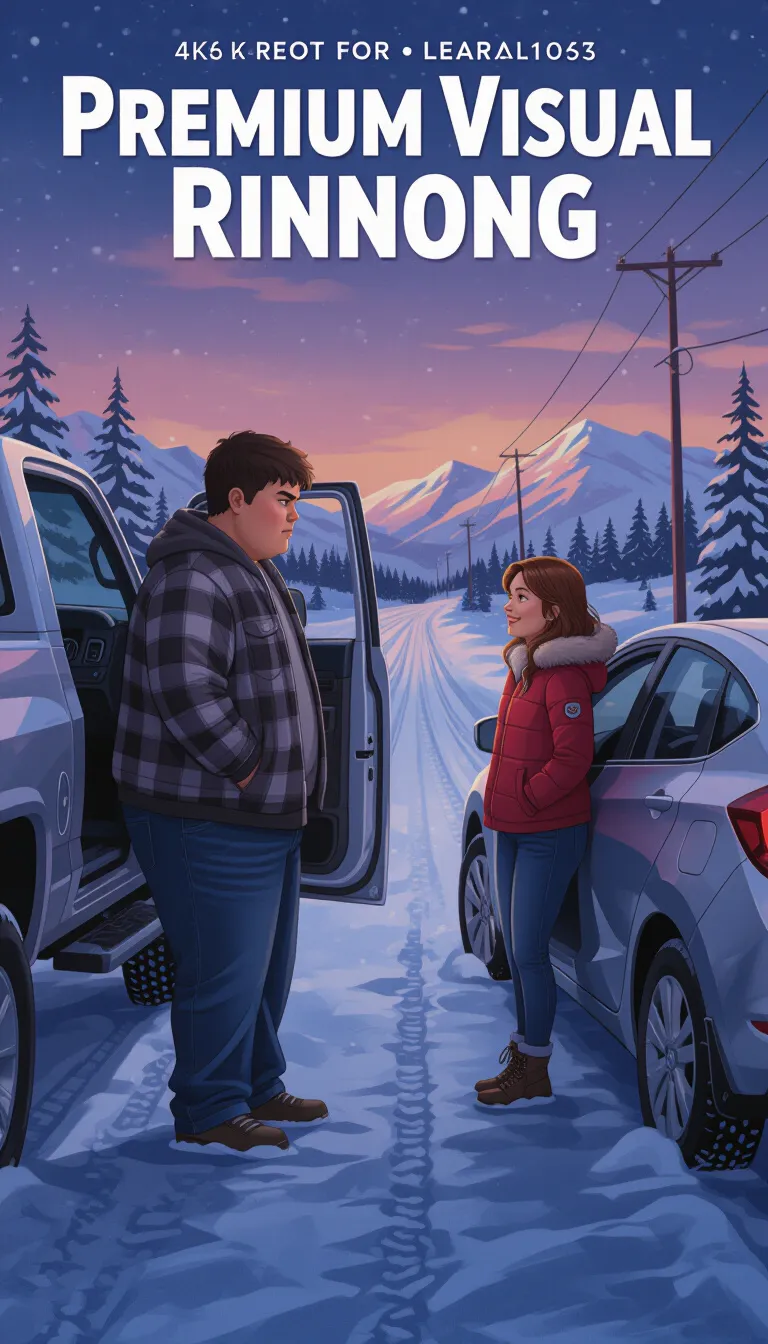
He drove his old Silverado to school in silence. No radio today, he wanted to think about what happened last night. The tires crunched on the cold asphalt, the headlights carving a lonely tunnel through the pre-dawn. He parked in his usual spot, far from the main doors, where the student council kids with their new SUVs wouldn’t ding his truck. He sat for a minute, engine off, watching his breath cloud the windshield. Another day. Another series of rooms to sit in and wait out.
First period was Trigonometry. Mrs. Elden’s voice was a distant drone. Ryan copied problems from the board, solved them in three lines where the textbook used ten, and then stared at the graph paper until the squares blurred. He understood the language of angles and cosines. It was clean. It had no opinions, no grief. It just was. The bell was a mercy.
U.S. History was worse. Mr. Gable was talking about the Louisiana Purchase, reducing it to dates and dollar figures. Ryan’s knee bounced under the desk. He knew the soil samples from the expedition, the secret negotiations with Spain that almost derailed it, the dysentery that killed more soldiers than any battle. His dad and him talked alot about history on hunting trips. He looked out the window at the gray sky, jaw tight. Facts in a textbook were a skeleton. His dad had given them flesh and blood.
Small Engines, third period, was different. The shop bay smelled of gasoline, stale coffee, and metal. Mr. Lanegan just nodded at him. Ryan went straight to the back corner, to the disassembled snowmachine engine on his bench. This was a language he understood with his hands. The puzzle of it—finding the sheared pin, cleaning the carbon-fouled piston head, feeling the exact resistance of a bolt torqued to spec. His world narrowed to the feel of a wrench, the smell of parts cleaner. For forty-five minutes, he didn’t think. He fixed.
Woodshop was after. The smell of fresh-cut pine and sawdust was better than any cologne. He was working on a cedar chest, a project with no real purpose except the making of it. The plan was his own, a design he’d tweaked for weeks. He ran a hand over the sanded lid, feeling for the slightest imperfection. The whine of the table saw, the rhythmic scrape of a hand plane—it was a kind of quiet he could live inside. Ben Delany was at the next station, hastily gluing a lopsided birdhouse.
“Dude, you’re gonna rub a hole in it,” Ben said, not looking up from his dripping clamps.
Ryan didn’t stop sanding. “It’s not smooth yet.”
“It’s a box. It holds stuff. Who cares?” Ben wiped his hands on his jeans. “You coming this weekend? Eureka got 4” yesterday. My sled’s tuned.”
“Maybe.”
“You say maybe every time. Then I show up at your place and you come. Your truck has the hitch, man. My dad’s rig is in the shop.”
Ryan knew the script. Ben needed his truck. He’d ride shotgun, they would laugh, and talk about school. Once out on the trails, in the screaming white freedom, Ryan would almost forget to be angry for a few hours.
But he also enjoyed the safety on his room. He knew the space by heart, and he had organized it to function for him. Ryan was always of two minds when it came to snowmachine trips.
“Okay.” Ryan gave in.
Ben grinned, mission accomplished, and went back to wrestling his birdhouse.
The lunch bell rang, a jarring electric buzz. The hallway erupted into noise and shoving. Ryan let the current carry him toward the main doors, toward the parking lot and the sanctuary of his truck. He’d eat the sandwiches his mom had left on the counter, listen to the country countdown on the weak AM signal, and wait for the hour to pass. It was the system. It worked.
He was pushing through the heavy double doors, the slap of cold air hitting his face, then the memory of the note, and the texts from last night.
He stopped. The stream of students parted around him like he was a stone in a river. The cold bit his ears.
That note. *Thanks Ryan, we should totally eat lunch together in the cafeteria on Monday. Riley*
He stood on the steps, the parking lot stretching before him. His truck sat there, reliable, empty. The cafeteria was behind him, a roar of chaos and smell of microwaved pizza.
It was a trick. It had to be. People like Riley Jones didn’t have lunch with people like him. She was probably surrounded by the student council table, the volleyball team, laughing that bright, easy laugh. She’d been nice because he helped her. It was politeness, not an invitation. Showing up would be pathetic. He’d be the lonely, fat kid clinging to a single act of decency, mistaking it for a connection.
But then again maybe Riley was really different. Maybe she was genuine, maybe she did like talking to him.
His feet turned him around.
The warmth of the hallway hit him, thick with the smell of sweat and cheap food. He walked, shoulders tense, toward the cafeteria. His heart was a dull, heavy thud against his ribs. This was a bad idea. This was the worst idea.
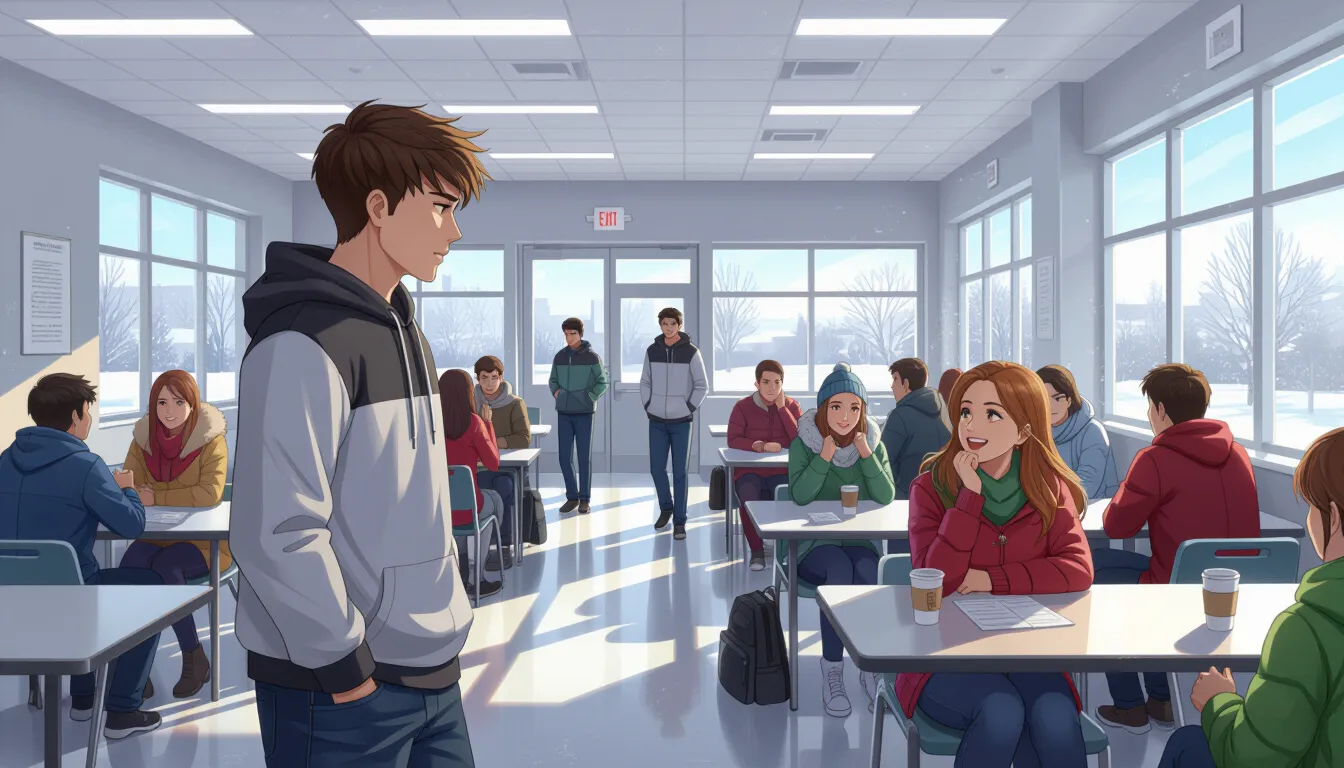
He paused at the cafeteria entrance, hidden by the brick archway. The noise was a physical wall. He scanned the sea of tables.
And he saw her.
She was at a table by the windows, sunlight making her blonde hair glow. She was laughing, head thrown back, surrounded by people. The volleyball setter, the student council treasurer, a guy from the yearbook staff. The bright, easy crowd he’d pictured. His stomach sank. Proof. He’d been right.
He turned to leave, the noise suddenly deafening, the smell of grease turning his stomach. A hand clapped his shoulder, hard.
“O’Connor! You lost, man? Since when do you grace the zoo?” Ben Delany grinned, his face flushed from the cold outside, smelling of gasoline and mint gum. He had a carton of chocolate milk in one hand.
“Just passing through,” Ryan muttered, trying to sidestep.
“Bull. You’re hunting for grub. C’mon, we’re over here.” Ben hooked a thumb toward a corner table, far from the windows. Dan Brewster was there, methodically dissecting a tater tot with a plastic fork, earbuds in, bobbing his head to a silent beat.
Ryan let himself be steered. This was safer. This was a known system. He slid onto the bench opposite Dan, who pulled one bud out.
“The prodigal son enters the lunchroom,” Dan said, his voice flat. “World event or just a malfunction in the truck’s heater?”
“Heater’s fine,” Ryan said, unzipping his coat. The table was sticky. He kept his arms close.
“So?” Ben dropped onto the bench, leaning in. “Spill. This is a seismic shift in routine. You only deviate for two things: a new History Channel documentary about WWII, or a planned gathering.”
Ryan focused on pulling the sandwiches from his backpack. The bread was slightly smushed. “Neither.”
“Liar,” Ben sang. “I know why you're here. My sister’s friend Kristina said Riley Jones’s car went into the ditch Saturay night. And who has a truck and a hero complex? Ryan O’Connor.”
Dan stopped dissecting his tot. “Riley Jones? The one who smiles so much it probably hurts her face?”
“She’s nice,” Ryan said, the defensiveness in his voice surprising him.
“Nice is for customer service reps,” Dan said, resuming his surgical tot operation. “Social butterflies are neurologically different from us. They require constant validation from the hive. It’s not personal.”
“He’s just jealous because she’s never tried to recruit him for the spring spirit rally,” Ben laughed, elbowing Dan. “So? You give her a ride? Was she all weepy and grateful?”
Ryan took a bite of his sandwich. It was turkey, snd his mom used Miracle Whip his favorite. “We talked. That’s it.”
“Talked,” Ben repeated, wiggling his eyebrows. “About what? The molecular density of snow?”
“Her mom’s dead.” The words came out quieter than he intended. Ben’s smirk faded. Dan looked up.
The noise of the cafeteria swelled around their sudden silence. Ryan stared at his sandwich. He hadn’t meant to share that. It felt like handing them a piece of her, something she’d trusted him with in the dark cab of his truck.
“Oh,” Ben said, uncharacteristically soft. “Damn. I didn’t know.”
“Most people don’t,” Ryan said. “She doesn’t… lead with it.”
Dan nodded slowly, a look of reassessment on his face. “Huh. So the perpetual sunshine is a conscious choice. That’s… computationally intensive.”
“She invited me to eat lunch,” Ryan said, the confession ripped out of him. He gestured vaguely toward the window tables. “Over there. But her table’s full.”
Ben followed his gaze, then whistled low. “The popular kid summit. You’d need a diplomatic passport to cross that border, man.”
“She invited you” Dan stated, putting his fork down. “The invitation stands until explicitly rescinded. The population density of her current location is irrelevant. The social contract is clear.”
“He means you should go over there, dummy,” Ben translated. He was looking at Ryan, not with mockery, but with a curious focus. “You want to.”
Ryan didn’t answer Ben. He just watched the table by the window. Riley was laughing again, a strand of blonde hair escaping her ponytail. She looked like a photograph of a life he’d never touch. He took another bite of his sandwhich.
The social contract might be clear to Dan, but to Ryan it was written in a foreign language full of exceptions and fine print.
“You’re gonna sit here and stare at your turkey on wonder bread all period, aren’t you?” Ben sighed, shaking his head. “Man. You helped her. You drove her home. The hard part’s over.”
“The hard part was the ditch,” Ryan muttered.
“No,” Dan said, adjusting his glasses. “The ditch was physics. Friction coefficients, kinetic energy, vector forces. This,” he pointed his plastic fork at the crowded room, “is chaos theory. Infinitely more complex.”
Ben stood up, grabbing his tray. “I can’t watch this. It’s like seeing a moose frozen in headlights.” Ben clapped him on the shoulder and left. Dan lingered for a moment, his techno beat leaking from his headphones.
“She shared a vulnerability with you,” Dan said, his voice low and analytical. “You reciprocated. A bond was formed. Ignoring the initiated protocol now would be… inefficient, and statistically likely to cause regret. Just walk over there. The algorithm is simple: one foot in front of the other.” Then Dan got up, grabbed his tray and walked over to him. “Go” was all Dan said as he walked away from the table.
Then Ryan was alone at the table. The noise of the cafeteria condensed into a single, buzzing hum. He balled up his napkin. He looked at his truck keys on the table, the promise of quiet solitude. Then he saw the folded edge of Riley’s note in his pocket, the one he’d transferred from his jacket this morning.
He stood up. The motion felt robotic. He put his remaning sandwiches in his backpack. He picked up his tray, then his keys. He didn’t walk toward the window. He walked toward the tray return, his planned escape route. His sneakers squeaked on the linoleum.
“Ryan!”
Her voice cut through the dim light, bright and sure. He froze, tray in hand. He turned.
Riley was weaving through the tables toward him, a smile on her face, her own tray balanced in her hands. She’d left the sunlit summit. She was crossing the border, no passport required.
He stood there, holding his tray like a shield. She stopped in front of him, her cheeks flushed from the cafeteria heat or maybe from the walk. Up close, he could see the faint freckles across her nose, the light blue of her eyes. She was wearing a soft-looking cream sweater.
“You were leaving,” she said. It wasn’t an accusation. It was an observation.
“I was… returning my tray.”
“Right.” Her smile didn’t waver. She looked at his tray, then at hers, which held a half-eaten yogurt, oranges, and an apple. “I saw you sitting with your friends. I was waiting for you to come over.”
“Your table’s full.”
“So?” She shifted her weight, her tray tipping slightly. He had the irrational urge to steady it, but fough it. “There are other tables.” She nodded toward the far corner of the cafeteria, past the vending machines, where two small, empty tables sat under a flickering light. “Over there?” she walked towards the abandoned tables.
He followed her. They dumped their trays and sat across from each other at a table meant for four. The fluorescent light buzzed and clicked above them. The distance from the main crowd made the room feel suddenly, intensely quiet.
Ryan pulled out his remaing sandwiches and set them on the tray. Riley pulled the lid off her yogurt. “So. Sarurday was weird.”
“Yeah.”
“Good weird, though. I meant to text you on Sunday. but my dad was… he was extra Dad-like after the ditch incident. Twenty questions about you. I wanted to text you this morning but I was running late.” She took a bite, watching him.
“What did you tell him?”
“That you were quiet. And kind. That you have a nice truck.” She smiled again, a smaller, private version. “He said to thank you again. So. Thank you again.”
Ryan’s face felt warm. He looked down at the scratched tabletop. “It was nothing.”
He said it was nothing, but the way he said it—soft, into the table—made it sound like everything. Riley let the silence sit. She scraped the last of her yogurt. The noise of the cafeteria was a distant ocean.
“Didn't see you in the halls,” she said, not looking at him.
“I was in the shop most of the morning” Ryan was lying.
“Bull.” She said it lightly, a fact. “Were you avoiding again?, You admmited you do that Saturday night”
It wasn't a dream. Saturday night he and Riley really did carry on for hours. He did get vulnerable enough to tell her everything, but why was she so interested?
“Maybe,” he finally said.
A crash of trays and loud laughter erupted from the football team’s table. Riley didn’t flinch. She watched Ryan take a bite, chew, swallow. He felt studied, but not in a bad way. Like she was reading a map.
“You’re good with your hands,” she said.
He froze, the sandwich halfway to his mouth.
“From what you said about your truck. And your dad. You know how things work.” She nodded at his hands, broad and rough-knuckled, holding the bread. “That’s a thing. A good thing.”
No one had ever called his hands a good thing. They were tools. For fixing, for holding engines, turning screwdrivers, for being useful. “I guess”
Then he heard Bens voice again “O’Connor. Hiding in the nook. And with Riley Jones?”
“Damnit.” Ryan though to himself “Why couldn't he just leave it alone.”
“We’re having lunch,” Riley said smoothly. “Ryan rescued me from a ditch yesterday. I’m repaying him with fascinating cafeteria ambiance.”
“Yeah, he’s good for that.” Ben's eyes looked upon Ryan. “So you still in for this weekend. Like I said fresh powder in Eureka.”
Ryan knew this conversation wasn't about snowmachining. He had already said yes to going. Ben was prying, and Ryan was getting annoyed.
Ben’s eyebrows moved to Riley. “‘Jones, you ever been on a sled?”
“Once. I spent more time digging it out than riding it.”
“You need a better guide. Think about it.” Ben stood up, clapping Ryan on the shoulder. “Later, O’Connor. Don’t do anything I wouldn’t do.” He winked and was gone, absorbed back into the noise.
The silence he left behind was different. Charged. Ryan focused on his sandwich.
“He seems fun,” Riley said.
“He’s a lot.”
“But he’s your friend.”
Ryan nodded. It was true. Ben dragged him out of his own head. It was a service.
“So, snowmachining,” she said, not looking up from her task. “Is it just going fast, or is there a point?”
“There’s a point, When you get up into the backcountry. Places you can’t see from the road. Just… white. Quiet. Until you fire up the engine.”
“Sounds lonely.”
“That’s the point.” The words were out before he could filter them. He concentrated on eating.
Riley placed a neat section of orange on a napkin and pushed it toward the center of the table. An offering. “My mom used to say that about gardening. That the point was the solitude. I never got it. I always wanted someone to talk to.”
Ryan glanced at the orange. He didn’t take it.
“You don’t have to try so hard.”
“Try what?”
“To be nice. To get me to talk. I’m fine.”
Riley stopped, another orange section poised in her fingers. She looked at him, really looked, and her perky expression softened into something more direct. “I’m not trying to be nice, Ryan. I’m being curious. There’s a difference.”
He felt pinned by that look. He shrugged, a tense movement of his shoulders. “Not much to be curious about.”
“See, I don’t believe that. The guy who reads Churchill biographies for fun? Who can fix a carburetor? Who texts about his dad at midnight?” She popped the orange into her mouth. “That’s a lot to be curious about.”
A warmth that had nothing to do with the cafeteria heat spread up his neck. He didn’t know what to do with it, but he liked it
“Hey, O’Connor! You surviving the mosh pit?
He heard the unmistakeable voice of Dan Brewster. He quickly slid onto the bench next to Ryan. “…both of them,” Ryan thought to himself. Dan had earbuds in, the tinny thump of a techno beat leaking out. His eyes flicked to Riley, then back to Ryan, a quick, assessing glance.
“It’s loud,” Ryan said.
“That’s why God invented distortion,” Dan said, tapping his earbud. He nodded at Riley. “Jones. Heard you went ditch-diving. Welcome to the club.”
“Thanks? I think.” Riley smiled, but it was different from the wide, easy smile she’d given Ben. This one was smaller, more watchful.
“Ryan’s the best guy to get stuck with. Calm. Knows his stuff. Doesn’t panic.” Dan shoved a load of tater tots into his mouth. “Unlike some people,” he added, gesturing vaguely toward where Ben had vanished.
“He seems like he enjoys a little chaos,” Riley said.
“Chaos is his brand.” Dan’s gaze settled on Ryan. “So. You logging in tonight? We're raiding, need a tank, and you’re the only one who doesn’t get distracted by shiny loot.”
It was an escape hatch. A familiar, dark room lit only by a monitor, the coordinated, wordless dance of a boss fight. A place where his actions had clear, mathematical consequences. He opened his mouth
His phone buzzed in his pocket. A text notification. He knew without looking it was his mom, probably telling him she was working late again. He hated when his mom was doing audits.
“Maybe”
Dan froze, a tot halfway to his mouth. He slowly lowered it. “Dude. Maybe? They buffed the raid boss, increased his rare drops, and I know you like a good challenge. Who are you and what have you done with Ryan O’Connor?” His eyes slid to Riley again, and this time his look was full of understanding and sharp interest.
“Just… might be busy,” Ryan mumbled, suddenly fascinated by the faux wood grain of the table.
“Right.” Dan drew the word out. He smirked, but it wasn’t unkind. “Well, the offer stands. Jones…, you play?”
Riley’s eyes, which had been following the conversation with amused curiosity peeked at Ryan before settling on Dan. “I don’t. My gaming career peaked with Mario Kart on a Super Nintendo when I was ten. I’m more of a face-to-face interaction girl.”
Dan shrugged. “Your loss. Ryan here is a legend. Silent, deadly, efficient. Doesn’t say a word for three hours, then saves the whole party with a perfectly timed taunt.”
Ryan felt his ears burn. The description felt like both a compliment and an indictment. It was who he was online: effective, necessary, quiet. Here, in the buzzing cafeteria, it just felt like being a ghost.
“That tracks,” Riley said, her voice thoughtful. She took a delicate bite of her apple. “Calm in a crisis. Useful in a ditch, useful in a digital dungeon.”
“See? She gets it.” Dan grinned, then pointed a fry at Ryan. “Which is why his sudden ‘maybe’ schedule is so fascinating. You corrupting him, Jones? Turning our reliable tank into a… social DPS?”
Before Ryan could formulate a denial, Riley laughed. The sound was bright and clear, cutting through the cafeteria drone. “I’m not corrupting anyone. We just talked. It was nice. It’s allowed, Dan.”
“It’s unprecedented,” Dan corrected, but he was smiling. He wiped his hands on his jeans and stood, gathering his tray. “I’m being third wheel adjacent. It’s itchy. I’m out. Ryan, think about the raid. Jones, try not to break our boy. He’s the only one who knows how to fix my computer.”
With a final, knowing smirk, Dan shouldered his backpack and melted into the river of students heading for the trash cans and the doors.
Silence descended, thick and sudden. It was just the two of them now, surrounded by the roar of a hundred other conversations. Ryan stared his last sandwhich. The ‘maybe’ hung in the air between them, a question he’d put there himself.
“He’s a good friend,” Riley said softly.
“He is.”
“Protective.”
Ryan glanced up. She was watching him, her head tilted. She wasn’t smiling the big, perky smile. This was something quieter, more focused. “I don’t need protecting,” he said, the words coming out rougher than he intended.
“I know,” she said simply. “That’s not what I meant.” She pushed her empty yogurt cup aside. “He sees you. The you that you show people. And that you are apparently very reliable and very quiet. So me showing up, asking you to lunch… it changes the algorithm.”
He blinked. “Algorithm?”
“The predictable pattern. Your pattern. Lunch in your truck, alone. History Channel after school. Raid at night. It’s a solid routine. I inserted a new variable.” She said it like she was discussing a science experiment, not his life. There was no pity in it. Just observation.
It should have made him angry. This perky girl mapping out his loneliness like it was a flowchart. But it didn’t. Because she was right. And because she’d said ‘reliable’ and ‘quiet’ like they were facts, not flaws. “Variables cause system errors,” he muttered.
“Or system upgrades,” she countered. “Maybe your routine could use a little expansion. A minor patch.”
“To what end?”
“To the end of having lunch with someone who doesn’t just talk about loot drops,” she said, and now the smile returned, a little teasing. “Unless you’d rather go talk to your steering wheel about Hitler.”
A shock went through him. He hadn’t mentioned that. Last night, on the phone, he’d told her about his dad, about the hunting trips, about the quiet. He hadn’t told her about talking to himself in the truck, about reciting historical facts to fill the silence. He felt exposed, the careful walls he’d built trembling.
“How did you…”
“You said you found comfort in fixed facts. The ones in your head.” She shrugged one shoulder. “It wasn’t a big leap to think you’d say them out loud. I talk to my cat about calculus. It’s not that weird.”
He let out a breath he didn’t know he was holding. It came out as a short, shaky laugh. “It’s a little weird.”
“Only to people who don’t need it,” she said. Her gaze was steady, holding his. In the ugly fluorescent light, her eyes were a warm, serious brown. “So. Is the variable causing a critical error? Should I force quit?”
He looked at her. At her waiting face, free of judgment. At the empty seat where Dan had been. He could walk away right now, and tell Dan he would be online tonight.
He thought of his text to her last night, her humor, her compassion towards his dad, how the conversation unspooled for hours, never boring him. He lying on his bed in the dark, telling her about Gordon O’Connor’s laugh, about the ways he’d taught him to change a tire, about the empty chair at the kitchen table that still felt like a physical blow every morning
“No error,” Ryan said, his voice low. “System is… processing.”
Riley’s smile then was not perky. It was slow, deep, and real. It reached her eyes and made them crinkle at the corners. “Good.”
The bell for next period screeched overhead, a jarring, metallic sound that made them both flinch. The cafeteria erupted into the chaotic symphony of scraping chairs and slamming trays.
“Walk me to chem?” Riley asked, standing and slinging her bag over her shoulder.
He nodded, standing as well, his own tray in his hands. They joined the flow of bodies, they returned thier trays, swept toward the trash cans and the doors. He was hyper-aware of her beside him, of the few inches of air between her arm and his.
“Can you drive me home tonight?” Riley asked, the words cutting through the hallway noise as they turned toward the science wing. “I really don’t like the bus.”
Ryan’s steps didn’t falter, but his mind did. The fact that she was asking. “Yeah,” he said. “Okay.”
“Okay,” she echoed, a note of finality in it. As if it were settled, as simple as that.
They walked in silence for a few paces, the current of students thinning as they neared her classroom. The silence felt different from the truck on Saturday. This one was full of the lunch just passed, of her note in his pocket, of the promise of tonight.
“My truck’s a mess,” he warned, stopping outside the chem lab door.
“I know,” she said, smiling. “I’ve seen it. Meet you at the main doors after last bell?”
He nodded. She gave a little wave, then disappeared into the room.
The rest of the day passed in a blur of irrelevant facts and equations. Ryan moved through the motions, but his focus was elsewhere. On the clock. On the parking lot. On the memory of her saying *system is processing* with that slow, real smile.
When the final bell rang, he went to his locker with a purpose he usually reserved for Friday afternoons. He shoved his books in, pulled on his heavy coat, and made his way through the throng to the main entrance.
She was already there, leaning against the wall by the doors, a bright spot in the sea of parkas. She straightened when she saw him.
“Ready?” he asked.
“Lead on,” she said.
The cold hit them like a wall, a sharp, clean contrast to the school’s stale heat. Their boots crunched in unison on the hard-packed snow of the parking lot.
He drove, the heater on full blast against the encroaching dusk. The cab of his truck was a familiar capsule of worn vinyl and the faint, permanent scent of gasoline and pine.
Riley sat with her backpack on her lap, her hands folded over it. She looked out the window at the passing spruce, their branches heavy with snow. “It’s different out here,” she said. “Quieter than town.”
“It is,” Ryan said. He kept his eyes on the winding road, the tires finding their familiar grooves in the hard-packed snow.
She nodded, absorbing that. “Do you like it? Being out here alone?”
“It’s not being alone. It’s just… not being surrounded.” He glanced at her. “You wouldn’t get it.”
“Try me.”
He was quiet for a half-mile. The wipers thumped a steady rhythm. “Out here, things make sense. The cold is just cold. The dark is just dark. It’s not a metaphor. It just is. In town, at school… everything feels like a question I’m supposed to have an answer for.”
Riley turned from the window to look at him. She didn’t say anything for a long moment. Then, softly: “What was your dad’s name?”
The question, so direct and calm in the humming quiet, didn’t startle him. “Gordon.”
“Gordon,” she repeated. A statement. An acknowledgment. “My mom’s name was Elaine.”
He knew this from their texts, but hearing it aloud here, in the moving truck, made it solid. A shared fact in the space between them.
“Take the next left,” she said, pointing to a narrow driveway almost hidden by a bank of plowed snow.
He turned in. The driveway was long, leading to a modest, two-story house with a wide porch. A single light glowed yellow in a downstairs window.
He put the truck in park but left it running. The implication was clear: he was dropping her off, not coming in.
Riley unbuckled her seatbelt but didn’t move to open the door. The heater hummed. “My dad’s making chili tonight. He’d really like to meet you. Will you come in for dinner?”
Ryan’s hands stayed on the wheel. He stared at the yellow window. “What time?”
“Six-ish,” Riley said, a small smile touching her lips. She finally opened the door, letting in a rush of cold air that smelled of pine and woodsmoke. “Don’t be late.”
He watched her walk up the shoveled path, her boots leaving crisp prints in the packed snow. She didn’t look back. The porch light flicked on as she reached the steps, and then the front door opened, spilling more yellow light onto the snow before swallowing her whole.
Ryan sat there until the cold fully invaded the cab. He put the truck in reverse, the tires crunching. The silence was different now—not a comfort, but an absence.