
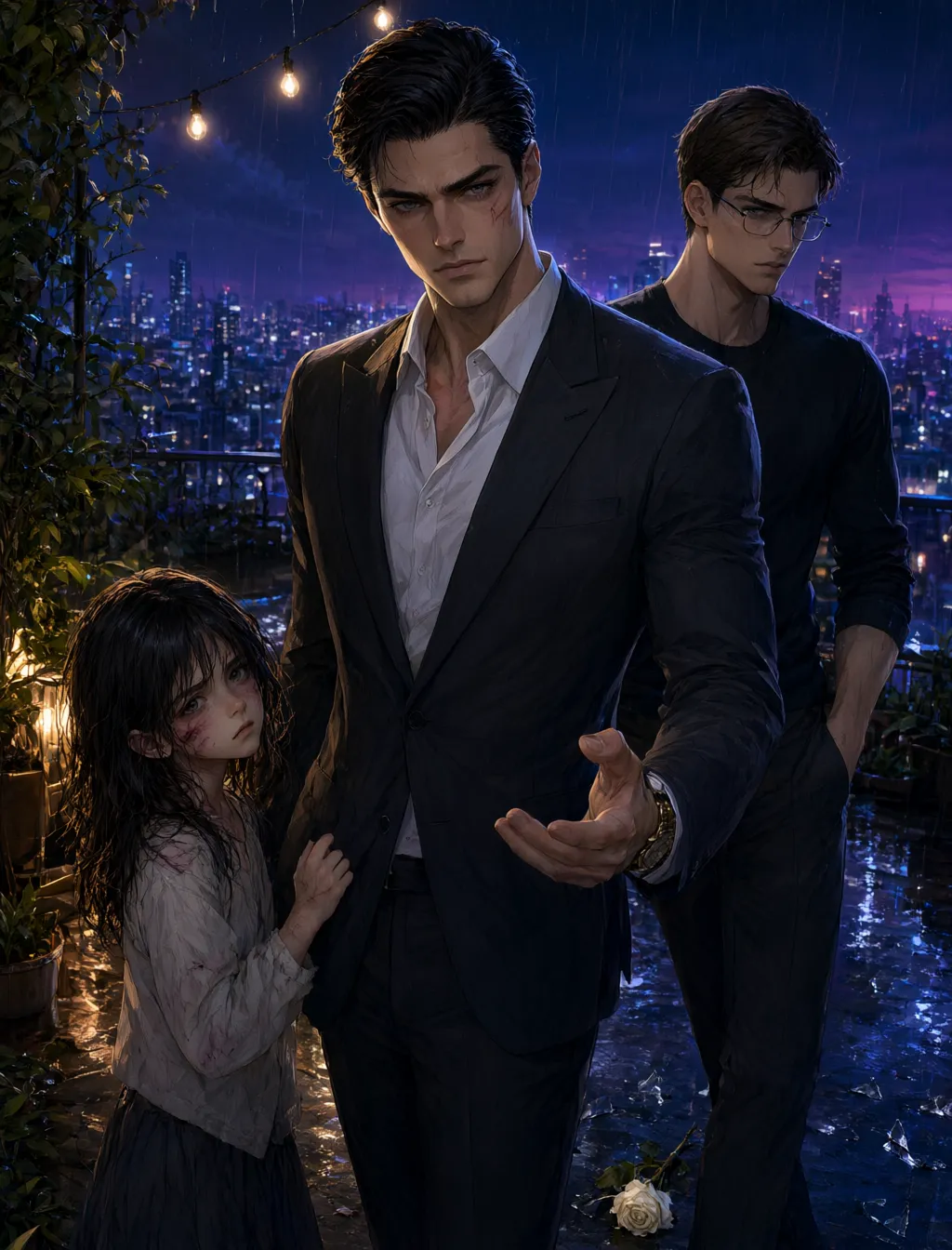
The sunlight hit her face like a hand on a shoulder, insistent and warm. She blinked against it, the smell of pancakes curling into the room from somewhere down the hall, and her body—her body ached less. The ribs were a dull throb now, the ankle a whisper instead of a scream. She pushed the blanket off.
Leo was in the doorway, arms crossed, gray eyes flat and unreadable. "You're not leaving this room."
She didn't answer. Her bare feet found the floor, the wood cool and solid, and she stood. Her jaw set itself. "I'm going to the garden."
Not a question. Not a tantrum. A decision, the way a soldier decides to take a hill or a general decides to burn a bridge. She took a step toward the door, her hand finding the frame.
His hand closed over hers on the wood. Firm. Not rough, but anchored, like a gate that had been locked for nine years and wasn't about to swing open now. She could feel the heat of his palm against her knuckles, the scarred roughness of it, and she didn't pull away—she just stood there, grumpy and unmoving, a small storm that had nowhere to break.
From the hallway, she felt them. Emerson's quiet weight against the wall, the gleam of his wire-rimmed glasses catching the light. Tomasso's arms crossed, jaw tight, watching her like she was a bomb that might go off. And Sorin, leaning around the corner, eyes wide and worried, a streak of flour on his cheek.
The silence stretched. It had teeth.
"Sweetheart," Sorin said finally, his voice soft as a peace offering, "you're still a security risk. We need to keep you safe. But also—guarded."
She turned her head just enough to look at him. "I'm not going to run."
"I know," Sorin said. "But Master might come looking. And if he finds you in the garden—" He stopped, his throat working. "We can't lose you again."
The word *again* hung in the air like a bell that had been struck. She heard it. She felt it land somewhere deep in her chest, a place she didn't have a name for. Leo's hand was still on hers, and she looked down at it, at the way his fingers curled around her smaller ones, like she was something precious and breakable all at once.
"I just want to see the sky," she said. Her voice came out smaller than she meant it to. "I haven't—" She stopped.
Leo's grip loosened, just slightly. "The garden." It wasn't a question.
"The garden," she repeated.
He looked over her head at his brothers, a conversation happening in a language she didn't know yet—eyebrows, jawlines, the tilt of a chin. Then he looked back down at her, and something in his gray eyes softened, cracked, just a little.
"Okay," he said. "But I'm coming with you."
She blinked. "Okay?"
"Okay." He stepped back, releasing her hand, and she stood there in the doorway, suddenly unsure of her feet. The hallway stretched out in front of her, bright and strange and full of people who kept looking at her like she mattered.
She took a step. Then another. And the brothers parted around her like water around a stone, Tomasso's hand brushing her shoulder as she passed, Sorin's voice trailing after her: "Pancakes when you get back, yeah?"
She didn't answer. She just kept walking toward the light at the end of the hall, Leo a step behind her, his shadow long and warm over her back. The garden was out there, green and open and waiting. And for the first time, the door wasn't locked.
The garden was bigger than she'd imagined. From the hallway window it had looked like a green square, a postage stamp of color against the gray stone of the compound. But standing at the edge of the lawn, her bare feet sinking into grass that was cool and damp with morning dew, it felt like a country. A whole country of green, bounded by high stone walls she could see in every direction, and above it all, the sky—an endless blue bowl she hadn't realized she'd been starving for until this moment.
She stood still for a long time, just breathing. The air smelled different out here. Cleaner. Like the earth itself was exhaling. She tilted her head back and let the sun hit her face, her eyes closed, and for one moment she was just a girl standing in the light.
Then she ran.
She didn't decide to. Her legs simply moved, carrying her forward across the grass in a sprint that was more joy than purpose. The ankle protested—a sharp twinge that she ignored the way she'd been trained to ignore pain—and then settled into a rhythm. Her bare feet slapped against the lawn, and the grass was soft and forgiving in a way the hard-packed dirt of the training yard had never been.
Behind her, she heard a laugh. Sorin's voice, bright and surprised. "She's running!"
She didn't slow down. She ran to the far wall and put her hand on the rough stone, feeling its warmth from the morning sun, then turned and ran back the other way, her arms spread wide like she was flying. The bandages on her back pulled, a dull reminder of the lashes underneath, but she didn't stop. She couldn't stop. The sky was too big, the grass too soft, the air too sweet.
On the second lap, she noticed them watching. Leo stood by the door to the house, arms crossed, but his gray eyes were soft in a way she'd never seen them. Tomasso was leaning against the wall, and his jaw wasn't tight anymore—his mouth had curved into something that almost looked like a smile. Emerson had come out too, his wire-rimmed glasses glinting as he watched her, and Sorin was bouncing on his heels like he wanted to run with her.
She slowed to a walk, then stopped in the middle of the lawn, chest heaving. The sun was warm on her shoulders. The grass tickled her ankles. She looked at them—her brothers, the word still strange in her head—and she felt something crack open in her chest. Not the bad kind of crack, not the kind that meant she was broken. The other kind. The kind that let light in.
"Again," she said, and took off running before anyone could answer.
This time, Sorin joined her.
He loped alongside her, his long legs making it look easy, a streak of flour still on his cheek. "You're fast," he said, genuinely impressed. "Like, actually fast. Can you teach me?"
She didn't answer. She just ran harder, and he laughed and kept pace with her, and for a few glorious minutes she forgot about the ache in her ribs and the sting on her back and the cold, dark room she'd slept in for as long as she could remember. There was only the grass and the sky and the sound of her own breathing, and Sorin's laugh ringing out behind her like a bell.
She ran until her legs turned to water, until she had to stop with her hands on her knees, gasping. Sorin stopped beside her, barely winded, and she hated him a little for it. Then she looked up and saw that Tomasso had moved from the wall, that he was standing closer now, and that his face had gone soft in a way that made her chest do something strange.
"You're going to wear yourself out," Tomasso said. His voice was gruff, but there was no bite in it. "You're still healing."
"I'm fine," she said, the words automatic. She straightened, pushing her tangled hair out of her face. "I'm not tired."
Tomasso raised an eyebrow. "You're panting like a dog."
"Am not."
"Are too."
She glared at him, and he glared back, and then something broke in both of them at the same time. He laughed first, a short, surprised sound, and then she was laughing too, a breathless giggle that felt foreign in her throat, like a language she'd forgotten she knew how to speak.
Sorin whooped. "She laughed! Tomasso made her laugh! That's a first!"
"Shut up," she said, but she was still smiling, and she couldn't make it stop.
Emerson had come closer, standing at the edge of the lawn with his hands in his pockets. She could feel his eyes on her, clinical and careful, the way he looked at her during the exams. She tried to ignore it, tried to hold onto the lightness in her chest, but she knew what that look meant. She'd seen it before, in the eyes of the men who'd patched her up after training sessions, the ones who'd told Master she needed rest when she was supposed to keep fighting.
She took a step back, her bare feet finding the grass again. "I'm not tired," she said again, louder this time. "I'm fine."
"Bella." Emerson's voice was gentle, but it had that firm edge to it, the one that meant he wasn't asking. "Your body is still recovering. You need to lie down."
The words hit her like a slap. The lightness in her chest curdled, turning sour and hot. She felt her jaw set, felt the familiar stubbornness rise up in her throat like bile.
"No."
Emerson blinked. "No?"
"I said no." She crossed her arms over her chest, the gesture small and defiant. "I'm not going back inside. I just got out here. I'm not—I'm not going back."
Leo moved then, stepping forward from the doorway. His shadow fell over her, long and dark, but she didn't flinch. She stood her ground, her chin lifted, her dark eyes fixed on his gray ones.
"Bella," he said, his voice low and careful. "You've been running for twenty minutes. Your ankle is swollen. Your ribs—"
"I don't care about my ribs."
"I do."
The words landed somewhere soft, somewhere she didn't have armor. She felt them hit, felt the crack spread, and she hated him for it. Hated him for making her feel things she didn't have names for. Hated him for caring when caring was a weapon, when caring was how people got hurt.
"You don't get to care," she said, her voice shaking. "You don't—you just met me. You don't know me. You don't get to tell me what to do."
Leo's face didn't change. He just looked at her, steady and unmoving, like a mountain that had been standing for a thousand years and wasn't about to budge for a nine-year-old's tantrum. "I'm your brother."
"I don't have brothers."
"You do."
"I don't!" The words tore out of her, raw and ragged. "I don't have anyone. I never have. I'm not—I'm not your sister. I'm not anything. I'm just a tool, and tools don't have brothers, and tools don't—tools don't—"
She stopped. Her chest was heaving, her eyes burning, and she realized with horror that she was crying. Actual tears, sliding down her cheeks, hot and shameful. She scrubbed at them with her fist, furious at herself for the weakness, furious at them for seeing it.
"I'm going back to the garden," she said, her voice cracking. "I'm not going inside."
She turned and ran. Not the joyful sprint of before, but a desperate, stumbling run, her bare feet slipping on the grass as she made for the far wall. The gate was there—she'd seen it from the lawn, a tall iron gate set into the stone, and she didn't know why she was running for it except that it was a way out, a way away from their eyes and their soft voices and the way they looked at her like she was something that mattered.
"Bella!" Sorin's voice, sharp with alarm. "Bella, stop!"
She didn't stop. She reached the gate and jumped, her fingers finding the iron bars, her feet scrambling for purchase as she started to climb. The metal was cold and rough under her palms, and her ankle screamed in protest, but she kept climbing, up and up, away from the grass and the sky and the brothers who wanted to put her back in that room.
She heard them behind her—footsteps, voices, a low curse from Tomasso—and then she heard something else. Heavy boots on the path. The guards. Marco and Dante, the same men who'd caught her the night she'd broken in, their faces grim as they approached the gate.
"Little one," Marco said, his voice surprisingly gentle for a man his size. "Come down from there."
"Go away!" She climbed higher, her hands finding the top of the gate, her fingers wrapping around the cold iron. "I'm not coming down! I'm not going back inside! You can't make me!"
Dante reached up and caught her ankle. His grip was firm but not cruel, a hand around her bare foot that stopped her climbing cold. She kicked at him, her heel connecting with his shoulder, and he grunted but didn't let go.
"Let go of me!" She kicked again, harder, her voice rising to a shriek. "Let go! You big meanie! Let go!"
"Can't do that, little one." Dante's voice was calm, steady. "Your brothers are worried about you."
"I don't care! I don't—let go!" She kicked and thrashed, her legs scissoring in the air, her hands white-knuckled on the gate. "Go away! All of you! Just go away!"
Marco's hands closed around her waist, and she felt herself being lifted, pulled off the gate despite her grip. She screamed, a wordless sound of fury and frustration, and kicked out again, her heel catching Marco in the chest. He grunted but didn't drop her, just held her firm as she twisted and fought, her small body a live wire of resistance.
"Put me down! Put me down right now!"
"I'll put you down," Marco said, and he did—gently, carefully, lowering her until her feet touched the grass. But his hands stayed on her shoulders, and Dante's hand was still around her ankle, and she was trapped, caught between them like a bird in a net.
She kept fighting. She didn't know how to stop. Her fists beat against Marco's chest, her feet kicked at Dante's shins, and she called them every name she knew, her voice cracking with tears. "Big meanies! Stupid! Let me go! I hate you! I hate all of you!"
They didn't let go. They just held her, firm and patient, waiting out the storm the way you wait out a thunderstorm, knowing it will pass.
And then her legs gave out.
It happened fast—one moment she was standing, the next her knees buckled and she was falling, the fight draining out of her like water from a broken cup. Marco caught her, lowering her to the grass, and she lay there on her back, panting, her chest heaving, her eyes fixed on the sky above her.
The sky was still blue. Still endless. Still beautiful. She hated it.
Her brothers stepped over her.
She saw them from the ground, their faces swimming above her—Leo's gray eyes, Emerson's dark ones, Sorin's wide and worried, Tomasso's tight with something she couldn't read. They stood around her like trees, their shadows falling across her body, and she felt small. Smaller than she'd felt in a long time. Small and tired and broken in a way she didn't know how to fix.
"I just wanted to see the sky," she whispered. Her voice was hoarse from screaming. "That's all. I just wanted to see the sky."
Leo crouched down beside her. His hand found her hair, brushing the tangled strands back from her face, and she didn't have the strength to pull away.
"I know, sweetheart," he said. His voice was rough, like he was holding something back. "I know."
"Why won't you let me?" She looked at him, her dark eyes swimming. "Why can't I just stay out here? I'm not going to run. I'm not going to—I'm not going to go back to him. I just—I just want to be outside. I want to feel the sun. I want to—"
Her voice broke. She turned her face away, pressing her cheek against the grass, and felt the cool earth against her hot skin.
"I want to feel like I'm alive," she said, so quietly she wasn't sure they could hear her. "Not like a tool. Not like a weapon. Just—alive."
No one spoke. The silence stretched, long and heavy, and she closed her eyes, waiting for them to pick her up and carry her inside, waiting for the lock to click behind her.
Instead, she felt the grass shift beside her. Then more shifting, more bodies lowering themselves down. When she opened her eyes, they were all lying on the grass with her—Leo on one side, Emerson on the other, Sorin and Tomasso at her feet, all of them flat on their backs, staring up at the same blue sky.
"The sky's pretty from down here," Sorin said, his voice soft. "You can see more of it."
She blinked. "What are you doing?"
"Lying in the grass," Tomasso said, as if it were obvious. "Watching the sky. It's not that complicated."
"You're—" She sat up, staring at them. "You're not supposed to be down here. You're supposed to be making me go inside."
"We are," Emerson said. His voice was calm, clinical, but there was something softer underneath it. "In a minute. But first, we're watching the sky with you."
She didn't understand. She didn't understand any of it—why they were lying in the grass, why they were looking at her like she was something precious, why they weren't dragging her inside and locking the door. She looked at Leo, and he looked back at her, his gray eyes steady and warm.
"You said you wanted to feel alive," he said. "We're going to stay here until you do."
Her throat closed up. She lay back down, slowly, her body sinking into the grass, and stared up at the sky. The blue was so wide, so endless, so impossibly beautiful. A bird crossed it, dark against the light, and she watched it until it disappeared.
"I feel alive," she said, her voice barely a whisper.
Leo's hand found hers in the grass. He didn't say anything. He just held it, warm and solid, and she held it back.
They lay there for a long time, the five of them, watching the sky together. And when Emerson finally sat up and said, "Okay. Time to go inside," she didn't fight it. She let him help her to her feet, let Leo carry her back across the lawn, let the warmth of their bodies surround her as they walked through the door and into the house.
She was still holding his hand when the door closed behind them.
Sorin appeared in the doorway of her bedroom like a whirlwind with a plan, flour still smudged on his cheek, his eyes bright with something that looked like mischief and tenderness all tangled together. Emerson had her cornered on the edge of the bed, a thermometer in one hand and that patient, clinical expression on his face that meant he was going to win eventually. She was losing the argument, her arms crossed, her jaw set, ready to dig in for the long haul.
"Nope," Sorin said, and scooped her up before anyone could react.
She let out a startled yelp, her hands grabbing for his shoulders, the thermometer clattering somewhere behind her. "What—"
"Sorin." Emerson's voice had that warning edge, the one that usually made men straighten their spines. "She needs to rest. Her ankle—"
"She can rest outside." Sorin was already moving, carrying her through the doorway like she weighed nothing, which she supposed she did. "She's been in this room for days. She's going to go stir-crazy."
"Sorin!" Leo's voice boomed from somewhere down the hall, heavy footsteps following. "What are you doing?"
Sorin didn't slow down. He broke into a jog, and she bounced against his chest, her fingers digging into his shirt. The hallway blurred past, the walls streaked with afternoon light, and she heard herself laugh—a real laugh, surprised out of her, bright and strange in her own ears.
"Where are you taking her?" Tomasso's voice, sharp and grumpy, from somewhere behind them.
"You'll see!" Sorin called back, and he was grinning, she could feel it in the way his chest moved against her.
She should have been scared. Being carried, being moved without her consent, being taken somewhere she didn't know—that was the kind of thing that usually made her fight, made her claw and bite and scream. But Sorin's arms were warm and steady, and he was laughing, and the whole world was tilting sideways in a way that felt like flying.
They burst through the back door into the sunlight, and she blinked, the brightness stinging her eyes. Then she saw it.
The patio was transformed.
Two enormous chairs sat side by side on the stone, so big they looked like they'd been built for giants—or for beds that had decided to grow legs and arms. They were piled with blankets, fluffy and soft, in colors she didn't have names for: cream and pale blue and the color of a sunset. Pillows were stacked in the corners, and a low table between the chairs held a spread that made her stomach growl: a plate of pancakes still steaming, a bowl of berries, a glass of juice, and a cluster of teddy bears arranged like they were having a tea party.
Sorin collapsed into the nearest chair, still holding her, and they sank together into a mountain of softness. The chair swallowed them, the blankets wrapping around her like a cocoon, and she let out a breath she didn't know she'd been holding.
"Ta-da," Sorin said, his voice warm with pride. "The Sorin Special. Patio edition."
She stared at him. Then at the chairs. Then at the pancakes. Then back at him.
"You did this?"
"Well, I had help." He shrugged, a little sheepish now. "Tomasso carried the chairs out. Emerson said you needed to stay off your ankle, so I figured—if you can't go to the garden, the garden can come to you. Sort of." He gestured at the patio, the lawn stretching out beyond it, green and open and waiting. "You can see the sky from here. All of it."
She looked up. The sky was a deep, endless blue, scattered with a few lazy clouds, and the sun was warm on her face in a way that made her chest ache.
"Thank you," she said, and her voice came out small and rough, like she'd swallowed sand. "Sori. Thank you."
He beamed at her, and she felt something loosen in her chest, something she hadn't known was clenched tight.
Then Leo appeared in the doorway, his arms crossed, his gray eyes flat and unreadable. "Sorin."
Sorin's smile flickered but didn't dim. "She's not running, Leo. She's sitting. There's a difference."
"She needs to rest."
"She is resting." Sorin gestured at the mountain of blankets. "Look at her. She's so rested she's practically horizontal."
Leo's jaw tightened, and she felt a flicker of something—fear, maybe, or the old instinct to brace for a blow. But Leo didn't move toward them. He just stood in the doorway, his shadow long across the stone, and looked at her.
"Are you okay out here?" he asked, and his voice was softer now, the edge gone.
She looked at the sky. At the chairs. At Sorin's hopeful face, flour still on his cheek. At the pancakes, steaming and golden.
"Yeah," she said. "I'm okay."
Leo nodded slowly, and something in his shoulders loosened. "Okay. You stay here. I'll be inside if you need me."
He turned and disappeared back into the house, and she let out a breath she hadn't known she was holding.
Sorin leaned over and grabbed the plate of pancakes, setting it on her lap. "Eat," he said. "You need fuel. Running around on the lawn burns a lot of energy."
She picked up a pancake, still warm, and took a bite. The sweetness flooded her mouth, and she closed her eyes, letting herself just feel it. The sun on her skin. The softness of the blanket. The warmth of Sorin's shoulder against hers.
"This is nice," she said, and the words felt strange in her mouth, like a language she was still learning.
Sorin grinned. "Wait until you see the chairs at night. You can see the stars from here. All of them."
She looked up at the sky, pale and bright, and tried to imagine it dark, scattered with stars. She'd seen stars before, from the compound where Master had kept her, but they'd always been distant and cold, pinpricks of light in a sky she wasn't allowed to touch.
"I've never watched the stars," she said quietly. "From somewhere comfortable."
Sorin's smile softened. "Well, now you have. And you can do it every night, if you want. I'll even bring out hot chocolate."
She didn't know what hot chocolate was, but the way he said it made it sound like a promise, warm and sweet and safe.
"Okay," she said, and took another bite of pancake.
Tomasso appeared a moment later, a mug in each hand, his expression carefully neutral. "Sorin said you'd want these." He set them on the table between the chairs—two mugs of something steaming, topped with whipped cream and a dusting of something brown. "Hot chocolate. With extra marshmallows, because Sorin has no sense of moderation."
"I have a sense of joy," Sorin corrected, reaching for a mug. "They're different."
Tomasso rolled his eyes, but there was no heat in it. He looked at her, and his voice softened. "You doing okay out here?"
She nodded, her mouth full of pancake.
"Good." He hesitated, then reached out and ruffled her hair, a quick, awkward gesture that made her freeze. But his hand was gentle, and he pulled back before she could react, his expression shifting to something almost embarrassed. "Don't let him talk your ear off. He never stops."
"I do too stop," Sorin protested. "I just choose not to."
Tomasso snorted and walked back inside, and she watched him go, something warm and strange settling in her chest.
They sat in the sun, Sorin chattering about nothing and everything—the garden, the birds, the time he'd tried to teach Tomasso to dance and it had ended with both of them in the fountain—and she listened, letting his voice wash over her like the warmth of the sun. She finished the pancakes. She drank the hot chocolate, which was sweet and rich and unlike anything she'd ever tasted. She let Sorin wrap another blanket around her shoulders, even though she wasn't cold.
And for a long, quiet while, she just sat there, in the enormous chair, under the endless sky, feeling the weight of the blanket and the warmth of the sun and the strange, unfamiliar sensation of being safe.
"Sori?" she said, her voice small.
"Yeah?"
"Why are you being so nice to me?"
He was quiet for a moment. Then he turned to look at her, his eyes serious in a way she hadn't seen before.
"Because you're my sister," he said, simply, like it was the most obvious thing in the world. "And sisters deserve nice things."
She blinked, her throat tight. "I've never had nice things before."
"Well, now you do." He grinned, the brightness flooding back into his face. "And I have a lot of them. I've been saving up."
She didn't know what to say to that. So she just leaned into him, her head against his shoulder, and let the sun warm her face, and listened to him talk about the time he'd convinced Tomasso that the compound was haunted and Tomasso had slept with the lights on for a week.
She was still smiling when Emerson came out a while later, a glass of water in one hand and his doctor's expression firmly in place. He set the glass on the table and looked at her, his dark eyes scanning her face, checking for signs of fever or fatigue.
"How are you feeling?" he asked, his voice clinical.
"Fine," she said, because it was easier than the truth.
He didn't look convinced, but he didn't push. He just nodded, and then, to her surprise, he sat down on the edge of the other enormous chair, his hands folded in his lap, his gaze fixed on the garden.
"The roses are blooming early this year," he said, and she blinked at the non-sequitur.
"What?"
"The roses." He gestured at a cluster of red blooms near the wall. "They usually don't come in until May. But this year, they're early."
She looked at the roses, bright and vivid against the gray stone, and felt something shift in her chest. "They're pretty."
"They are." He was quiet for a moment, and when he spoke again, his voice was softer, less clinical. "I used to sit out here with Amelia. After she—" He stopped, his jaw tightening. "She liked the roses. Said they reminded her of something our mother used to grow."
She didn't know who Amelia was, but she could see the weight of the name in the way Emerson's shoulders curved, the way his hands tightened in his lap. She didn't ask. She just sat there, in the warm sun, and let him be quiet.
After a while, he stood, his movements careful and deliberate, and looked down at her. "You're doing well," he said. "Better than I expected."
She didn't know what to do with the praise, so she just nodded.
He left, and Sorin leaned over, his voice conspiratorial. "He does that. Gets all sad and mysterious. But he's a good guy. The best, really."
"Who's Amelia?" she asked, before she could stop herself.
Sorin's smile flickered. "Our mom," he said softly. "She died when we were little."
She processed that, turning it over in her mind. "I didn't know I had a mom."
Sorin looked at her, his eyes unreadable. "You did. She was—she was wonderful. I don't remember her much, but Leo says she used to sing to us. And she always smelled like bread, because she was always baking."
She thought about that—a woman who smelled like bread, who sang, who grew roses. It was so foreign, so impossibly distant, that it felt like a story about someone else's life.
"I don't remember her," she said, and the words felt heavy, like a confession.
"That's okay," Sorin said, his voice gentle. "You can get to know her through us. We have pictures, stories. Leo has a whole box of them."
She nodded, not sure what to say, and let the silence settle around them like a blanket.
The sun moved across the sky, the shadows shifting, and she stayed in the enormous chair, wrapped in blankets, surrounded by softness and warmth and the strange, unfamiliar feeling of being cared for. She didn't fall asleep—she was too wired for that, too aware of every sound, every movement, every breath. But she let herself rest, let herself sink into the comfort of the moment, and for a while, she forgot to be afraid.
When Leo came out again, the light had turned golden, and the air had cooled. He stood at the edge of the patio, his hands in his pockets, and looked at her with an expression she couldn't quite read.
"Dinner's ready," he said. "If you're hungry."
She looked at Sorin, who was already scrambling to his feet, and then at the sky, still blue and endless above them.
"Can I come back out here after?" she asked, and her voice came out smaller than she meant it to.
Leo's expression softened. "You can come out here whenever you want."
She nodded, and let Sorin help her out of the chair, her legs shaky and uncertain. He kept a hand on her shoulder, steadying her, and she let him, because it was easier than pulling away.
They walked inside together, the warmth of the house washing over her, and she glanced back once, at the enormous chairs and the towering pile of blankets and the teddy bears still arranged on the table, waiting for her return.
She was still thinking about the stars when they sat down to dinner.