
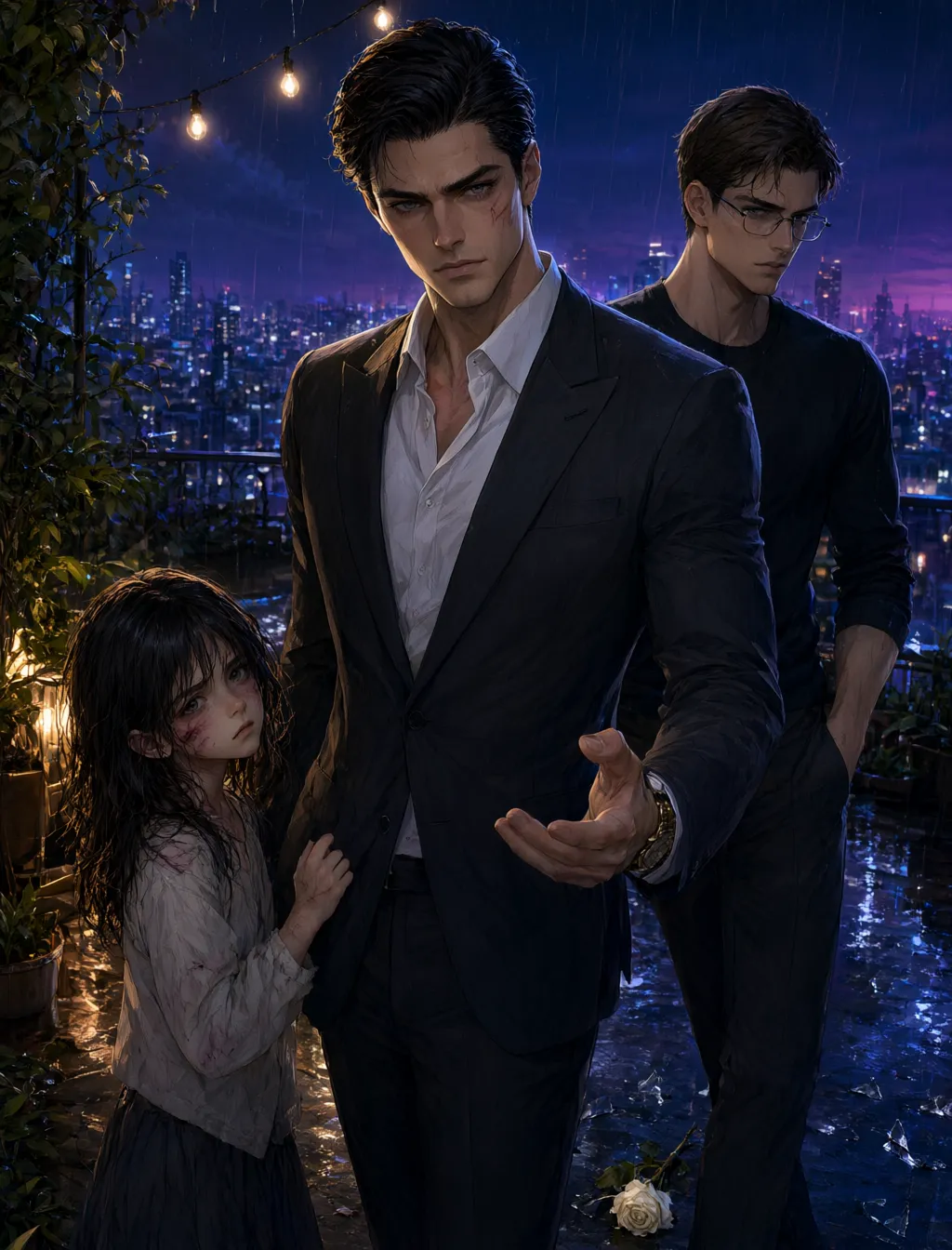
The morning came through the curtains like a slow gray tide, and Isabella woke to the unfamiliar sensation of not being in pain.
That was the first thing she noticed. Not the ceiling above her—white and clean and far too high—but the absence. The ache was still there, buried in her ribs, throbbing in her ankle, a dull burn across her back that she'd learned to catalog and dismiss. But it was muted. Softened. Like someone had wrapped her whole body in cotton while she slept.
She lay still for a long moment, the way she'd been taught. Eyes half-closed, breathing shallow, cataloguing. Ribs: sore but not broken-worse. Ankle: swollen but not screaming. Back: stinging but not bleeding. Head: foggy, but the fever had broken sometime in the night, leaving her skin cool and damp against the pillow.
The bed beneath her was impossibly soft. She'd never slept on anything like it—her whole life had been hard cots and cold floors and, when Master was feeling generous, a thin mattress on a metal frame. This bed swallowed her. It held her. The quilt was heavy and warm, and there was a hot water bottle still pressed against her feet, wrapped in cloth, radiating a gentle heat that made her toes curl.
She pushed herself up slowly, one hand pressed to her ribs, and looked around the room.
It was the same room from before—she remembered the soft walls, the dresser, the window. But in the daylight it looked different. Less like a cell dressed up to look kind, and more like... a room. A place someone had made for her. The curtains were pale blue, the same color as the quilt. There was a small bookshelf against one wall, mostly empty, but with a few picture books that looked untouched. A wooden chair sat by the window, and on its seat, folded neatly, were clothes.
She stared at them.
Clean clothes. No blood. No dirt. No smell of smoke or sweat or fear. Just soft fabric, folded in precise squares the way someone's mother might have done it.
Isabella didn't know what a mother was supposed to look like. But she thought maybe this was it.
She swung her legs over the edge of the bed, testing her ankle. It held. The bandages were still snug around her ribs, and she could feel the tape pull against her skin when she moved, but she could stand. She could walk. She wasn't chained.
The door was closed. She looked at it for a long moment, remembering the lock on the outside from the first night. Remembering the way it had clicked when Leonardo had turned the key.
She waited for the fear to come. It didn't. Not exactly. There was a tightness in her chest, a wariness she couldn't shake, but it was quieter than before. Muffled by the warmth of the bed, by the hot water bottle, by the memory of Tomasso's voice calling her sister.
She crossed to the chair and picked up the clothes. They were soft—a plain gray shirt and a pair of loose pants, the kind that would be easy to move in. She changed quickly, her fingers clumsy on the buttons, her ribs protesting every time she reached too far. The clothes fit. They'd been chosen for her size, not just handed to her. Someone had thought about her when they'd picked these out.
The thought made something twist in her chest, and she didn't know what to do with it.
She looked at the window.
The garden was green and open, stretching out from the house in a way she'd never seen before. Grass, and trees, and flowers—actual flowers, bright spots of color against the gray morning. The sky was pale, the rain from last night gone, leaving everything washed clean and fresh. She could see a path winding through the garden, and beyond it, a wall. A high wall, topped with wire.
She knew a wall like that. She knew what it meant.
But the garden was still green. Still open. Still there.
Isabella pressed her palm against the glass. It was cool, and she could feel the faint vibration of the house around her—distant, quiet, no voices. She didn't know where her brothers were. She didn't know if they were even awake.
She thought about Master.
She thought about the way he'd look at her when she came back empty-handed. The way his hand would close around her wrist, the way his voice would go soft and patient, the way she'd learned to read the quiet before the storm. She thought about the folder she'd stolen, the names inside it, the reason she'd come here in the first place.
And she thought about the way Leonardo had held her during the exam. The way Emerson had carried her back to bed. The way Sorin had smiled at her like she was something precious, and Tomasso had called her sister like it was the most natural word in the world.
She didn't know what to do with any of it.
So she did the only thing she knew how to do. She moved.
She crossed to the door, her bare feet silent on the floor, and reached for the handle. Her hand looked small against the metal—small and pale and scarred, the knuckles still bruised from the fight in the courtyard. She remembered the way Marco and Dante had grabbed her. The way she'd fought them. The way she'd lost.
The door wasn't locked.
She knew it wasn't locked. She'd heard Emerson apologize for leaving it open, had watched him close it behind him, but she'd also heard the click of a key in the lock that first night, and she knew what a locked door felt like under her hand. This one didn't have that give. This one was just... closed.
Isabella frowned.
It didn't make sense. She was a prisoner. She was a threat. She'd been sent to kill them, and instead they'd given her a bed and a teddy bear and clothes that fit. They'd left her door unlocked.
She didn't understand it. She didn't trust it.
But she also couldn't stay in this room.
The walls were too soft. The bed was too warm. The window showed her a garden she couldn't reach, and the quiet of the house pressed in on her like a hand on her chest, asking her to stay still, to be good, to wait for someone to tell her what to do.
Isabella had never waited for anyone to tell her what to do. Not even when she was small enough to be carried. She'd learned to move, to fight, to survive, and the one thing she knew—the only thing she'd ever been sure of—was that staying still meant dying.
She pulled the door open.
The hallway stretched empty before her, clean and quiet, the walls a soft cream color that caught the morning light. She could hear something downstairs—a low murmur of voices, too distant to make out words, but unmistakably there. Her brothers, already awake. Already deciding what to do with her.
She stepped into the hallway, and the door swung shut behind her with a soft click.
The sound felt final. It felt like a decision.
Isabella stood in the hallway for a moment, her bare feet cold on the wooden floor, and listened. The voices were coming from somewhere to her left, down the stairs, probably the kitchen she'd seen before. She could smell coffee, and something warm—bread, maybe, or eggs. Her stomach turned over, a sharp pang of hunger she hadn't felt since yesterday, when the pancakes had been a test she'd passed by eating them.
She didn't go toward the kitchen.
She went the other way, down the hall, looking for the stairs. She passed closed doors—so many closed doors—and she didn't open any of them. She wasn't looking for a room. She was looking for a way out.
The garden was out there. The wall was out there. And beyond the wall, the world she knew, the only world she'd ever understood.
She found the stairs at the end of the hall, a wide sweep of polished wood that led down to a foyer. She could see the front door from here, dark wood with a brass handle, and beside it, a window that looked out onto the gravel drive where she'd collapsed two days ago.
She took the stairs slowly, one hand on the banister, her ankle protesting with every step. The voices were louder now, but they were still muted, still somewhere else. She could make out words if she tried—"she's sleeping," and "let her rest," and something about a fever—but she didn't try. She didn't want to hear what they were saying about her.
She reached the bottom of the stairs and stopped.
The front door was right there. Twenty feet away. Maybe less. She could cross the foyer in seconds, pull the door open, and be outside. The gravel would hurt her bare feet, but she'd walked on worse. She'd walked on glass and concrete and the cold metal floor of a truck. Gravel was nothing.
She took a step toward the door.
And then the kitchen door swung open, and Sorin stepped out, a piece of toast in his hand, his eyes bright and eager.
"Bella!"
She froze. Her hand was already half-raised, ready to reach for the door, and she let it drop to her side, her face going blank the way she'd been taught. No fear. No guilt. No anything.
Sorin's smile faltered. He looked at her, then at the front door, then back at her, and something flickered in his eyes—confusion, maybe, or worry.
"What are you doing up?" he asked, taking a step toward her. "You should be resting. Emerson said—"
"I'm fine." The words came out flat, clipped. She didn't mean for them to sound like that, but she couldn't stop them. "I'm going outside."
Sorin blinked. "Outside?"
"The garden." She said it like it was the most obvious thing in the world. "I want to see the garden."
Sorin's brow furrowed. He looked at her bare feet, at the bandages peeking out from under her sleeve, at the way she was standing—weight shifted off her bad ankle, shoulders squared, ready to run.
"Bella," he said carefully, "you're sick. You were really sick yesterday. Maybe you should—"
"I'm better."
"You're not—"
"I said I'm better."
It came out sharper than she meant it to. Sorin flinched, and she saw it—the hurt in his eyes, the way he pulled back just slightly, like she'd stung him. She'd done that. She'd made him flinch, the way Master made her flinch, and she didn't know why that thought made her stomach turn.
She looked away. "I'm going outside," she repeated, quieter this time. "I just want to see the garden."
"I don't think that's a good idea."
It wasn't Sorin who said it. It was Leo.
He came out of the kitchen behind his brother, a cup of coffee in his hand, his gray eyes sharp and steady. He was dressed in a dark shirt, sleeves rolled up to his elbows, and he looked at her the way he'd looked at her in the exam room—like she was something fragile, something precious, something he was afraid to break.
"You need to rest," he said, and his voice was gentle but firm. "You were running a fever last night. Doctor's orders."
Isabella felt something twist in her chest. It wasn't fear. It wasn't anger. It was something else, something she didn't have a name for, and she didn't like it.
"I want to see the garden," she said.
"You can see it from your window."
"I want to see it from outside."
Leo's jaw tightened. "Bella—"
"I'm not asking permission."
The words hung in the air between them. She saw Sorin's eyes go wide, saw Leo's expression shift, the gentleness hardening into something more guarded. She'd done it wrong. She knew she'd done it wrong. She was supposed to be grateful, supposed to be good, supposed to stay in her room like a proper prisoner and wait to be told what to do.
But she'd never been a proper prisoner. She'd never been good. And she was so tired of being told what to do by people who thought they owned her.
"You're not allowed to leave your room," Leo said, and his voice was quieter now, harder. "Not until you're better."
Isabella looked at him. She looked at the front door, twenty feet away. She looked back at him.
And then she walked past him, toward the door, her bare feet silent on the floor.
"Bella." Leo's voice was sharp. "I said no."
She didn't stop. She didn't even slow down. She reached the door and pulled it open, and the morning air hit her face, cool and damp and full of the smell of cut grass and wet earth, and she stepped out onto the gravel before anyone could stop her.
The stones bit into her bare feet. She didn't care.
The garden was even bigger than it had looked from the window. Greener. Wilder. The path wound between flower beds and under trees, and the wall at the edge of the property was high and white, topped with wire that glinted in the pale morning light.
She heard footsteps behind her. Leo, and Sorin, and the murmur of other voices from inside the house.
"Bella." Leo's voice was right behind her now, close enough that she could feel the warmth of him. "Turn around. Come back inside."
She didn't turn around. She stood on the gravel, her feet cold and cut, and she looked at the garden.
"I'm not going to run," she said quietly. "I just want to see it."
There was a long silence. She could feel them all behind her—Leo, and Sorin, and maybe Tomasso, maybe Emerson, all of them watching her like she was a bird that might take flight at any moment.
She heard Leo exhale behind her—a long, slow breath that carried the weight of a man counting to ten in his head. She'd heard that sound before, from Master, right before the belt came off. Her shoulders tensed, bracing for the blow that never came.
"Bella." His voice was softer now. Closer. "You're barefoot. You're sick. The ground is cold and wet from last night's rain."
"I don't care."
"I know you don't. That's the problem."
She heard the gravel crunch as he took a step toward her. Then another. She didn't turn around, but she felt him stop just behind her, close enough that she could feel the warmth radiating off him, smell the coffee on his breath.
"Come inside," he said quietly. "Please."
The word surprised her. Please. Master never said please. Master didn't ask—he took, he demanded, he punished. Please was a word for people who thought you had a choice.
She didn't have a choice. She'd never had a choice. That was the one thing she'd always known, the one truth she could hold onto when everything else was pain and hunger and the dark. She was a tool. Tools didn't choose.
But here, in this garden, with the cold gravel under her feet and the green world opening up around her, she felt something she'd never felt before.
She felt like she could choose.
"No," she said.
It came out quiet, but it didn't waver. She heard Sorin make a small sound behind her, something between a gasp and a laugh, and she felt Leo's presence shift, the air changing as he straightened.
"No?" he repeated.
"I want to see the garden." She said it slowly, carefully, the way she'd learned to speak when she was about to be punished—steady, flat, giving nothing away. "I want to walk on the grass. I want to touch the flowers. I want to—"
She stopped. She didn't have words for the rest of it. She didn't know how to say that she'd never stood in a garden before, never felt grass under her feet, never seen flowers that weren't wilted in a vase on a table she wasn't allowed to touch. She didn't know how to say that this green, open space felt like a different world, one she'd only seen through windows and fences and the cracks between buildings.
She didn't know how to say that she wanted to stay here forever, in this moment, where no one was hitting her and nothing was hurting and the air smelled like rain and cut grass instead of smoke and blood.
So she just stood there, her bare feet cold on the gravel, and waited for them to drag her inside.
Instead, she heard Emerson's voice.
"Isabella."
It came from the doorway, calm and measured, the voice of a man who'd spent years delivering hard truths. She turned her head, just slightly, and saw him standing on the threshold, his wire-rimmed glasses catching the morning light, his arms crossed over his chest.
He looked at her for a long moment. Then he said, "You have ten seconds to turn around and come back inside with us."
She blinked.
"Or what?"
"Or we carry you in."
The words were gentle, but the tone wasn't. It was the voice he'd used when he'd told her she needed vaccines, the voice he'd used when he'd explained that her ribs were broken and she needed to rest. It was the voice of a man who was not asking.
She should have obeyed. She knew she should have obeyed. That was what she'd been taught—obey the voice that could hurt you, obey the hand that held the belt, obey the man who owned you. And Emerson was bigger than her, stronger than her, and he had that look in his eyes, the one that said he would do exactly what he'd threatened.
But he wasn't Master.
None of them were Master.
And Master wasn't here.
"Ten," Emerson said.
She didn't move.
"Nine."
She felt her jaw tighten. Her hands curled into fists at her sides, the old instinct rising, the one that said fight, fight, fight, don't let them take you, don't let them put you back in the cage.
"Eight."
Sorin shifted behind her. She could hear him whispering something to Tomasso, who must have come out at some point, and she could hear Tomasso's low grumble in response. They were watching her. All of them were watching her.
"Seven."
She stamped her foot. It was a small, childish gesture, the kind of thing she'd never done in her life, and it made her ankle throb and her ribs ache, but it also made something loosen in her chest, something she hadn't known was wound tight.
"I don't want to go inside!" The words burst out of her, louder than she'd meant them to be, and she heard her own voice crack on the last word. "I want to stay here! I want to see the garden! I want—"
She stopped. Her breath was coming fast now, and her eyes were stinging, and she didn't understand why. She wasn't scared. She wasn't hurt. She was just... standing in a garden, shouting at the men who'd fed her and bandaged her and given her a bed, and she didn't know why she was doing it, didn't know why she couldn't stop.
"I want to stay," she said again, quieter this time. "Please. I just want to stay."
There was a long silence.
And then, from somewhere behind her, she heard Sorin make a sound—a small, choked sound, like he was trying not to laugh. She turned her head and saw him with his hand over his mouth, his eyes bright, and next to him, Tomasso, whose face was doing something strange, the corners of his mouth twitching like he was fighting a smile.
Even Leo's expression had changed. The hardness was gone, replaced by something softer, something almost like wonder.
She didn't understand. She'd just thrown a tantrum. She'd just shouted at them, disobeyed them, stamped her foot like a baby. That was the kind of behavior that got you punished. That was the kind of behavior that got you locked in a room with no light and no food until you remembered your place.
Why were they smiling?
"She's throwing a tantrum," Tomasso said, and his voice was rough, but there was something warm underneath it. "She's actually throwing a tantrum."
"I'm not—" Isabella started, but Sorin cut her off.
"You are. You're stamping your foot and everything." He was grinning now, a wide, helpless grin that made his whole face light up. "That's the most normal thing you've done since you got here."
Isabella stared at him. "Normal?"
"Normal," Sorin confirmed. "Like a real kid. Like a little sister."
The word hit her like a blow to the chest. Little sister. She'd heard Tomasso call her sister yesterday, had felt the warmth of it spread through her like honey, but this was different. This was Sorin, the one who smiled at her like she was precious, saying it like it was the most natural thing in the world.
She didn't know what to do with it. She didn't know what to do with any of this.
So she did the only thing she could think of.
She ran.
Not toward the door—away from it. She turned and bolted across the gravel, her bare feet slipping on the stones, her ankle screaming in protest, her ribs sending sharp spikes of pain through her chest with every step. She didn't know where she was going. She just knew she had to move, had to get away from those smiles and those words and that feeling in her chest that she couldn't name.
"Bella!" Leo's voice was sharp behind her. "Bella, stop!"
She didn't stop. She reached the edge of the gravel and hit the grass, and the feel of it under her feet—soft and cool and damp, giving way beneath her like nothing she'd ever felt—made her stumble. She caught herself, kept running, her arms pumping, her breath coming in ragged gasps.
The garden was bigger than she'd thought. The path wound between flower beds, past a fountain that wasn't running, under the branches of a big oak tree. She could see the wall at the edge of the property, high and white and topped with wire, and she knew she couldn't get over it, knew she couldn't get out, but she kept running anyway, because running was the only thing she knew how to do.
She heard footsteps behind her. Multiple sets. They were chasing her.
She dodged left, off the path, into a flower bed. The soil squelched under her feet, cold and muddy, and she felt something brush against her ankle—a thorn, maybe, or a stem—but she didn't stop. She ducked under a low branch, came up on the other side, and found herself in a small clearing, ringed by bushes, with nowhere else to go.
She turned, breathing hard, and found Leo coming through the gap after her.
He was faster than she'd expected. Bigger, too. He filled the space, his broad shoulders blocking out the light, and she took a step back, her hands coming up automatically, the old fighting stance rising out of her like a reflex.
Leo stopped. He looked at her, at her raised fists, at the way she was standing, and something crossed his face—pain, maybe, or understanding.
"Bella," he said quietly. "I'm not going to hurt you."
"I know." She did know. That was the strange thing. She knew he wasn't going to hurt her, knew it the same way she knew the sun was up, and it made everything worse, because she didn't know how to fight someone who wasn't going to hurt her.
"Then why are you running?"
"I don't know."
It was the truth. She didn't know why she was running. She didn't know why she'd thrown a tantrum, why she'd stamped her foot, why she'd shouted at them like a child instead of behaving like the soldier she'd been trained to be. She didn't know why she wanted to stay in the garden so badly, or why the thought of going back inside made her chest feel tight and hot.
She just knew she couldn't go back. Not yet. Not while the sun was up and the grass was soft and she could feel the air on her skin without the taste of fear in her mouth.
Leo took a step toward her. She danced back, light on her feet despite the ankle, and saw his eyes flicker with something—frustration, maybe, or admiration.
"You're fast," he said.
"I know."
"You're also out of breath, and you're favoring that ankle, and you're going to hurt yourself if you keep running."
"I don't care."
"I do."
The words were simple, but they landed like a blow. She stared at him, her fists still raised, her breath still coming fast, and she felt something crack inside her chest—something she'd been holding together for so long she'd forgotten it was there.
She heard footsteps behind her and spun, ready to fight, but it was just Sorin, emerging from the bushes with Tomasso right behind him. They spread out, flanking her, and she backed up until her shoulders hit the rough bark of a tree.
She was cornered. She knew she was cornered. But she didn't lower her hands.
"Bella." Emerson's voice came from somewhere to her left, and she saw him standing at the edge of the clearing, his arms still crossed, his expression unreadable. "This isn't a game."
"I know it's not a game."
"Then stop."
"I don't want to."
"Isabella—"
"I don't want to!" Her voice cracked again, and she felt something hot and wet slide down her cheek. She wiped it away with the back of her hand, furious at herself for crying, furious at them for making her feel things she didn't have words for. "I don't want to go inside and I don't want to be in a room and I don't want to be told what to do and I don't want—"
She stopped. Her throat was closing up, and she couldn't breathe, and she didn't understand what was happening to her.
And then Emerson did something she didn't expect.
He smiled.
It was small, barely there, a twitch at the corner of his mouth that he seemed to be fighting with everything he had. But it was there. She saw it.
"Bella," he said, and his voice was gentle now, almost warm. "You're poking your tongue out at me."
She blinked. She looked down at herself, at her raised fists, at her stance, and realized—she was. Her tongue was sticking out at him, a childish gesture she hadn't even noticed making, and he was looking at her with that barely-suppressed smile, and she felt her face go hot.
She pulled her tongue back in. "I wasn't—"
"You were."
"I wasn't!"
Sorin laughed. It was a bright, delighted sound, and it set Tomasso off, and soon both of them were laughing, not at her—she could tell it wasn't at her—but at the absurdity of it, at the image of this fierce, bruised, half-starved little soldier standing in a flower bed with mud on her feet and her tongue sticking out at the family doctor.
Even Leo's mouth was twitching now.
Isabella felt her face burn even hotter. "Stop laughing at me."
"We're not laughing at you," Sorin managed, wiping his eyes. "We're laughing because—because you're—"
"She's a menace," Tomasso finished, but he was grinning. "A tiny, barefoot menace."
"I'm not—"
"You are," Leo said, and his voice was warm, so warm it made her chest ache. "You're absolutely a menace. And you're coming inside."
He took a step toward her. She danced back, but there was nowhere to go—the tree was behind her, and the bushes were closing in, and she could feel the wall of his presence blocking the only path out.
"No," she said, but it came out weaker than she meant it to.
"Yes."
"I don't want to."
"I know you don't." He took another step. "But you're sick, and you're hurt, and you're going to make yourself worse if you keep running around on that ankle. So you're coming inside, you're getting back in bed, and you're resting."
"You can't make me."
"I can." His voice was gentle, but there was iron underneath it. "And I will. I don't want to, but I will."
She looked at him. She looked at Sorin, still grinning, and Tomasso, who was watching her with something like pride, and Emerson, who had stopped smiling and was looking at her with that doctor's gaze, assessing, measuring.
She was outnumbered. She was outmatched. She was tired and sore and her ankle was throbbing and her ribs were aching and she'd been running on empty for so long she'd forgotten what full felt like.
But she still didn't want to go inside.
"If you don't come inside voluntarily," Leo said, and his voice was soft, almost apologetic, "I'm going to call the guards."
The words hit her like a slap.
Guards. Guards meant men with guns. Guards meant being dragged, being restrained, being carried back to a cell. Guards meant Master's men, the ones who'd held her down while the belt came down, the ones who'd laughed when she screamed.
She knew Leo didn't mean it like that. She knew his guards were different. She knew Marco and Dante had been gentle with her, had promised she wouldn't be hurt.
But the word still landed, and her lip trembled, and she felt the tears spill over before she could stop them.
"Don't," she whispered. "Please don't."
Leo's face crumpled. The iron fell away, replaced by something raw and desperate, and he closed the distance between them in two quick strides, his arms coming around her before she could think to dodge.
She stiffened. Every instinct screamed at her to fight, to push him away, to run. But she was so tired. And he was so warm. And she couldn't remember the last time someone had held her like this, like she was something to protect rather than something to use.
"I'm sorry," Leo murmured into her hair. "I'm sorry, I shouldn't have said that. I didn't mean it. I would never—I would never let anyone hurt you. Do you understand me?"
She didn't answer. She couldn't. Her throat was too tight, and her face was wet, and she was shaking, and she didn't understand why she was crying, didn't understand why she couldn't stop.
"Bella." Leo's hand came up to cup the back of her head, gentle, so gentle. "Look at me."
She didn't want to. But she did, tilting her head back, meeting his gray eyes through the blur of tears.
"I would never let anyone hurt you," he said again, and his voice was fierce, almost angry. "Not ever. Not again. You're my sister, and I've been looking for you for nine years, and I'm not going to lose you now because you ran around a garden on a broken ankle."
She stared at him. His sister. He'd said it before, but it still sounded strange, still sounded like a word that didn't belong to her.
"I'm not broken," she said, and her voice came out small and wavering.
"I know you're not." His thumb brushed a tear from her cheek. "I know. But you are hurt, and you need to rest, and I need you to be okay. Do you understand?"
She didn't. Not really. She didn't understand why he cared, why any of them cared, why they'd given her a bed and a teddy bear and clothes that fit instead of locking her in a cell and throwing away the key.
But she was tired. And he was warm. And the garden was still green around them, and the sun was still up, and no one was hitting her.
She nodded.
Leo let out a breath, and his arms tightened around her, pulling her close against his chest. She could feel his heart beating under her ear, steady and strong, and she let herself lean into it, just for a moment.
"That's my girl," he murmured. "Come on. Let's get you inside."
He lifted her, one arm under her knees, the other around her back, and she let him. She was too tired to fight, too tired to run, and the garden was still there, waiting for her, but she knew she'd see it again. She knew, somehow, that they'd let her come back.
Inside, the house wrapped around her like a held breath — warm, still, smelling of lemon polish and something baking. Leo carried her through the kitchen where Sorin had already darted ahead, yanking open the door to her room and standing aside like a footman presenting a carriage.
"Your chamber, my lady," Sorin said, sweeping a bow.
Isabella glared at him over Leo's shoulder. "You're ridiculous."
"And yet you're the one being carried like a princess."
"I'm not a princess. I'm a soldier."
"A very small, very grumpy soldier," Tomasso said, brushing past them into the room. "Who is about to get back into bed whether she likes it or not."
Leo set her down on the mattress with a gentleness that made her throat tight again. The sheets were cool and clean, and the teddy bear was still there, propped against the pillow where she'd left it. She grabbed it on instinct, pulling it against her chest, and immediately felt stupid for it.
But nobody laughed.
Emerson was already moving around the room with quiet efficiency, pulling instruments from a leather bag she hadn't noticed him carrying. A stethoscope. A blood pressure cuff. A small thermometer that glowed when he waved it near his palm.
Isabella's spine went rigid.
"No."
"Yes," Emerson said, not looking up. "You have a fever, and I need to check your vitals."
"I don't—"
"You don't have a choice," he said mildly, and something about the calmness of it, the way he said it like a fact rather than a threat, made her want to hit him.
"You're not my—" She bit the word off. She'd almost said *master*. The word sat on her tongue like ash.
Emerson's eyes flicked to her, dark and unreadable behind his wire-rimmed glasses. "I'm not what?"
"Nothing." She shoved herself deeper into the pillows, clutching the teddy bear like a shield. "I don't need checking. I'm fine."
"You're not fine. You have a fever, a broken rib, a sprained ankle, and a hand that looks like you tried to fight a wolf."
"It was a window."
"A window that bit you."
"It was a *stupid* window."
Tomasso snorted. "She's got you there, Em."
Emerson ignored him, moving closer with the stethoscope already in his ears. "Sit up."
"No."
"Isabella."
"Don't call me that."
"What should I call you, then?"
"Not that." She crossed her arms, which pulled at her ribs and made her wince, which she tried to hide and failed. "You're all so—so *proper*. With your 'Isabella' and your 'please' and your—your *manners*." She spat the word like it was a bug in her mouth. "It's weird."
"Weird," Emerson repeated flatly.
"Yes. Weird. Like you're all trying to sell me something."
Sorin's grin was audible. "She's got a point, Em. You do sound like a salesman sometimes."
"I'm a doctor."
"A salesman doctor."
"Sorin."
"Sori," Sorin corrected cheerfully. "We're family now, you have to use the nickname."
"I'm not calling you Sori."
"You already did."
"I—" Isabella's mouth opened and closed. "I did not."
"You absolutely did. In the garden. You said 'Sori' and 'Tommy' and everything." Sorin was practically bouncing on the balls of his feet. "You can't take it back. It's in the official record."
"There's no official record."
"There is now. I'm making one. It's going to be laminated."
Isabella stared at him. "You're insane."
"Insane and loving it."
She turned to Tomasso, desperate. "He's your twin. You should be responsible for him."
"I've been trying for twenty years," Tomasso said, deadpan. "It doesn't work. He's immune to responsibility."
"I am not immune!" Sorin protested. "I'm just—selectively resistant."
Emerson cleared his throat. The sound was quiet, but it cut through the noise like a scalpel. "Isabella. Vitals. Now."
"I don't want—"
"I know." He held up the blood pressure cuff. "And I don't care. You're going to sit still for two minutes while I check you, and then I'm going to give you medicine for the fever, and then you can go back to being a menace."
"I'm not a menace."
"You're the most menacing nine-year-old I've ever met."
"That's because you've only met boring nine-year-olds."
"Probably true." Emerson's mouth twitched. "Now sit still."
She didn't sit still. She sat *defiantly*, her chin up, her eyes blazing, her small body rigid with the effort of not flinching as he wrapped the cuff around her arm. It was too big for her — it had to be, she was so small — and he had to adjust it twice, his surgeon's fingers working with a precision that was almost hypnotic.
"Isabella," he said, not looking up. "You're shaking."
"I'm not."
"You are. It's fine. It's just a cuff."
"I know what it is."
"Do you?"
She didn't answer. She was looking at the needle on the gauge, the way it jumped and twitched, and her mind was somewhere else entirely, somewhere with cold concrete and a man who wore gloves when he touched her so he wouldn't leave marks.
"Hey." Sorin's voice was soft now, close to her ear. He'd settled himself on the bed beside her, cross-legged, his knee almost touching hers. "Hey, look at me."
She didn't want to. But her eyes dragged to his, and he smiled, and it was such a ridiculous, sunny smile that she almost forgot to be afraid.
"You're fine," he said. "You're here. You're with us. Nobody's going to hurt you."
"You don't know that."
"I do know that."
"You don't know anything about me."
"I know you stuck your tongue out at Emerson in the garden." Sorin's grin widened. "That's all I need to know. Anyone who can do that is made of strong stuff."
The cuff tightened around her arm. She flinched, and Sorin was there, his hand on her wrist, not grabbing, just resting, a warm anchor in the cold tide of her panic.
"Two minutes," he said. "That's all. Then you can go back to insulting us."
"I wasn't insulting you."
"You called me insane."
"That's not an insult. That's a statement of fact."
Sorin gasped, clutching his chest. "Tomasso. Tomasso, she's bullying me."
"Good," Tomasso said from the chair. "Maybe you'll learn to shut up."
"I will not!"
Isabella felt the corner of her mouth twitch. She tried to stop it. She didn't want to smile. She didn't want to give them the satisfaction. But Sorin was making a face, his eyes crossed, his tongue poking out, and it was so stupid, so *ridiculous*, that she couldn't help it.
She laughed.
It was a small sound, barely more than a breath, but it stopped Sorin mid-grimace, and Tomasso looked up from his phone, and even Emerson paused, the stethoscope hovering over her chest.
"There it is," Sorin whispered, awed. "I heard it. She laughed."
"I didn't laugh."
"You absolutely did. It's in the official record."
"There's no official—"
"I'm making a second record. It's going to be framed."
Isabella rolled her eyes, but she couldn't hide the way her shoulders had loosened, the way the tight knot in her chest had eased just a little. Sorin was still holding her wrist, his thumb tracing a slow circle over her pulse point, and she realized she didn't want him to let go.
The cuff beeped. Emerson peeled it off, and she felt the blood rush back into her arm, a pins-and-needles tingle that made her flex her fingers.
"Heart rate's elevated," Emerson murmured, writing something on a tablet. "Blood pressure's low. Fever's still up." He reached for the thermometer, and Isabella's hand shot out, grabbing his wrist.
"No."
"Isabella."
"I said no."
"It's just a thermometer."
"I don't care what it is. I don't want it."
"You're burning up."
"I'm fine."
"You're not fine, you're—"
"I said I'm *fine*!"
Her voice cracked on the word, and she felt the tears coming again, hot and stupid and humiliating, and she hated herself for it, hated the way her body kept betraying her, kept leaking and shaking and falling apart when she needed to be strong.
"Isabella." Leo's voice was low, grounding, and she hadn't realized he was still in the room until his hand landed on her shoulder. "Bella. Look at me."
She didn't want to. But she did, meeting his gray eyes through the blur.
"Nobody's going to hurt you," he said. "Emerson is a doctor. He's checking you because he cares about you, not because he wants to hurt you. Do you understand?"
She swallowed. Nodded.
"Good. Now let him finish. And then—" He paused, something softening in his face. "And then we're going to make sure you're comfortable. Okay?"
She nodded again, smaller this time.
Emerson moved carefully, holding the thermometer up where she could see it, showing her exactly what it was before he brought it near her face. "It's a temporal scanner," he said. "It just touches your forehead. No needles. No pain."
She held her breath as the device swept across her temple. It beeped, and Emerson glanced at the reading, his brow furrowing slightly.
"One-oh-one point two," he murmured. "Still elevated, but coming down. Good."
He packed up his instruments with that same quiet efficiency, and Isabella felt something loosen in her chest that she hadn't known was tight. He was done. It was over. She'd survived.
Then Emerson reached into his bag and pulled out something soft and brown — a teddy bear, smaller than the one Leo had given her, with floppy ears and a stitched smile. He held it out to her, and she stared at it like it was a live grenade.
"What's that?"
"A teddy bear."
"I can see that. Why are you giving it to me?"
"Because you look like you need something to hold." His voice was gentle, almost careful. "And because I thought you might like it."
She didn't take it. She stared at it, then at him, then back at it. "I don't—I'm not a baby."
"Nobody said you were."
"I don't need toys."
"Nobody said you did."
"Then why—"
"Because you're allowed to want things," he said simply. "Even soft things. Even silly things. You're allowed to want them, and you're allowed to have them."
Her throat closed. She looked down at her hands, at the bandage wrapped around her palm, at the scars crisscrossing her knuckles.
"I don't know how to want things," she whispered.
"That's okay." Emerson set the bear down on the blanket beside her. "You can learn."
He reached for something else then — a blanket, thick and impossibly soft, the color of cream. He unfolded it with a snap, and she watched, transfixed, as he wrapped it around her shoulders, tucking it carefully around her body, around her feet, around the teddy bear still clutched to her chest.
"There," he murmured. "Better?"
She glared at him. It was a good glare, fierce and sharp, the glare of a soldier who had survived things no child should survive. But her hands had already curled into the blanket's fleece, and her body had already leaned into its warmth, and she couldn't hide the way her eyes had gone soft around the edges.
"I'm still mad at you," she said.
"I know."
"For the thermometer."
"I know."
"And the cuff."
"I know."
"And the—the *checking*."
"I know." Emerson's mouth curved into something that was almost a smile. "You can be mad at me all you want. It won't stop me from taking care of you."
She opened her mouth to argue, but he was already leaning down, and before she could dodge, his lips pressed against her forehead — light, dry, impossibly gentle.
"The guards are outside," he said, straightening. "Marco and Dante. They'll be standing watch at your door. They won't come in unless you allow it, or unless you're in immediate danger. They're only there to keep an eye on you — not to hurt you. Do you understand?"
She nodded, but her eyes had gone wide, and she was gripping the blanket so hard her knuckles had gone white.
"They're leaving," she whispered.
"What?"
"The guards. They're—you're putting them outside. Because you're all going to leave." Her voice was rising, cracking. "You're going to leave me alone, and they're going to be out there, and I'm going to be in here, and—"
"Isabella." Leo's voice was firm, kind, but unyielding. "The guards will be there whether you like it or not. It's for your safety. It's not negotiable."
"No." She shook her head, and the tears were spilling over now, hot and fast. "No, you don't understand. You're all going to leave. You're going to go away, and I'm going to be alone, and—and—"
"Bella—"
"I don't want the guards!" she sobbed. "I want *you*! I want—I want you to stay! I don't want to be alone! I don't want you to go!"
The words tumbled out of her, raw and desperate, and she couldn't stop them, couldn't catch them, couldn't pull them back. She was crying, ugly and loud, her face buried in the teddy bear, her shoulders shaking, and she hated it, hated herself, hated the way she kept breaking apart in front of them.
But then there were arms around her.
Leo's, first, pulling her against his chest, his hand cradling the back of her head. Then Sorin's, wrapping around her from the side, his cheek pressed against her hair. Then Tomasso's, hesitant at first, then firm, settling over her back like a shield.
And Emerson, standing at the foot of the bed, his dark eyes soft behind his glasses, watching her with something that looked almost like wonder.
"We're not going anywhere," Leo murmured into her hair. "We're right here. We're staying."
"You—you promise?"
"I promise."
"Sori?"
"I'm not moving," Sorin said, and his voice was thick. "You couldn't pry me off this bed with a crowbar."
"Tommy?"
Tomasso was quiet for a moment. Then: "I've got you, little sister. I'm not going anywhere."
She cried into Leo's chest, and they held her, all three of them, a wall of warmth and solidity and impossible, undeserved love. And for the first time in nine years, Isabella let herself believe — just for a moment — that maybe she didn't have to be alone anymore.
Outside, the guards took up their posts. The door stayed open a crack.
And in the warm, soft room, a girl who had never been held learned what it felt like to be kept.