
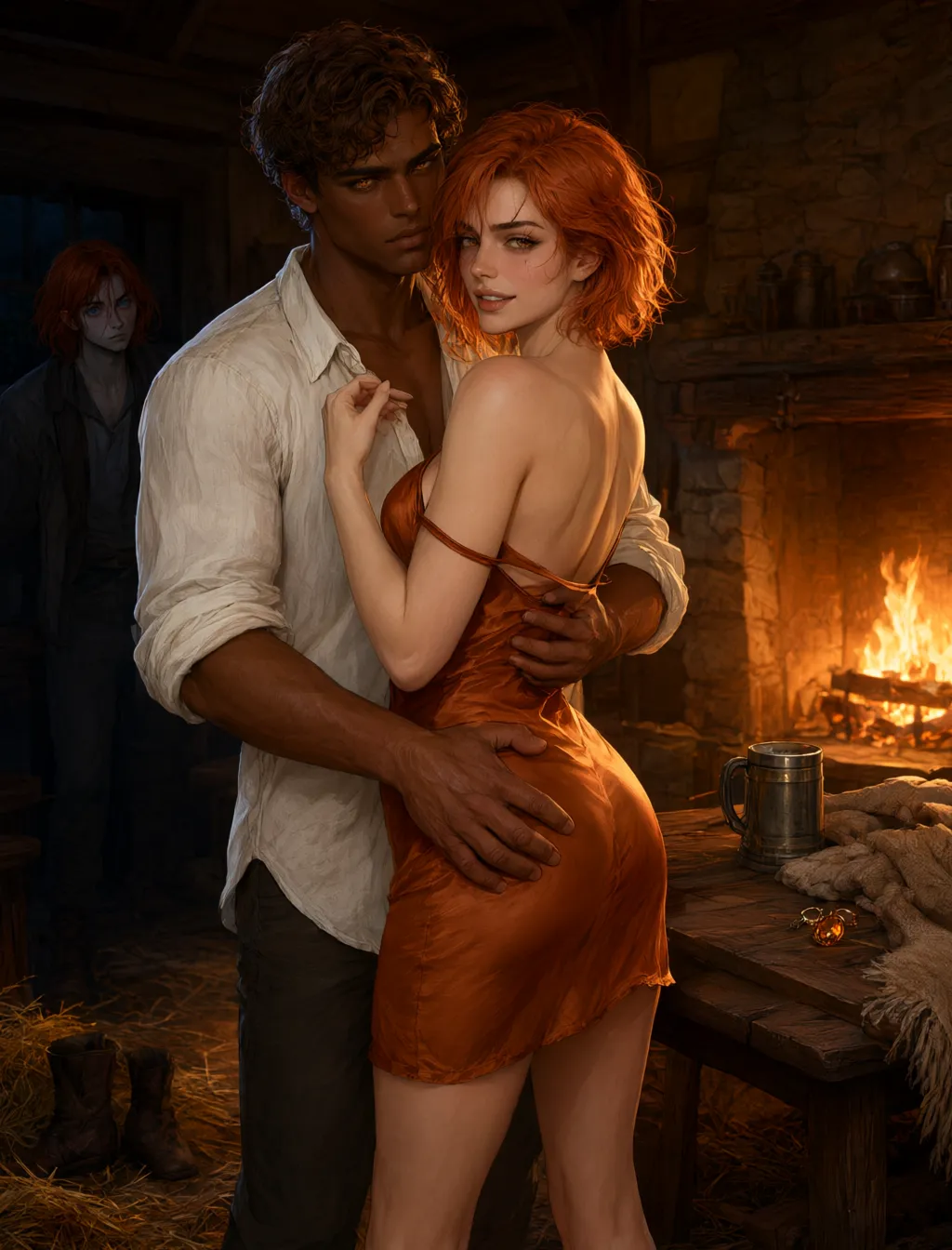
The morning came in stripes. Sun through the shutter slats laid bands of light across the floorboards, across the foot of the cot, across the amber fabric where it hung from the back of the chair Evals had dragged in from the common room the night before. Dust turned slow circles in the brightest band. Somewhere below, a pot clattered and the innkeeper's voice rose and fell — the same shape of sound every morning since the healer had gone, and Evals had begun to trust it the way a man trusts a fence line he's walked a hundred times.
He stood with his back to the door, the pack strap in his hand. He had not meant to pick it up. It had been on the floor by his boot, and his hand had found it the way his hand found things now — without asking him first. The leather was worn smooth where his thumb sat. He tightened his grip until the strap creased, then loosened it, then tightened it again.
Mika turned from the window. She had been standing at the shutter, one slat pushed open with two fingers, watching the road. She did that most mornings. She never said what she was looking at. Now she turned, and the light caught the dress — the amber gone gold where the sun found it, dark as honey in the folds — and her hands came together at her waist, fingers laced, the way she stood when she was about to ask for something she wasn't sure she was allowed.
"Husband," she said.
The word landed in him the way it always did. Low, and warm, and slightly wrong, like a coat that fit in the shoulders and hung loose everywhere else. He had stopped flinching at it. That was the thing he noticed about himself now — that he had stopped flinching. He answered to it. He had begun to turn his head before she finished the second syllable.
"Tell me the story," she said. "The one about how we met."
He looked at the pack strap in his hand. He had not told her that one yet. He had told her the shape of it — the road, the cold, the two of them walking north — but not the meeting. Not the first hearth. He had been putting it off the way a man puts off a debt he knows he can pay but doesn't want to count the coin for.
"Which part of it," he said.
"The start." She crossed the room and sat on the edge of the cot, and the cot gave under her the way it gave under him, and she folded her hands in her lap and looked up at him with her whole face. "I want to know where it begins. You said you'd tell me as many times as I asked."
"I did say that."
"You did."
He set the pack down. Not because he was staying — the pack was packed, it had been packed since before dawn, and she knew it, and he knew she knew it — but because he couldn't tell her a story with the strap cutting into his palm. He set it against the wall, by the door, where he could see it. Then he sat down on the floor with his back to the wall, because the room had one chair and the chair had her dress on it, and because sitting on the floor put his eyes below hers, and he found he wanted that. He wanted to be looking up when he did this.
"It was a work field," he said.
And then he stopped, because the lie had to start somewhere, and every place he started it, he could feel the true version standing behind it, waiting to be noticed. The true version was a road. The true version was two men who had been bought and sold and had learned each other's silences before they learned each other's names, and there had never been a work field, and there had never been a fence. He closed his eyes for a moment. He built the field.
"South of here," he said. "A long way south. Flat country, mostly. You could see weather coming a day out."
"What kind of work?"
"Fence work. Posts and rails. The kind that has to be mended every spring because the frost heaves it up." He opened his eyes. She was watching him the way she watched everything — steadily, without hurry, as if there were all the time in the world and she had decided to spend it here. "I was mending a gate. The hinge had pulled loose from the post and I was working it back in with a hand drill, and I had my shoulder against the gate to hold it up, so I couldn't reach the pin."
"And I came along," she said.
"You came along the fence line." He looked at the dust turning in the light. "You had a bucket. You'd been carrying water to the far field, and you set the bucket down and you watched me for a while before you said anything."
"Did I say something?"
"You said, 'You want me to hold that?'"
She laughed. It was a small laugh, mostly breath, and it moved her shoulders, and the amber fabric moved with her. "That sounds like me."
"It does."
"And you said yes."
"I said yes." He could see it now, the way you see a thing you've built out of nothing — the gate, the drill, the pale dust on his knuckles. "You put your hands on the gate and held it, and I set the pin, and you didn't let go until I told you it was in. Most people let go too early. They get nervous about being in the way."
"I'm not most people."
"No," he said. "You're not."
The room went quiet. Below, the pot clattered again, and someone laughed at something, and the sound came up through the floorboards and was gone. Mika's hands were still folded in her lap. She had the same stillness she'd had the first morning she woke — the stillness of a person who is listening for something they can't quite hear, and is patient about it.
"And then?" she said.
"And then we worked the same fence line for a season." He shifted his weight against the wall and the floorboard under him creaked, and he pressed his palm flat on the boards to stop it, though there was no one below to disturb. "It's slow work. You learn a person in slow work. You learn how they hold a tool, and when they stop to rest, and whether they put the cap back on the water jug or leave it off like a fool."
"Did I put the cap back?"
"Never once."
"Liar."
"I'm telling you the truth," he said, and the words sat in his mouth like a stone, and he made himself swallow them. "You never put the cap back. I drank warm water all summer because of you."
She smiled at that, and looked down at her hands, and turned her wedding band — there was no wedding band, there had never been a wedding band, and he had not thought of that until this moment, and now the absence of it sat in the room like a third person. He looked at the shelf. The healer's salve was there. The folded cloth. The empty bowl from breakfast. No ring. Nothing that a wife would wear.
He heard his own voice go on without him.
"There was a night," he said. "After the fence was done. They'd put up a moon that was bigger than it had any right to be, and we sat out on the rail of the far gate because neither of us wanted to go in, and we didn't say much."
"What did we say?"
"Nothing worth repeating." He looked up at her. "But you put your hand out over the rail, and I put mine over yours, and that was the first time."
She was quiet for a moment. Then she said, "That's not the whole story."
He felt it — the small cold drop in his chest, the one that came when the lie ran thin under his feet. "It's the start of it."
"It's the start of the fence," she said. "It's not the start of us. A hand over a rail isn't the choosing. There has to be a moment where one of us decided." She leaned forward, elbows on her knees, and her voice was gentle and it did not let him off anything. "You said there was a day you chose me. You said it in the market. You said, 'You spilled stew on your shirt, all elbow and apology, and I chose you there.'"
He had said that. In the market, with the mirror, with the amber dress on her, he had said it, because it had been true in the only way that mattered — because there had been a moment, a real one, on a real road, when he had looked at the man beside him and understood that he had stopped being able to imagine the road without him. He had told her the shape of the truth and dressed it in a shirt and a bowl of stew, and now she was holding it up to the light and asking him to finish it.
"All right," he said. "Stew."
"Stew."
"It was a common house. One long table, benches on both sides, a fire at the end that smoked if the wind was wrong." He could see it. He had seen a hundred rooms like it. He built this one out of the last one he'd actually sat in, and it fit well enough. "You came in with your bowl and you sat down across from me and you didn't look at where you were sitting, and your elbow went into the bowl, and the bowl went over."
"Onto my shirt."
"Onto your shirt. All down the front of it." He looked at her. "And you didn't swear. You just sat there with your hands in the air like a man who'd been arrested, and you said, 'Well. That's the shirt, then.'"
She laughed again — the real one this time, the one that came up from her chest and shook the cot, and she put her hand over her mouth and then took it away because there was no one to hide it from. "That's — that's exactly what I'd say."
"I know."
"And you chose me there."
"I chose you there." He said it slowly, and he made himself mean it, and he did mean it — that was the part that frightened him. He meant every word of it. He had chosen the man across the table with the stew on his shirt, and he had chosen him again on the road, and he had chosen him in the dark before the club came down. He was choosing him now, in a room with a shuttered window and a dress on a chair, and the choosing had not changed. Only the story around it had.
Mika sat back. The cot creaked. She was looking at him with her head slightly tilted, and there was something in her face that he could not read, and he had gotten very good at reading her face — he had spent every hour of the last three days learning it, because it was the only map he had of what she remembered and what she didn't.
"And what came then?" she said.
He looked past her.
The shutter was open two fingers' width, and through the gap he could see the road — the border road, running north between the low stone walls, and past the walls the country climbing toward the Dog Territory line, the hills going green and then grey and then blue with distance. A cart was on the road. A dog-keidran woman with a yoke across her shoulders was walking the other way. The road did not care that they were in this room. The road went where it went.
"Then," he said, and stopped.
She waited. She was good at waiting. She had the patience of a person who had woken up with nothing and had decided to be calm about it, and he was beginning to understand that this patience was not the same as trust — that she was giving him room the way you give room to a man carrying something heavy, because you can see that he's carrying it and you don't want to be in his way.
"Then we walked," he said. "We walked north. There was a winter in it. There was a river we couldn't cross where we wanted to and had to go around, and that cost us three days, and you were angry about it for two of them."
"Was I?"
"You were. You didn't say anything. You just walked faster than me for two days, which is how you get angry."
She smiled. "And on the third day?"
"On the third day you waited for me at the top of a hill." He looked at the light on the floorboards. "You didn't say you were sorry. You just waited. And I caught up, and we went on."
The silence came back. It was warm now, the way the outline had promised it would be warm — the room had heated with the morning, and the sun had moved down the wall, and the dust was gone from the air, and the two of them sat in the gold of it and the story sat between them like something that had been in the room all along. He could feel it settling. He could feel her taking it in and putting it somewhere, filing it, making it hers.
And behind her eyes — he saw it, because he was watching for it, because he had been watching for it since the first morning — something moved. Not doubt. Not quite. A door closing softly on a room she had not known was there. The lie had gone in. It had found a place to sit. It would be harder now to take it back out.
He looked at his hands. They were flat on his knees. There was a callus at the base of his right thumb from the cudgel, and he turned his hand over and looked at it, and he thought about how he had made this. Not the callus — the room, the story, the wife, the dress on the chair. All of it. He had made it out of nothing because a man he loved had woken up not knowing who he was, and Evals had looked at him and had not been able to say the true thing, and so he had said the false thing, and the false thing had worked.
It had worked. That was the part he could not get past. She was happy. She was sitting on a cot in a village inn with the sun on her and a story in her hands and she was happy, and he had made that, and the making of it had cost him nothing he could point to and everything he could feel.
"Husband," she said.
He looked up.
"You stopped."
"I was thinking."
"About what?"
He could have said the truth. The thought arrived the way it always did, quietly, without drama, the way a man notices a door he left unlocked. He could have said: I was thinking that I have never told you a single true thing about where we came from, and that you have believed every word, and that I do not know how to stop.
What he said was, "About the road. It's a day to the border. If we leave after noon, we make the line by dark."
She nodded. She did not press him. She stood up from the cot and crossed to the chair and took the dress by the shoulders — carefully, the way she handled everything, as if the world were made of things that could be torn — and she shook it out and laid it over the back of the chair again, smoothing the folds with the flat of her hand. Then she went to the window and pushed the shutter open another finger's width, and the light came in stronger, and she stood in it with her back to him and looked out at the road.
"It's a good story," she said.
"It is."
"You tell it well."
"I've had practice."
She was quiet. The cart on the road creaked past and was gone. He watched her shoulders, the line of them under the amber fabric, the way she stood with her weight on one hip the way she had always stood — the way he had always stood, before, on the road, when he was still a man and still called Mike, and Evals had never told him that he stood that way, and now he was watching a woman stand that way in a dress he had bought, and the two things would not fit together in his head no matter how he turned them.
"Evals," she said.
"Yes."
"The story has a hole in it."
He went still.
"Not a bad one," she said, and turned, and she was smiling, and the smile was patient and it was kind and it was waiting. "You told me the field, and the fence, and the stew. But you skipped the part where I knew. Where I looked at you and knew you were the one." She folded her arms. "You said I was your soulmate. You said we were made for each other. So there must have been a moment when I knew it. Where is that moment?"
He looked at her.
He looked past her, at the road through the shutter, at the border hills going blue with distance, at the day they had to walk and the line they had to cross and the life he had promised her out of thin air. The next thing he said would go into her and stay there. He could feel it waiting in his mouth, the next room of the house he was building, and he knew that once he said it she would move into it and make it hers and he would have to build the room after that, and the room after that, all the way to the end of the road.
He took a breath. Held it. Let it go.
"It was the night after the stew," he said.
Mika's smile widened, just slightly, the way a person's does when they have been given the thing they asked for and are already reaching for the next.
"Tell me," she said.
He had not planned the words. That was the truth of it — he had planned everything else, the field and the fence and the stew and the hill, built them out of the last room he had actually sat in and the last road he had actually walked, but this one he had not planned, and he heard it come out of him the way he heard the far gate creak in the wind: something he had already set in motion and could not now recall.
"You knew first," he said.
Mika's hands, folded in her lap, went still. Not tense — still, the way a bird goes still on a rail when it has decided you are not a threat and has not yet decided whether you are worth the trouble of leaving over. She was watching him with her whole face, the way she did, and the light through the shutter caught the edge of her jaw and the dark under her eyes and the faint pale line of the scar through her eyebrow, which he had told her came from a spill down a riverbank when they were young, which was a lie, which was the newest lie, and he had not even noticed himself telling it until the words were already out and she had already touched the scar with two fingers and said, I don't remember the river.
"I knew first," she repeated.
"Yes."
"When?"
He looked at the wall behind her, where the sun had moved down past the peg and the peg's shadow had gone soft and short against the boards. He had a small window here — the width of a breath, the length of a pause — and he used it. He thought about the true answer. The true answer was a road in the cold, and a night when the man beside him had stopped walking and said nothing and Evals had understood, without being told, that he was being asked a question, and had not answered it, because he had been afraid. The true answer was a hand on his wrist, and it had not been his hand. The true answer was that Mika was right, that the choosing had been hers, that it had always been hers, that he had spent years being chosen by someone who never once said so out loud, and that he had spent those same years pretending not to notice.
He could not say any of that. He could only say the shape of it.
"It was a fire," he said.
"A fire."
"A camp. After the stew — a while after. We were traveling and we'd stopped for the night, and there was a fire, and I was — I'd been quiet. I get quiet. You know that about me now."
"You do." She said it without emphasis, the way she said true things, and it landed anyway. He had not told her that. He had not told her anything true. She had learned it from three days of watching him, and she had filed it away with everything else she had learned from watching him, and somewhere in the file there was a version of him that was accurate, and he did not know how to feel about being known by someone who had been told nothing.
"I was sitting with my back to the fire," he said, "because it was too hot on my face. And you came around the other side of it and you stood there for a while. I could see your feet. I didn't look up."
"Why not?"
"Because I knew if I looked up you'd say something, and I didn't want to hear it."
Mika tilted her head. The tilt was small and precise, and it was the same tilt she had given the seamstress in the market when the seamstress had held up the second dress, the grey one, and Mika had looked at it and then at the amber one and had not needed to say a word. She had a way of asking a question with the angle of her skull. He had learned it in three days. He had spent thirty years not learning anything about this man and had learned his whole face in three days, and he did not know what to do with that, and so he did what he always did, and went on.
"You sat down next to me," he said. "Not across. Next to. Close enough that our shoulders were touching, and I could feel you deciding whether to say the thing, and I could feel you deciding not to, and then you said it anyway."
"What did I say?"
"You said my name."
The room was very quiet. Below, the innkeeper had stopped moving pots; the common room had gone to the flat middle of the morning, when everyone is out and no one has come back yet. The cart on the road had long since passed. The dust had settled out of the light and the light had gone thin and white and lay across the floorboards like a plank, and Mika sat in the middle of it with her hands in her lap and her eyes on him and did not move.
"Just my name," he said. "That was all. You said it like a question. Like you were checking whether I was still there."
"And you were."
"I was." He looked at his hands. "I turned my head. That was the first time I looked at you, and I mean — the first time. I'd been looking at you for a season by then, at the fence and on the road and across the table, but I hadn't looked. And I looked, and you were right there, close enough that I could see the fire moving in your eyes, and you didn't say anything else. You just — you put your hand out."
He stopped.
His own hand had moved. He had not told it to. It was out in front of him, palm up, at the height of a hand resting on a knee, and it was held there in the air between them as if it were waiting for something, and he looked at it and understood that he had been about to show her, and that he could not show her, because the hand was a man's hand and the hand he was describing had been a man's hand and the whole room would come down if he let his own hand finish the gesture.
He lowered it. Put it flat on his knee. Pressed until the knuckles went pale.
Mika had watched all of it. She had not moved. Her eyes had followed his hand out and down and back, and now they came up to his face, and there was something in them that he had not seen before — not the patience, not the waiting. Something narrower. Something that had caught the tail of a thing and was holding on to it.
"You put your hand out," she said slowly. "And I took it."
"No," he said. "You did."
She blinked.
"You reached for me," he said, and the words came out low and even, and he heard himself making them true as he said them, because they were true, and because the true version and the false version had the same bones and he could dress the bones however he liked. "You reached across and you put your hand on my wrist. Right here." He touched the inside of his own wrist, below the heel of the hand, where the skin was thin and the pulse sat close. "And you held it. You didn't say anything. You just held it, and you waited, and you looked at me like you already knew what I was going to say, and you wanted to hear me say it anyway."
"What did you say?"
He looked at her.
He looked at her, and the room was gold and white and quiet, and the dress hung over the chair behind her with its folds smoothed flat, and her hands were folded in her lap and her face was open, and she was asking him — with her whole face, with the tilt of her skull, with the patience she had woken up wearing — to tell her that she had chosen him. That it had been her. That the reaching had been hers, first, before he ever reached back.
And he understood, in that moment, what he was being asked to give her. Not the story. The story was nothing, the field and the fence and the stew were nothing, he could build rooms forever. This was something else. She had woken up in a strange body in a strange room next to a man who claimed her, and she had believed him, and she had worn his dress and called him husband, and underneath all of it — he could see it now, plain as the light on the floor — she had been carrying the small cold weight of being the one who was told. Of being handed a life. Of having nothing of her own to hold up and say, this, I made this, this is mine.
And he could give her one thing. He could give her the first move. He could put the choosing in her hand and let it be hers, and it would be true in the only way that mattered to her, and it would be a lie in the only way that mattered to him, and there was no version of this where both of those were not the same sentence.
"I said your name," he said.
"My name."
"Mika." He said it slowly. He had said it a hundred times in three days, to the healer and the seamstress and the innkeeper and the empty room at night, and it had never cost him anything, and now it cost him something and he did not know what. "I said it back to you. That was all. You had your hand on my wrist and I said your name, and that was the whole of it. That was the choosing."
She was quiet for a long moment.
Then her eyes changed.
He saw it happen. He was watching for it, the way he watched for everything now, and he saw it — the shine coming up along the lower lid, the way water comes up through sand, slow and from underneath. Her mouth did not move. Her hands did not move. But her eyes filled, and the light in them bent, and she sat very still in the middle of the white plank of sun and looked at him and did not wipe them, and did not look away, and did not seem to know that she was crying at all.
"I chose you," she said.
"You did."
"I reached for you first."
"You did."
She nodded, once, and the nod moved the tears, and one of them went down the side of her nose and stopped at the corner of her mouth and stayed there, and she did not wipe it. She was still looking at him. She had the same face she'd had in the market with the mirror, the same face she'd had the first morning when she'd woken and called him husband and he had answered and the answering had made it real — the face of a person who has just been given something and is still deciding whether it can be kept.
Then she moved.
She came off the cot, and the cot creaked behind her, and she crossed the two steps of floor between them, and she knelt down in front of him — not beside, in front, so that her face was level with his, so that he had to look at her and had nowhere else to look — and she reached out and took his hand.
It was the first time.
He had held her hand in the market. He had walked her through the village with her hand in his, and it had been a thing he did, a thing a husband did, and he had done it the way he did everything now, from the outside, watching his own body perform the part. This was not that. This was her hand closing around his, her fingers fitting between his fingers, the flat of her palm against the flat of his, and it was warm and it was dry and it was the same hand — the callus at the base of the thumb, the knuckle that had gone thick somewhere in the years he had never asked about, the small scar on the second finger that he had never asked about either — and it was a different hand entirely, and he could not make the two facts sit in the same room.
He looked at their hands. He could not look at her face. Not yet.
"That's the moment," she said. Her voice was low and it was even and it was a little wet at the edges, and she did not try to hide that either. "That's where it starts. Not the field. Not the stew. That."
"That's where it starts," he said.
"You should have told me sooner."
"I know."
She was quiet. She had not let go of his hand. Her thumb had found the inside of his wrist — the thin skin, where the pulse sat close — and she was not moving it, only resting it there, and he could feel his own heart going under her thumb, and he could feel her feeling it, and the room was so quiet that he could hear the innkeeper's broom on the floor below, one stroke, another stroke, the slow patient sound of a woman sweeping a room that would only need sweeping again tomorrow.
"Husband," Mika said.
He looked up.
Her face was close. Close enough that he could see the fire had gone out of her eyes a long time ago and there was only the morning in them now, and the tears on her cheeks, and the small steady line of her mouth, and the scar through her eyebrow, which was his scar, which he had put there, which he had told her came from a riverbank.
"I remember it now," she said. "The fire. The wrist. I remember saying your name."
He opened his mouth.
He did not know what he was going to say. He did not know if it would be a lie or the truth or the third thing, the one that was neither, the one he had been speaking for three days without knowing its name. Below, the broom stopped. The room held its breath. And Mika's hand stayed closed around his, warm and dry and steady, and she waited for him to answer her the way she had waited for everything — with her whole face, patient, certain, and utterly unaware that she had just told him the one thing he could not survive hearing: that she remembered a moment that had never happened, in a voice that had never been hers, on a night she had spent as a man.
He looked at their hands.
He did not let go.