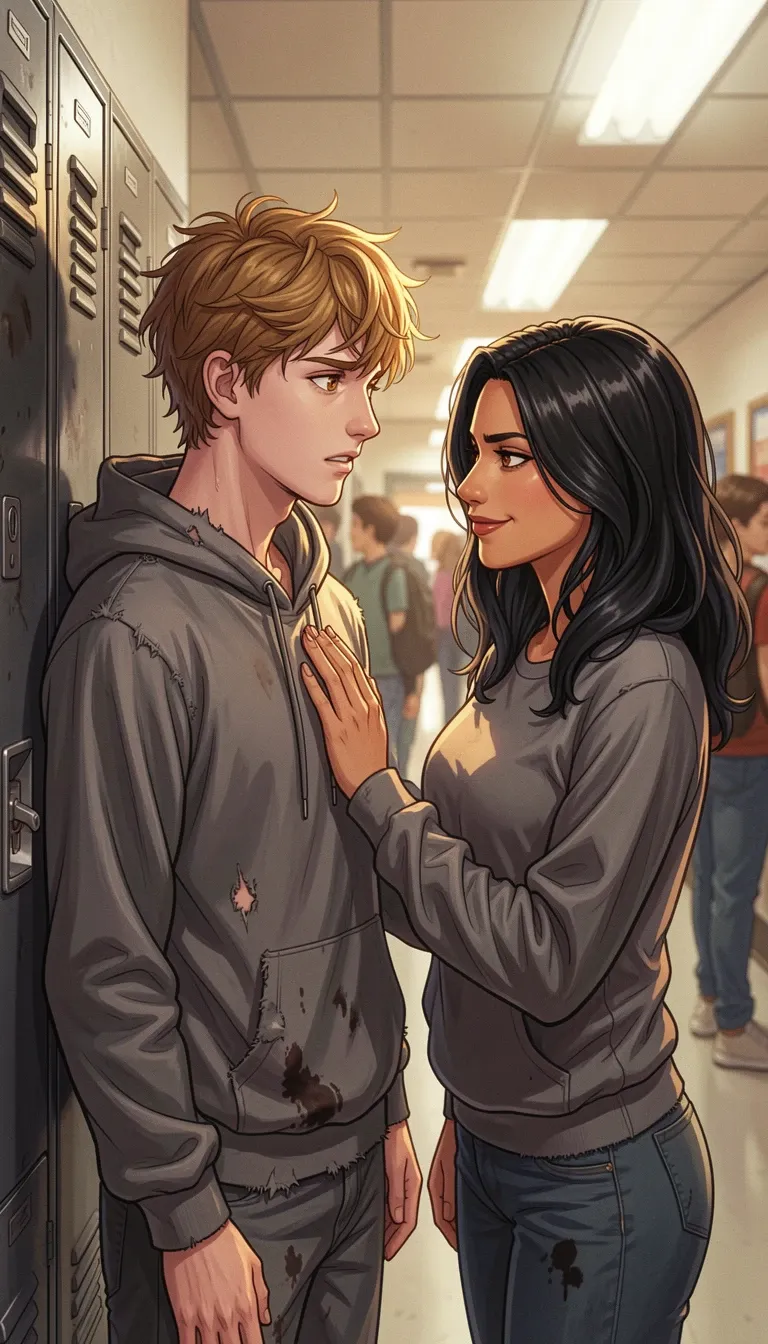
Her hand stays on my shoulder. Warm. Grounding. The gravel crunches under my sneakers as she tugs me forward, and my legs move before my brain catches up, stumbling after her like a puppet with cut strings.
The path behind the bleachers is narrow, overgrown with weeds that brush against my jeans. I can feel everything — the damp heaviness in my pants, the way the fabric clings to my skin, the smell that follows me like a shadow. I want to disappear. I want the earth to open up and swallow me whole.
She doesn't let go.
"Almost there," she says, her voice low, like she's talking to a spooked animal. "Just a little further."
I don't ask where. I don't ask anything. My throat is closed, my teeth clamped together so tight my jaw aches. If I open my mouth, I'll say something stupid. Or worse — I'll cry.
The bleachers loom above us, rusted metal and peeling paint, casting a long shadow across the cracked asphalt. There's a space underneath, where the ground dips and the weeds grow thick, hidden from the parking lot and the main path. She leads me there, ducking under the low-hanging crossbeam, and I follow because I don't know what else to do.
She stops. Turns. Looks at me.
We're standing in the shadow now, the afternoon light filtered through the gaps in the bleachers above, stripes of gold across her face. Her hand drops from my shoulder, and I feel the absence like a physical thing — cold, empty, wrong.
"Okay," she says, soft. "Okay. You're okay."
I shake my head. I can't help it. The motion is small, barely there, but she sees it. She sees everything.
"I'm not," I manage, and my voice cracks on the second word. "I'm really, really not."
She doesn't argue. She just nods, her dark eyes steady on mine, and waits.
The silence stretches. Somewhere above us, a bird calls, sharp and lonely. The wind rustles through the weeds, carrying the sour smell of old beer and dust. And underneath it all, the smell of me — earthy, heavy, wrong. I can't escape it. I can't hide from it. She's standing right here, breathing it in, and she's not running.
"I don't know what to do," I whisper. "I don't know how to fix this."
She tilts her head, studying me. "Who said you have to fix anything?"
"I—" I stop. Swallow. My hands are shaking, so I shove them into my hoodie pockets. "I can't just stand here. I can't go back out there. I can't—"
"Breathe," she says, and it's not a suggestion. It's a command, quiet but firm. "Just breathe, Shawn."
I try. I really try. But the air tastes like shame and the smell is everywhere and her eyes are on me and I can't—
She steps closer.
One step. Small. Careful. Like she's approaching something fragile. Her hand comes up again, but this time she doesn't touch my shoulder. She reaches for my hand, pulling it out of my pocket, and wraps her fingers around mine.
Her palm is warm. Dry. Steady.
"With me," she says. "In through your nose. Hold it. Out through your mouth."
She demonstrates. I watch her chest rise, pause, fall. And I follow, because I don't know what else to do, because she's holding my hand and looking at me like I'm not a monster, like I'm just a person who made a mistake.
In. Hold. Out.
My shoulders loosen a fraction. My jaw unclenches. The world stops spinning quite so fast.
"Good," she says. "Again."
We breathe together, standing in the shadow of the bleachers, her hand around mine, the smell thick between us. It takes three rounds before I feel like I can speak without my voice breaking.
"You don't have to do this," I say. "You don't have to—"
"I know." She squeezes my hand once, firm. "I'm not doing anything I don't want to do."
I look at her. Really look. Her dark hair is tucked behind her ears, a few strands loose against her cheek. There's a smudge of dirt on her forearm from the gravel. Her eyes are steady, patient, unreadable in the striped light.
"Why?" The word comes out before I can stop it. "Why are you being so—" I gesture vaguely with my free hand, unable to find the word. "Nice. Why are you being so nice to me?"
She considers the question. Her thumb traces a slow circle on the back of my hand, absent, thoughtful.
"Because you looked at me like you expected me to hurt you," she says finally. "And I didn't want to prove you right."
I don't know what to say to that. I don't know what to do with the tenderness in her voice, the way she's holding my hand like it's something precious instead of something that's been inside my own filth.
"I'm sorry," I whisper. "I'm sorry you have to smell this. I'm sorry you have to see me like this. I'm sorry for—"
"Stop." She says it gently, but it stops me cold. "You don't have to apologize for being human."
"This isn't—" I laugh, a broken sound that's half a sob. "This isn't normal. People don't just—"
"People have bodies, Shawn." Her voice is quiet, but there's steel underneath it. "Bodies do things. Sometimes embarrassing things. Sometimes messy things. That doesn't make you broken."
I shake my head, but I don't pull my hand away. "You don't get it."
"Then explain it to me."
I look at her. She's serious. She's standing here, in the shadow of the bleachers, holding my hand, asking me to explain the worst moment of my life like it's a story she wants to understand.
"I can't," I say. "I can't even think about it without wanting to die."
"Okay," she says, and she doesn't push. "Then don't think about it. Just stand here with me for a minute."
So I do. I stand there, in the shadow, her hand warm in mine, the weight in my pants heavy and wet against my skin. The smell is still there — I can't escape it — but it feels less like a scream now and more like a fact. An ugly fact, but a fact nonetheless.
She's still holding my hand.
I don't deserve this. I don't deserve the patience in her eyes, the steadiness of her grip, the way she's creating a little pocket of safety in the middle of my worst nightmare.
But I'm too tired to argue. Too grateful to push her away.
"I don't know how to go home," I say after a long silence. "I can't walk through campus like this. I can't get on the bus. I can't—" I stop, my throat tight. "I don't know what to do."
She nods slowly, processing. "You live off-campus, right? The apartments near the grove?"
"Yeah."
"How far?"
"About a mile. Maybe a little more."
She's quiet for a moment, her thumb still moving on my hand. Then she says, "I have my car. It's parked in the lot by the music building."
I shake my head immediately. "I can't get in your car. I'll ruin your seat. I'll ruin—"
"I have a blanket in the trunk," she cuts me off. "I'll lay it down. You won't ruin anything."
"Maya—"
"Shawn." She says my name like it matters. "Let me help you."
I look at her, and I feel the tears coming. I try to blink them back, but one escapes, hot and traitorous, tracing a path down my cheek. She sees it. Of course she sees it. But she doesn't mention it, doesn't make it awkward. She just squeezes my hand again.
"Okay," I whisper. "Okay."
She nods once, decisive. "We'll take the path behind the art building. It's longer, but there's less foot traffic. No one will see us."
I should argue. I should tell her she doesn't have to do this, that I'm not worth the effort, that she should just leave me here to figure it out on my own.
But I don't.
Because she's still holding my hand. Because she looked at me in my worst moment and didn't flinch. Because for the first time since I felt that terrible pressure in my gut, I don't feel completely alone.
"Thank you," I say, and the words are small, but they're real.
She smiles. Just a small one, barely a curve at the corner of her mouth. "Don't thank me yet. We still have to get you to the car."
She lets go of my hand, and I feel the loss again, sharp and cold. But she doesn't step away. She just turns, peeking around the edge of the bleachers, checking the path.
"Coast is clear," she says. "You ready?"
I take a breath. The smell hits me again, but I don't flinch. Not this time.
"No," I admit. "But I don't think I'm gonna get any more ready by waiting."
She huffs a quiet laugh. "Fair enough."
She steps out from under the bleachers, and I follow. The sunlight hits me, warm and bright, and for a moment I feel exposed, vulnerable, like everyone can see the stain spreading down my pants, smell the mess I made.
But there's no one here. Just her. Just me. Just the path stretching ahead, shadowed and quiet.
She starts walking, and I fall into step beside her. She doesn't reach for my hand again, but she stays close, close enough that our shoulders brush when we take a tight corner. Close enough that I know she's there.
We walk in silence for a while. The path curves behind the art building, past the dumpsters and the loading dock, through a patch of overgrown grass that leads to the faculty parking lot. She veers left, toward a row of cars near the edge.
Her car is a small white sedan, a little beat-up, with a sticker on the back bumper that says "I'd rather be reading." She unlocks it, pops the trunk, and pulls out a folded blanket — old, soft, faded blue.
She spreads it across the passenger seat without a word, smoothing out the wrinkles, making sure it covers everything.
Then she straightens and looks at me.
"Get in."
I stand there, frozen, staring at the blanket on the seat. It's such a small thing. Such a simple kindness. And it breaks something open in my chest that I didn't know was closed.
"Maya, I—" My voice cracks. I stop, swallow, start again. "I don't know how to—"
"You don't have to know," she says. "Just get in the car. We'll figure the rest out on the way."
And for the second time today, I do what she says.
I lower myself onto the blanket, careful, afraid of the sound it might make, the smell I might leave behind. The fabric is soft beneath me, and the seat is worn and comfortable, and I sit there with my hands in my lap, feeling like a stranger in my own body.
She closes the door. Walks around. Slips into the driver's seat. The engine starts with a low rumble, and she pulls out of the parking lot without looking back.
The afternoon light streams through the windshield, warm and golden. She reaches over and turns on the air conditioning, and the cool air washes over me, carrying away some of the heat, some of the weight.
"You can put the window down if you want," she says, her eyes on the road. "I don't mind."
I shake my head. "I don't want to—" I stop. "The smell. I don't want it to—"
"Shawn." She glances at me, quick, soft. "I've been smelling it for twenty minutes. I'm not gonna pretend I haven't. Put the window down if you need air."
I hesitate. Then I reach for the crank and roll it down a few inches. The wind rushes in, fresh and clean, and I breathe it in like I've been drowning.
"Thank you," I say again, because I don't know what else to say.
She doesn't answer. She just reaches over, her hand finding mine on the center console, and squeezes once, quick, before pulling away.
It's not a fix. It's not a solution. I'm still sitting in my own mess, still wearing the evidence of my worst moment.
But I'm not alone.
And for now, that's enough.