
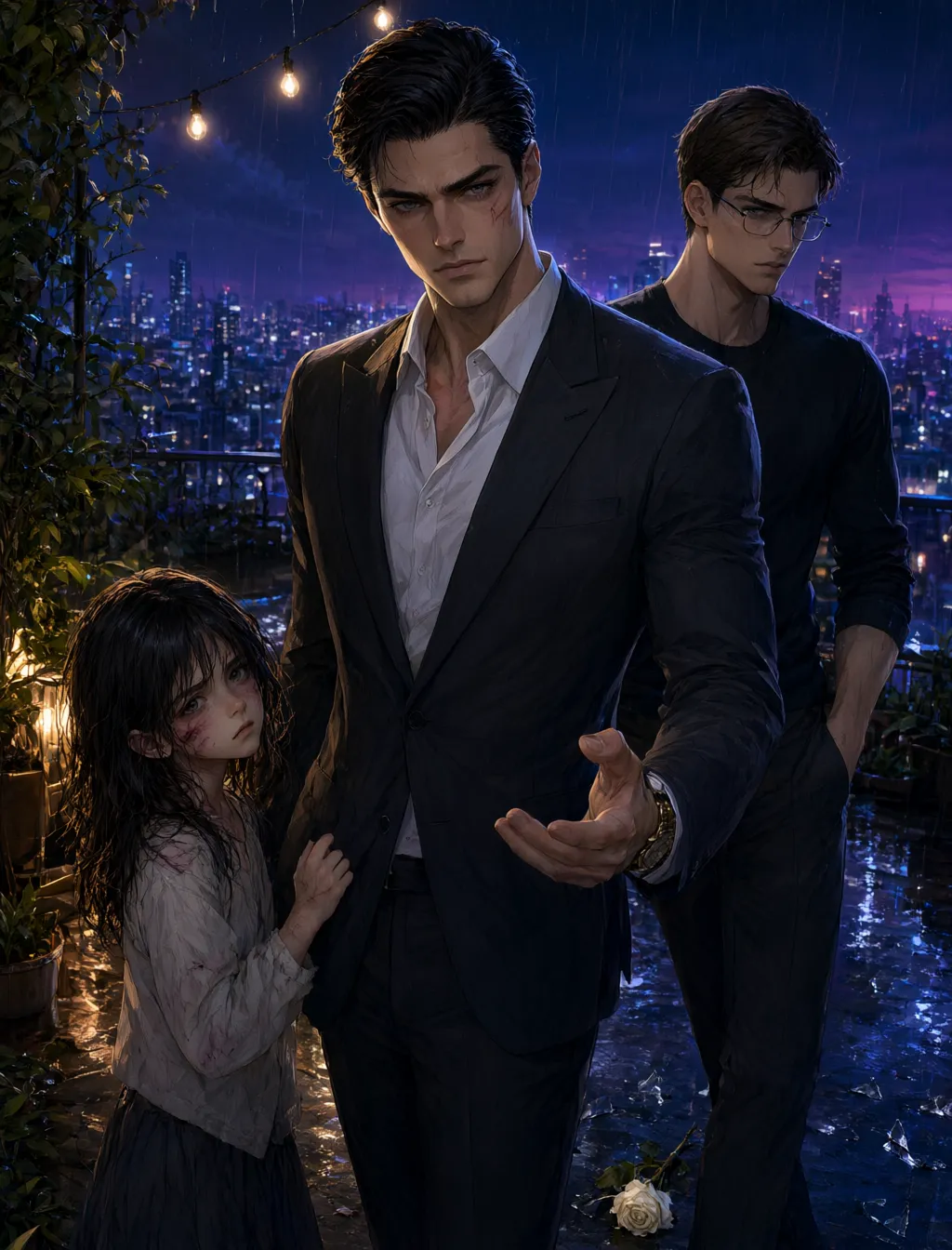
Leo stood in the doorway of Bella's room, his hand still on the frame, his breath caught somewhere in his chest. The nightlight cast its dim amber glow across the bed, and the silence pressed against him like a physical thing—not the quiet of a sleeping child, but the absolute stillness of a room that had been empty for hours.
He didn't move. Didn't speak. His gray eyes swept the room with the methodical precision of a man trained to read crime scenes, except this was his sister's bedroom, and the crime was that she was gone.
The sheets were thrown back, twisted at the foot of the mattress in a way Bella never left them. She was meticulous about her bed—he'd noticed it the first morning, the way she smoothed the blanket flat, tucked the corners sharp, a soldier's habit from a childhood that had none of the softness this room was supposed to give her. But now the pillow was dented, the duvet bunched, and the small lamp on the nightstand still burned, casting its weak pool of light across the pages of a closed book.
The Little Prince. Emerson had brought it to her, claiming it was from the house library, though Leo recognized the worn spine from their mother's shelf. The same copy Amelia had read to them as children, the one Emerson had kept in his private study for nine years, untouched, until Bella arrived.
Leo's jaw tightened. He stepped into the room, his boots silent on the carpet, and crossed to the bed. He pressed his palm flat against the mattress, feeling for warmth. Cold. The sheets had been empty for a long time—an hour, maybe more.
His hand came away, and he let it hang at his side.
The closet door stood open. He didn't need to look inside to know what he'd find: the sneakers Sorin had bought her, still lined in a neat row; the soft clothes Leo had ordered, all still hanging. She hadn't packed. Hadn't taken anything.
Except herself.
Leo turned in a slow circle, cataloguing. The window was unlatched, the screen cut from the bottom corner, a clean slit just wide enough for a nine-year-old body to slip through. The cut was neat. Deliberate. Not the work of someone fumbling in the dark, but someone who knew exactly what they were doing.
His hands were steady, but the cold in his chest was spreading, a familiar dread he'd carried for nine years. The same cold he'd felt the night their parents died, when he'd stood in the wreckage of the car and realized the baby was gone.
He'd been seventeen. Old enough to be a man, too young to know what it meant to lose a sister twice.
"Leo."
Emerson's voice came from the doorway, quiet and careful. Leo didn't turn. He was still staring at the window, at the darkness beyond the glass, the city's distant lights blurring into the black.
"She's gone," Leo said. His voice came out flat, an octave lower than usual, stripped of everything but the fact. "She's gone."
He heard Emerson's sharp inhale, the scrape of his brother's shoes on the threshold as he stepped into the room. Then the click of a phone being pulled from a pocket, Emerson's voice low and clipped as he started making calls.
Leo's fingers found the edge of the window frame. The screen was flimsy, cheap mesh meant to keep out bugs, not children. She'd cut it with something—a knife, maybe, or a piece of metal from somewhere in the house. He didn't know where she'd gotten a blade. He'd thought they'd been careful. He'd thought she was safe.
Boots thudded down the hallway, fast and heavy. Sorin burst into the doorway, his hair mussed, his eyes wide and wild in the dim light. He was wearing pajama pants and a t-shirt, no shoes, and his face was pale.
"What—" Sorin's voice cracked. He saw the empty bed, the twisted sheets, and his mouth fell open. "Where is she? Where's Bella?"
Leo didn't answer. He turned from the window and crossed to the nightstand, picking up the book. The spine was cracked, the pages soft with age. He flipped it open, scanning the first few lines—the narrator's childhood, the drawing of the boa constrictor digesting an elephant. Bella had been reading it. She'd told him the night before that she liked the little prince, liked how he kept asking questions no one else thought to ask.
He closed the book and set it back down, precisely, aligning it with the edge of the nightstand.
"She didn't take anything," Leo said. He was talking to himself, working through it the way he'd worked through a hundred hostile takeovers, a hundred threats, a hundred men who thought they could cross the Conti family and survive. "No clothes. No shoes. No food. She went out the window, and she didn't take anything."
"Maybe she didn't have time," Sorin said, his voice high and tight. "Maybe someone—"
"No." Emerson cut him off, his dark eyes fixed on Leo. He'd put his phone away, his face unreadable in the lamplight. "The cut is from the inside. She did this herself."
Sorin made a sound, something between a gasp and a sob. He pushed past Emerson into the room, his bare feet padding across the carpet as he crossed to the closet, yanking open the door as if he didn't believe Leo, as if he needed to see for himself that her clothes were still there.
They were. The sneakers. The dresses. The soft blue pajamas with the stars on them that Sorin had picked out himself.
"She ran," Sorin whispered. His hands were shaking. "She ran away. Why would she—we were—she said she loved us. She said—"
"She was scared." Tomasso's voice came from the hallway, hard and sharp. He must have run from the other end of the compound; his chest was heaving, his face flushed. He was dressed—jeans, a jacket, boots already laced—and his eyes were dark with something that looked like fury and fear all mixed together. "She's been scared since she got here. Scared of us, scared of that master of hers, scared of everything. You really thought a few pancakes and a teddy bear would fix that?"
"Tomasso," Emerson said, a warning in his voice.
"Don't 'Tomasso' me." Tomasso stepped into the room, his gaze sweeping the empty bed, the open window. His jaw was set, his hands clenched at his sides. "She's nine years old. She's been beaten, starved, trained to kill, and we thought she'd just—settle in? Like a stray cat?"
"She's not a stray cat," Sorin snapped. "She's our sister."
"Exactly." Tomasso's voice cracked, and for a second Leo saw it—the fear underneath the anger, the same fear that was eating at all of them. "She's our sister, and she's out there alone, in the middle of the night, with no shoes and no food and a man who wants her dead."
The room went silent. Leo stood by the nightstand, the weight of the book still on his fingers, and he let the silence stretch. He needed it. Needed the quiet to think, to push past the cold dread and find the clarity he was trained for—the clarity that had kept the Conti family alive through war, betrayal, and the loss of their parents.
Nine years. He'd spent nine years searching, hoping, certain that somewhere out there, his baby sister was alive. And now she was alive, and she was here, and she had run.
She hadn't run to Master. Leo was certain of that. If she'd wanted to go back to the man who raised her, she would have taken the folder, the photos, the evidence. She would have gone to the drop spot, left a marker, done what she'd been trained to do. Instead, she'd cut through a screen and slipped into the night, alone, with nothing.
She was running from something. Or running to something. Or maybe she didn't know the difference anymore.
Leo pulled out his phone. The screen lit up his face, the glow sharp against the darkness. He scrolled through his contacts, found the group—the five cousins, the men he trusted with his life and his family's safety—and pressed call.
The line rang once. Twice. Three times.
"Leo." Matteo's voice, rough with sleep. "What's wrong?"
"She's gone," Leo said. The words were easier the second time, flatter, stripped of everything but command. "Bella. She slipped out through her window sometime in the last few hours. I need every man we have on the streets. I need the city searched—every block, every alley, every doorway."
There was a pause. Then Matteo's voice, sharp and clear, the sleep burned out of it: "On it. I'll call the others."
Leo ended the call and dialed the next cousin. And the next. His commands were short, absolute, the same voice he used in boardrooms and war rooms, the voice that made men straighten their spines and reach for their guns. He didn't have to raise it. He didn't have to shout. The cold in his chest had spread to his voice, and it was enough.
"I want the perimeter swept. Every street within a mile of the compound. Check the bus stations, the train stations, the shelters. If anyone sees a nine-year-old girl with dark hair and bruises, I want to know before they finish their sentence."
He hung up. Pocketed the phone. Turned to face his brothers.
Emerson was standing by the door, his arms crossed, his dark eyes unreadable. Sorin had sunk onto the edge of the bed, his head in his hands, his shoulders shaking. Tomasso stood by the window, staring out at the dark, his fists still clenched.
Leo crossed to the closet and pulled out his coat—a long black wool one, the one he wore when he needed to disappear into the city. He shrugged it on, checking the weight of the gun at his hip, the knife in his boot. Old habits. The habits that had kept him alive for twenty-six years.
"What's the plan?" Tomasso asked. His voice was steady now, the anger banked. He was ready to move.
"We find her," Leo said. He pulled open the door, the hallway beyond dark and cold. "We find her before he does."
"You think he's out there?" Sorin asked, lifting his head. His eyes were red-rimmed, but there was steel in his voice now, the same steel that had carried him through the worst moments of their lives. "You think Master—"
"I think," Leo said, "that she didn't run to him. She ran away from him. And if she's out there alone, scared, with nowhere to go, he's going to find her before we do."
The words hung in the air, heavy and cold. Leo stepped into the hallway, his boots silent on the tile, and his brothers followed—Sorin's bare feet, Tomasso's heavy tread, Emerson's quiet steps at the rear.
They moved through the compound like ghosts, past the guards who snapped to attention, past the rooms that had been filled with Bella's laughter just hours ago, past the kitchen where Sorin had made her pancakes, past the patio where she'd watched the stars and asked if she could come out whenever she wanted.
Leo's chest ached with it. The weight of nine years pressed into every step, the weight of a promise he'd made to a baby he'd never gotten to hold, the weight of a sister he'd finally found and already lost.
He pushed through the front door, and the night hit him—cold, damp, smelling of rain and exhaust and the city's endless dark. The gate was already open, guards streaming out, headlights cutting through the black as cars roared to life.
Leo stood at the edge of the compound, his breath misting in the cold, and he looked out at the city. The streets stretched away from him, a maze of alleys and doorways and shadows, each one a place a small, frightened girl could disappear.
He didn't shout. He didn't run. He just stood there, his gray eyes fixed on the dark, and let the cold settle into his bones.
She was out there. Alone. Scared. And somewhere in the city's dark arteries, a man was waiting for her.
Leo pulled out his phone, hung up, pocketed it. The room was dead silent behind him, the compound's chaos muffled by the night. He turned to Emerson, who had stepped up beside him, his dark eyes scanning the same dark streets.
"She's out there," Leo said. His voice was flat, lethal, stripped of everything but the truth. "And she didn't just run—she was taken."
The words hung in the dark, heavy as stone.
No one spoke.
He found them in the old garage—the one that had been their father's, before the war had taken everything soft from the Conti name. Five men in dark coats, gathered around a scarred wooden table that had once held their father's maps and now held five phones, five sets of keys, five cups of coffee gone cold. They looked up when Leo pushed through the door, and the room went still.
Marco was the first to move. He was the oldest of the cousins, forty if he was a day, with silver threading his black hair and a face that had been carved by grief long before it was carved by age. He crossed the garage in three strides and took Leo's shoulder in a grip that meant something.
"We heard." His voice was rough, the way it got when he'd been awake too long. "Matteo called. Said the little one slipped out."
"She didn't slip," Leo said. "She cut the screen. She knew exactly what she was doing."
Marco's jaw tightened. He'd been there, nine years ago, when they'd combed the wreckage of their parents' car. He'd been the one to hold Leo back when the boy had tried to climb into the burning metal to find his sister. He'd never stopped looking, not once, not through all the years of dead ends and false leads. Leo had seen him age twenty years in nine, and he knew it was because of Bella just as much as it was because of anything else.
"She's smart," Marco said. "Your father's daughter. That's what we always said, remember? When we found her, we'd know her because she'd be smart and fierce and she'd fight like a cornered wolf." He almost smiled. "Sounds like she did."
Leo let out a breath he hadn't known he was holding. "She fought. Dante and Marco—the guards, not you—they had to cuff her to get her inside. She broke one of them's nose."
"Good," said a voice from the table, and Leo turned.
Nico was standing now, the youngest of the cousins at twenty-two, with the kind of restless energy that had made him a terror in the ring and a better man in the field. He'd been a kid when Bella was taken—thirteen, all gangly limbs and too much anger—and he'd never quite forgiven himself for being too slow to stop it. He'd trained harder than anyone Leo knew, as if he could make up for it with his fists.
"Good," Nico repeated. "Means she's got fight left in her. Means she's not broken." He picked up his coat from the back of the chair. "Where do we start?"
Leo looked around the room. His five cousins, the men who had carried the search with him for nine years. Marco, steady as stone. Nico, all fire. There were three more—Dante's younger brother, Luca, built like a bull and twice as stubborn; Alessandro, who had been their father's right hand and had wept when they'd buried him; and Enzo, who had been a baby when the Contis fell, who had grown up on the stories of the lost little girl and had never stopped believing she'd come back.
They were all here. All watching him. All ready to move.
"I need you to understand something," Leo said, and his voice dropped into the register he used when he needed men to listen. "Bella isn't a normal nine-year-old. She's been trained to fight, to hide, to survive. She's been beaten and starved and told she's a tool that gets thrown away. She's scared of everything, and she's brave anyway." He paused, letting the weight of it settle. "She doesn't trust adults. She doesn't trust safety. She doesn't believe she deserves to be found."
Marco's eyes went dark. "Who did this to her?"
"A man she calls Master. We don't have a name yet. We have a folder, a photo, a drop spot with a ribbon marker. It's not enough." Leo's hands were steady at his sides, but his voice was tight. "What I need from you is to find her before he does. And when you find her, I need you to know how to handle her."
Nico stepped closer. "Tell us."
Leo took a breath. This was the part that hurt. Putting words to the broken pieces of his sister, handing them to other men like ammunition.
"She speaks in short sentences. She doesn't explain herself. If she's scared, she'll fight before she talks—she's got a mean right hook and she's not afraid to use it. Don't grab her from behind. Don't corner her. Give her space and let her come to you." He paused. "She likes pancakes. Sorin made them for her and she ate until Emerson told her to slow down. She likes the stars—she asked if she could watch them every night. She has a teddy bear, a big one, that she holds when she sleeps. She calls Sorin 'Sori' and Tomasso 'Tommy.' She told us she loves us." His voice cracked, just slightly, on the last word. "She'd never said that to anyone before."
The garage was silent. Leo could feel the weight of it, the way the men around him were absorbing every detail, committing it to memory like a map of a place they'd never been.
"She's nine years old," Leo said. "She's been alone her whole life. She thinks she's protecting us by running. She thinks if she goes back to him, we'll be safe." He shook his head. "She's wrong. And I need you to find her so I can tell her that."
Luca spoke for the first time, his voice a low rumble. "We'll find her, Leo. We searched nine years for a ghost. We can search one night for a girl."
"She's not a ghost," Alessandro said quietly. "She's our blood. She's been out there alone long enough."
Enzo, the youngest, had tears in his eyes. He was twenty-one, barely older than Nico, and he'd grown up on the story of the little girl who'd been taken from them. He'd asked Leo about her every birthday, every Christmas, every time he'd seen him, always the same question: Have you found her yet? And Leo had always had to say no.
"I used to dream about her," Enzo said, his voice rough. "When I was a kid. I used to dream that I found her, and she was okay, and she came home. I used to think—" He stopped, swallowed. "I used to think if I found her, everything would be okay again. Like she'd fix everything that broke when they took her."
Leo crossed to him and put a hand on his shoulder. "She's not here to fix anything. She's here to be taken care of. And that's what we're going to do."
Enzo nodded, wiping his eyes with the back of his hand. "Okay. Okay. Where do we look?"
Leo turned back to the table, spreading his hands over the scarred wood. "She's a child who's been trained to hide. She knows how to disappear. But she's also a child who's never had anything—no home, no family, no softness. She's going to go somewhere that feels safe, even if it's not. Somewhere small. Somewhere dark. Somewhere she can watch the doors."
Marco nodded slowly. "The old rail yards. The warehouses on the east side. The underpasses near the river."
"She knows the compound's perimeter," Leo said. "She walked it with Sorin. She knows where the cameras are, where the guards post. She'll stay away from those. She'll go somewhere she thinks we won't look."
"The church," Alessandro said suddenly. Everyone turned. He was staring at the table, his face unreadable. "The old Conti chapel, out on the edge of the city. Your mother used to take you there, remember? When you were little. It's abandoned now, but the doors still open. She might go there."
Leo felt something twist in his chest. The chapel. He hadn't thought of it in years. Their mother had taken them there every Sunday, had lit candles for their father, had taught them to pray in a language that felt like home. It had been the one place she'd gone alone, after the war had taken so much from them. The one place she'd seemed at peace.
"She wouldn't know about it," Leo said slowly. "She never met our mother. She never saw the chapel."
"But she might feel it," Alessandro said. "She might feel pulled there. Blood remembers, Leo. It remembers even when the mind doesn't."
Leo held his gaze for a long moment, then nodded. "It's a place to start. It's more than we had an hour ago."
He straightened, looking at the five men around the table. His cousins. His family. The men who had carried the search with him for nine years, who had never given up, who had loved Bella before they'd ever met her.
"We split into pairs," Leo said. "Marco and Nico—take the east side. The warehouses, the rail yards, the underpasses. Ask around. Someone's seen her. Someone always sees." He turned to Luca and Alessandro. "You two take the west. The shelters, the churches, the old chapels. Check the Conti chapel first—if she's anywhere, she might be there." He looked at Enzo. "You're with me. We'll take the center, the streets closest to the compound. She knows this area. She'll stay close to what she knows."
He pulled out his phone, already typing. "I'm sending you the file—her photo, her description, what she was wearing when she left. She's barefoot. She has a bandaged hand. She's small for her age, dark hair, bruises on her arms." He looked up, his gray eyes hard. "If anyone sees a girl who matches that description, I want to know before they finish their sentence."
Marco nodded. "We'll find her, Leo. We'll bring her home."
"She's not home yet," Leo said. "She's out there, alone, scared, thinking she's protecting us by running. And I need to tell her she's wrong."
He pulled on his coat, checked the weight of his gun, and moved toward the door. The night hit him again—cold, damp, smelling of rain. The city stretched out before him, a maze of alleys and shadows, each one a place a small, frightened girl could disappear.
Enzo fell into step beside him, his face set with the same determination Leo had seen in the mirror for nine years. "We're going to find her," he said. It wasn't a question.
Leo looked at him, at this young man who had grown up on the story of a lost girl, who had never stopped believing she'd come back. He thought of Bella, curled in a doorway somewhere, crying silently, convinced she was alone in the world.
"Yes," Leo said. "We are."
They moved into the night, the five cousins fanning out behind them, a net of men and purpose closing over the city's dark. And somewhere in the shadows, a nine-year-old girl with a bandaged hand and a broken heart was waiting to be found.
The cold air hit them like a wall the moment they stepped past the compound's outer gate. Leo pulled his collar up against the wind and checked his phone—still no word from Emerson, which meant the others were still asleep, still unaware that the little girl in the room down the hall had slipped through their fingers like water.
Enzo walked close beside him, shoulders squared, hands shoved deep in his pockets. He kept scanning the street ahead, the alleys, the rooftops, as if he could conjure her from the shadows by sheer will.
"She can't have gotten far," Enzo said. "She's nine. She's hurt. She's—"
"She's trained," Leo cut in. "She doesn't walk like a child. She moves like a soldier. She'll have found somewhere to hide within the first ten minutes."
Enzo's jaw tightened. "Then we look in the places soldiers hide."
Leo almost smiled. The kid had learned something in all those years of listening to the stories. "That's the idea."
They hit the first block of shops, dark and shuttered for the night. Leo pulled out the photo from his coat—the one from the folder, the one of Bella as a baby, wrapped in their mother's arms. He'd stared at it so many times over the past days that he could trace the shape of her face in his sleep. But the girl out there tonight wasn't that baby. She was older, harder, scarred by a life he couldn't imagine. He tucked the photo away and knocked on the first door.
A man in an undershirt cracked it open, squinting at them through the gap. "We're closed. Come back in the morning."
"I'm not here for coffee," Leo said, and something in his voice made the man's eyes go wide. "A girl came through here tonight. Nine years old, dark hair, barefoot. She might have asked for help, or she might have just passed by. Have you seen her?"
The man shook his head, too fast. "No. No kids. I don't—"
"Think," Leo said, and the single word hung in the air like a blade. "She's small. She's scared. She might have been crying. She might have looked like she was running from something."
The man's face changed. Something flickered in his eyes, a memory surfacing. "There was a kid. An hour ago, maybe two. I was closing up, saw a little shape huddled in the doorway of the old bakery across the street. I figured it was a stray dog at first, then I saw it move. Didn't get a good look. She took off when I opened the door."
Leo's heart slammed against his ribs. "Which direction?"
"East. Toward the rail yards." The man pointed, and Leo was already moving, Enzo at his heels.
They crossed the street at a run, the bakery's dark windows staring back at them like empty eyes. Leo crouched in the doorway where the man had seen her, his hand brushing the cold concrete. Nothing. No sign she'd ever been there. But the man had seen something, and that was more than they'd had ten minutes ago.
"She's heading for the rail yards," Leo said, pulling out his phone. He typed a quick message to Marco—*Possible sighting, moving east toward the yards. She's alone. She's scared. Close in from the north side.*
The reply came back in seconds. *On it.*
Leo pocketed the phone and looked at Enzo. "We move. Fast and quiet. She'll hear us coming if we crash through the streets like a herd."
Enzo nodded, his face set. "I'll take the left side of the tracks. You take the right. We'll meet at the old signal tower."
Leo grabbed his arm, holding him still for a moment. "If you find her, don't grab her. Don't corner her. Call me and wait. She needs to come to you, not the other way around."
"I remember," Enzo said. "You told us. Give her space."
"Give her space," Leo repeated. "And whatever you do, don't raise your voice."
They split, Enzo disappearing into the dark between the warehouses, Leo cutting across the open ground toward the tracks. The rail yards were a graveyard of rusted boxcars and abandoned machinery, the kind of place a child might think was safe because it was empty and dark and far from the eyes of the city. Leo had searched places like this a hundred times over the years, always hoping, never finding. But tonight was different. Tonight he had a name and a face and a broken little girl who thought she was protecting him by running.
He moved between the cars, his footsteps silent on the gravel, his eyes scanning every shadow, every gap. The wind whistled through the metal, carrying the smell of oil and rust and something faintly sweet, like the memory of a flower long dead. He stopped, listening. Nothing but the wind and the distant hum of the city.
Then he heard it. A sound so small he almost missed it, a breath caught and released, a scrape of bare feet on gravel. He turned toward the sound, his hand going to the gun at his hip, not to draw it but to remind himself it was there.
She was there. Curled in the gap between two boxcars, her knees drawn up to her chest, her bandaged hand pressed against her mouth to hold in the sound of her crying. She was smaller than he remembered, smaller than she'd looked even in the compound, and the sight of her there, alone in the dark, cracked something open in his chest.
He didn't move. He didn't speak. He just stood there, letting her see him, letting her decide.
Her eyes went wide when she saw him. For a moment, she looked like a cornered animal, ready to bolt. Then something in her face shifted, and the fight drained out of her.
"Leo," she said, and his name on her lips was the most broken sound he'd ever heard.
He crossed the distance slowly, his hands open at his sides, his voice low and steady. "Hey, piccola. I've been looking for you."
She didn't run. She didn't fight. She just sat there, shaking, and when he crouched down in front of her, she reached out and grabbed the edge of his coat with her good hand, holding on like he was the only solid thing left in the world.
"I'm sorry," she whispered. "I'm sorry. I didn't mean to—I just—"
"Shh." He pulled her into his arms, careful of her injuries, and she buried her face in his chest and cried the way a child should have been allowed to cry nine years ago. "You don't have to be sorry. You don't have to explain. You're safe now."
She shook against him, her small body heaving with sobs she'd probably held in for years. "He'll find me. He'll—"
"He won't," Leo said, and he meant it with every fiber of his being. "He'll never touch you again. I swear it."
He held her there in the dark, between the rusted boxcars and the cold metal, until her crying quieted to hiccups and her grip on his coat loosened. Then he lifted her gently, cradling her against his chest, and carried her out of the rail yard and back toward the compound, where the lights were on and the door was open and the brothers who loved her were waiting to prove that she was never going to be alone again.