
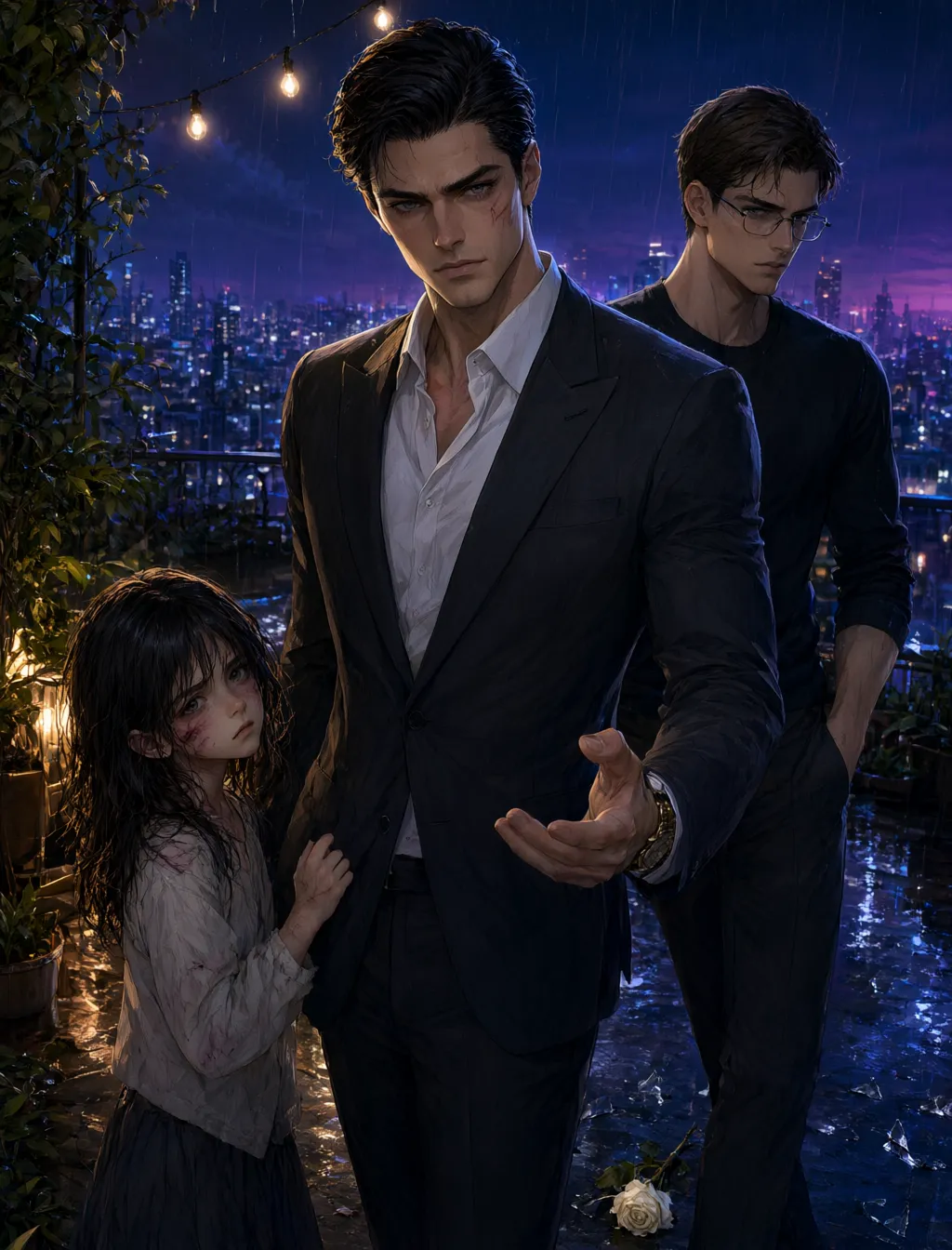
She woke to the smell of butter.
It came under the door like a hand reaching for her, warm and sweet and so thick she could taste it at the back of her throat before she even opened her eyes. Syrup. Something frying. Her stomach clenched so hard it hurt, a hollow ache that doubled her over before she could stop it.
She lay very still in the strange soft bed, the quilt pulled up to her chin, and tried to understand what her body was telling her. No pain. That was the first thing. No sting across her back where the lash marks were, no fire in her ribs, no throb in her ankle. Just the deep, bone-tired ache of sleep, and the hunger.
The hunger was familiar. The hunger was a language she knew.
She opened her eyes. Morning light fell thin through curtains she didn't recognize, pale gold across a floor of warm wood. The room was clean. Bright. A dresser with a mirror. A chair with her folded clothes on it, washed and soft. Nothing like the cell. Nothing like the room she'd been given last night, either — this was a different room, or the same room in daylight, she couldn't tell. All she knew was she was alone.
Alone, and the smell of pancakes was curling under the door.
Her stomach cramped again. She pressed a hand to it, hard, as if she could push the hunger down. She knew this trick. She knew this game. The food was a test. It had to be. She'd cried last night — real tears, in front of them, in front of the Don himself, her face pressed into his chest like a baby. She'd shown weakness. She'd let them see her break.
And now there was food, and she wasn't allowed to have it.
That was how it worked. That was how it had always worked. Master would put food on the table, hot and rich and smelling like a feast, and then he'd sit across from her and watch her stare at it, and he'd tell her why she couldn't eat. Because she'd flinched in training. Because she'd cried when the whip came down. Because she'd looked at him with something other than obedience in her eyes. And she would sit there, hands in her lap, stomach screaming, and learn.
Weakness meant starvation. Weakness meant the whip. Weakness meant watching the food go cold while her body ate itself from the inside.
She'd cried last night. She'd sobbed like a broken thing in the Don's arms, and she'd told them about Master, about the tool that gets thrown away, and she'd let them hold her. She'd let them see.
The pancakes were a punishment. They had to be.
She lay in the bed and catalogued her body, waiting for the pain to start. The whip would come later. Or the belt. Or the open hand. Or maybe just the food, the smell of it, the torture of it, all day, until she learned her lesson.
But the pain didn't come. The door didn't open. No footsteps in the hall, no raised voice, no shadow falling across the floor. Just the smell. Just the hunger.
Her stomach made a sound — a low, hollow groan that seemed to echo in the quiet room. She pressed her hand harder, but it didn't help. It never helped. The hunger was a hole in her, a pit that had been dug so deep she didn't know if food could ever fill it again. She'd gone three days without eating before she'd broken into the compound. Three days, and then the bread. That bread. The dark-haired brother had given it to her, torn and warm, and she'd eaten it so fast she'd nearly choked.
She thought about that bread now. The taste of it. The way it had felt in her mouth, solid and real, the first thing she'd eaten in days.
She thought about the pancakes under the door, and she made a decision.
It was a stupid decision. She knew it was stupid. Stealing food was a beating. Stealing food was a day without meals and a night without sleep and a lesson carved into her back. But she was so hungry. She was so hungry she could feel it in her teeth, a hollow ache that made her want to cry again, and she'd already cried once. She'd already been weak. What was one more sin on top of it?
She pushed the quilt back. The air was cool on her skin, and she realized she was wearing a soft cotton shirt, too big for her, sleeves rolled up past her wrists. Her bandages were clean and white. Her ankle had a fresh wrap on it, and when she put weight on it, it held.
She padded to the door. Her bare feet made no sound on the wood. She turned the handle, slow, ready to find it locked.
It opened.
She stood in the doorway, heart hammering, listening. Voices from downstairs. Low, unhurried. The clatter of a pan. The murmur of conversation, none of it sharp, none of it raised. No one was coming for her. No one was waiting in the hall with a belt.
She slipped out.
The hallway was long and bright, lined with doors she didn't open. The stairs were at the end, wooden and polished, and she took them one at a time, her hand on the rail, her weight on the balls of her feet. Each creak was a gunshot. Each groan of the wood under her made her freeze, listening, waiting for the shout.
It didn't come.
The smell got stronger as she descended. Butter. Syrup. Something crisp and golden, fresh off the griddle. Her mouth flooded with saliva, and she had to swallow twice to keep from drooling. She reached the bottom of the stairs and pressed herself against the wall, peering around the corner.
The kitchen was warm and bright, morning light spilling across a long wooden table. And there were people in it. Four of them — the Don in a dark sweater, sleeves pushed up, coffee in his hand; the doctor with his wire-rimmed glasses, reading something at the table; the grumpy one, Tomasso, slumped in a chair, hair sticking up like he'd just rolled out of bed. And at the stove, the fourth one — Sorin, the one who'd left her cell door unlocked. His back was to her, broad and relaxed, and his hands moved over the griddle with a cook's ease, flipping pancakes with a flick of his wrist that had nothing of a killer in it.
She watched him. She couldn't help it. There was something about the way he moved — easy, unhurried, like he had all the time in the world. Like food was something to make with joy, not something to withhold as punishment.
The stack on the counter was tall. Pancakes, golden and steaming, butter melting on the top one, syrup in a jug beside it. She counted them. Eight. Nine. Ten. More than enough for four men. More than enough for a girl who hadn't eaten properly in days.
Her stomach made that sound again. Louder this time.
Sorin didn't turn. The Don didn't look up. No one moved.
She darted forward.
It was the stupidest thing she'd ever done, and she'd done a lot of stupid things. She crossed the kitchen in four silent steps, her hand shot out, and she grabbed the top pancake off the stack. It was hot, searing her palm, and she almost dropped it. She clutched it to her chest instead, backing toward the door, heart slamming so hard she could feel it in her throat.
No one saw. Sorin was still at the stove. The Don was still drinking his coffee. The doctor was still reading. Tomasso was still slumped in his chair, eyes half-closed.
She made it to the hallway. She made it to the bottom of the stairs. She pressed herself against the wall, pancake clutched to her chest, greasy and warm and so good she could smell it with every breath.
She was going to eat it. She was going to eat it and take the beating and it would be worth it, it would be worth it because she was so hungry, she was so hungry she thought she might die of it.
And then, from the kitchen, Sorin's voice. Calm. Flat. Conversational, like he was commenting on the weather.
"One's missing."
She froze.
The pancake was hot against her chest. The grease was soaking through her shirt. Her heart was a drum, a war drum, pounding in her ears, and she couldn't breathe, couldn't move, couldn't think. She'd been caught. She'd been caught stealing food, and now they would come, and they would drag her back, and they would show her what happened to girls who took what wasn't theirs.
The whip. The starvation. The lesson carved into her back.
She heard a chair scrape. She heard footsteps.
She pressed herself harder against the wall, pancake crushed against her ribs, and waited for the beating to start.
The footsteps stopped. Not at the hallway. Not at her. Somewhere in the kitchen, and then nothing. She heard a voice — low, unhurried, the Don's rumble — and then another, softer, the doctor's. They were talking. Not shouting. Not calling for her. Just talking, the way men talked over coffee, the way people did when nothing was wrong.
She didn't understand it. The pancake was gone from the stack. The stack was on the counter. She was the only one who could have taken it. And they were… talking.
Her palm was burning. The pancake had seared her skin when she grabbed it, and now the heat was settling into a dull throb, the kind she knew would bloom into a red mark by nightfall. She looked down at it. At the pancake in her fist, greasy and warm, butter soaking through the cotton of her too-big shirt. She could feel her own heartbeat in her hand, fast and hard, a bird trapped against her ribs.
She should run. She should run now, while they were still talking, while no one had come to the hallway. She could make it back up the stairs. She could hide in the bedroom, eat the pancake in secret, and pretend she'd never come down. They wouldn't know. They'd think the stack had just been miscounted — the grumpy one had been half-asleep, and Sorin had been cooking, and maybe they'd just lost track.
But her legs wouldn't move.
She stood pressed against the wall, pancake clutched to her chest, and listened to the murmur of voices from the kitchen. No sharp bark. No chair thrown back. No belt being unbuckled. Just the low, easy rhythm of a morning that had nothing in it but pancakes and coffee and four brothers who didn't seem to know that a girl had just stolen from them.
She knew this trick. She knew it. It was the quiet before the whip. Master would let her think she'd gotten away with it — let her relax, let her breathe — and then the door would open and the belt would come out and he'd ask her, calm as anything, why she thought she could take what wasn't hers.
She waited for it. She waited for the footsteps to start again, for the shadow to fall across the hallway, for the voice to turn sharp.
It didn't come.
Instead, she heard Sorin laugh. It was a bright sound, easy, like he'd just told himself a joke. And then the Don said something she couldn't catch, and the doctor made a low sound that might have been a chuckle, and the grumpy one — Tomasso — grumbled something that made all of them laugh.
She didn't understand. She didn't understand any of it. In her world, food was currency. Food was reward or punishment. Food was something you earned with obedience, or lost with weakness. It was never just… there. It was never something to laugh about.
Her hand was shaking. She looked down at it, at the pancake, at the way her fingers were curled around it like a lifeline. She'd stolen it. She'd actually stolen it. And no one had come.
She brought it to her mouth. She couldn't help it. The smell was so strong, so sweet, and her stomach was a hollow pit that had been screaming for days. She took a bite — a small one, quick, barely a mouthful — and the taste hit her like a wall. Warm. Buttery. Sweet in a way she'd almost forgotten food could be. She'd eaten bread three days ago, torn and warm from the dark-haired brother's hand, and she'd thought that was the best thing she'd ever tasted. But this. This was different. This was soft and rich and so good it made her eyes sting.
She ate the whole thing in four bites. She didn't chew. She just tore and swallowed, tore and swallowed, grease running down her chin, and when it was gone she stood there with an empty hand and a mouth full of sweetness and a heart that was still slamming against her ribs.
The footsteps started again.
She froze. The last bite went down wrong, stuck in her throat, and she had to swallow twice to keep from choking. The footsteps were coming closer. Steady. Unhurried. The sound of someone who knew exactly where they were going.
She pressed herself flat against the wall, pancake crumbs on her shirt, butter on her chin, and waited.
The shadow fell across the hallway. A figure rounded the corner — broad, dark-haired, sleeves pushed up. The Don. He stopped when he saw her. His gray eyes went to her face, to her chin, to the crumbs on her shirt, and then, very slowly, to the empty space in the stack on the counter behind him.
She waited for the anger. She waited for the strap. She waited for the cold, flat voice that would tell her what she already knew — that she was a thief, that she was weak, that she'd shown them exactly what she was.
Instead, the Don's mouth did something strange. It curved. Just slightly. A smile so small she almost missed it, there and gone in the time it took her to blink.
"Good morning," he said.
She didn't answer. She couldn't. The word *good morning* sat in the air between them like a thing she didn't have a name for, and her hand was still pressed flat against her chest where the pancake had been, the grease cooling on her shirt, the taste of butter still on her tongue.
The Don didn't move. He stood at the mouth of the hallway, sleeves pushed to his elbows, coffee cup in one hand, and he looked at her the way he'd looked at her last night — like she was something precious that might shatter if he breathed too hard.
"You can come in," he said. "If you want. No one's going to—" He stopped. Started again. "No one's going to hurt you for taking food."
She shook her head. It was a small movement, barely a twitch, but it was enough. She couldn't go in there. She couldn't sit at that table with the pancakes and the syrup and the easy laughter, because she'd already shown them what she was. A thief. A weakling. A girl who cried in the night and stole food in the morning.
"I'm sorry," she heard herself say. The words came out rough, scraped. "I shouldn't have—"
"Shouldn't have what?"
"Taken it." She looked down at her empty hand. "It wasn't mine."
The Don was quiet for a long moment. Then he did something she didn't expect. He set his coffee cup down on the hall table, and he crouched. Not towering over her, not looming. He crouched until his gray eyes were level with hers, and he said, very softly, "Bella. Look at me."
She didn't want to. But her eyes lifted anyway, traitors that they were, and she looked at him.
"Why didn't you think you could have pancakes?"
The question was so simple. So stupidly, impossibly simple. She opened her mouth to answer, and nothing came out. Because the answer was *because I'm not allowed*, but that wasn't true anymore, was it? The door had been unlocked. The food had been on the counter. No one had told her she couldn't.
But that was the trick. That was always the trick. They let you think you could have something, and then they took it away, and they showed you exactly what happened to girls who reached for what wasn't theirs.
"I cried," she said. The words came out small. "Last night. I—" She swallowed. "I showed weakness. That's when he—" She stopped. Pressed her lips together. She'd already said too much. She'd already told them about Master, about the tool that gets thrown away, about the whippings. She'd sobbed it into the Don's chest like a baby, and now she was standing in his hallway with butter on her chin, explaining why she'd stolen his food.
"Bella." His voice was low. Patient. "When you cried, did I hurt you?"
She shook her head.
"Did Emerson hurt you?"
She shook her head again.
"Did anyone in this house raise a hand to you?"
She thought about it. The doctor with his gentle hands. The grumpy one who'd given her bread in the cell. The bright one who'd left her door unlocked. The Don who'd held her while she wept. No. No one had hurt her. No one had even come close.
"No," she whispered.
"Then why would you think—" He stopped. Rubbed a hand over his face. When he spoke again, his voice was rougher. "Bella, in this house, we love food. All of us. Sorin especially. He cooks because he likes it, not because he has to. And he'd cook for you every single day if you let him. He'd cook you pancakes until you couldn't eat another bite, and then he'd ask you what you wanted for dinner."
She stared at him. The words didn't make sense. They were in the right order, they came out of his mouth in the right language, but they didn't make sense. Food wasn't love. Food was currency. Food was reward or punishment. Food was the thing on the table while you watched it go cold.
"He says it's his personal mission," the Don continued, "to make sure everyone in this house has as much food as they'd like. Especially you."
"Why?"
The Don's mouth did that thing again. The small, strange curve. "Because you're his sister. And Sorin shows love with pancakes."
Sister. The word sat in her chest like a stone. She didn't know what to do with it. She'd been a weapon. A tool. A thing to be used and thrown away. She'd never been anyone's sister.
He held out his hand. Not grabbing, not demanding. Just an open palm, waiting, like he had all the time in the world.
"Come eat with us," he said. "Please."
She looked at his hand. It was broad, scarred across the knuckles, a working man's hand. A killer's hand, maybe. But it was open. It was waiting.
Her own hand moved before she could stop it. Small and bony, the fingers still smeared with pancake grease, and it landed in his palm like a bird coming to rest. His fingers closed around hers, warm and solid, and he didn't pull. He just stood, slow, letting her come with him at her own pace.
The kitchen was brighter than she remembered. The light had shifted, gold now instead of pale, and it caught the steam rising off the coffee cups and the butter melting on the stack of pancakes. Tomasso was still slumped in his chair, but his eyes were open now, watching her. Emerson had set down whatever he was reading, his wire-rimmed glasses catching the light. And Sorin—
Sorin was beaming.
It was a ridiculous smile. Too wide, too bright, like the sun had decided to live in his face. He had a spatula in one hand and a plate in the other, and he looked at her like she was the best thing he'd seen all morning.
"I'm sorry," he said, and his voice was warm, almost giddy. "I said one was missing, but I thought Tomasso had stolen one." He shot a look at his twin. "He does that. He's a pancake thief."
"I am not," Tomasso grumbled.
"You are. You took three last Tuesday."
"They were going to get cold."
"They were going to get *eaten*."
She watched them. The way they bickered, easy and familiar, no sharpness in it. The way Sorin's smile never dimmed. The way Tomasso's grumble had no heat behind it. She'd never seen anything like it. She'd never seen brothers who could argue without one of them reaching for a belt.
And then Sorin's eyes landed on her again, and the smile softened. "I'm sorry, principessa. I didn't mean to scare you."
Principessa. Princess. The word hit her in the chest, strange and warm, and before she could stop it, a sound escaped her. A small, choked thing. A giggle.
It was the first time she'd laughed in— she couldn't remember. Years. Maybe ever. It came out rusty and broken, half a cough, but it was a laugh, and Sorin's face lit up like she'd given him a gift.
"There it is," he said, delighted. "I knew she had one in there."
She felt her face heat. She pressed her lips together, trying to push the smile back down, but it wouldn't go. It sat there, small and stubborn, while the Don guided her to a chair and she climbed into it, her bare feet dangling above the floor.
She looked at the table. The stack of pancakes was still there, taller than her hand, butter melting down the sides. The syrup jug sat beside it, glass and amber. There was fruit too — strawberries, sliced and glistening — and a small pitcher of what smelled like juice.
Her stomach made that sound again. Loud. Embarrassing.
Sorin laughed, but it wasn't mean. It was bright, delighted. "She's hungry," he announced. "Tomasso, move the syrup. Principessa, how many do you want?"
She didn't know how to answer. How many was she allowed? One? Two? She looked at the Don — at Leo, she thought, but she couldn't call him that, not yet — and he gave her a small nod.
"As many as you want," he said. "That's the rule."
She didn't believe him. But she was so hungry, and the pancakes smelled so good, and Sorin was already sliding two onto a plate and pushing it toward her, the syrup jug following.
She ate.
She ate like she was starving, because she was. She tore into the first pancake with her fingers, ignoring the fork Sorin had set beside her plate, and she didn't chew, she just swallowed, the sweetness hitting her stomach like a shock. The second one went the same way. The third—
She reached for a third before she'd finished swallowing the second, her hand already out, her mouth still full, and she grabbed it off the stack and shoved it in, grease running down her chin, syrup sticking to her fingers.
No one stopped her. No one told her to slow down. No one said she was being greedy or weak or wrong. Sorin just kept sliding pancakes onto her plate, and Tomasso watched with something like awe, and the Don— the Don was smiling. Actually smiling, not the small curve from before, but a real smile, warm and crooked, like she'd done something wonderful.
She was on her fourth pancake — or maybe her fifth, she'd lost count — when a hand closed gently around her wrist.
She flinched. It was automatic, a full-body jerk, her shoulders hunching, her hand curling into a fist. But the hand didn't tighten. It just held, soft and warm, and when she looked up, Emerson was watching her with those dark, quiet eyes.
"Bella," he said softly. "Do you know you can get sick if you eat too quickly?"
She stared at him. The words didn't make sense. "Sick?"
"Your stomach isn't used to this much food," he said, his voice clinical but gentle. "If you eat too fast, your body might reject it. You could throw up."
She didn't know that. She'd never known that. Food was food. You ate it when you could, as much as you could, because you never knew when the next meal was coming. The idea that too much food could hurt her— that was a new language. A new world.
Her hand dropped. The pancake fell back onto her plate, half-eaten, and she stared at it, her stomach churning. She'd eaten too fast. She'd eaten too much. She was going to be sick, and then she was going to waste the food, and then—
"I'm sorry," she heard herself say. "I'm sorry, I didn't— I didn't know—" Her voice cracked. "I'll eat it slower. I'll— I won't waste it, I promise, I'll—"
"Bella." Emerson's voice cut through the spiral. His hand was still on her wrist, gentle, grounding. "Breathe."
She tried. The breath came in shaky, uneven, and she felt tears prick at her eyes. Stupid. She was so stupid. She was crying again, over pancakes, in front of all of them, and they were going to see that she was broken, that she was weak, that she couldn't even eat without ruining it.
"You won't waste it," Emerson said. His voice was steady, sure. "Even if you did, it wouldn't be a problem. Sorin would love the excuse to cook more."
She blinked at him. Then at Sorin, who was nodding vigorously, his smile back in full force.
"I would," Sorin said. "I genuinely would. I've been looking for an excuse to try a new recipe. I found one for chocolate chip pancakes last night, and I've been dying to—"
"Sorin," the Don said, a warning in his voice.
"What? She'd like them. They're good."
She looked down at her plate. The half-eaten pancake sat there, syrup pooling around it. Her hand was shaking, but it wasn't fear, not exactly. It was something else. Something she didn't have a name for.
"I've never—" She stopped. Swallowed. "I've never had enough to waste."
The kitchen went quiet.
She felt their eyes on her — all four of them, the Don and the doctor and the grumpy one and the bright one — and she wished she could take it back. She wished she could shove the words back into her mouth and pretend she hadn't said them. But they were out now, hanging in the air like smoke, and she couldn't unsay them.
Emerson's hand tightened on her wrist. Just a little. "You have enough now," he said. "You'll always have enough now."
She didn't know if she believed him. But his hand was warm on her wrist, and Sorin was already sliding another pancake onto her plate — smaller this time, gentler — and the Don was watching her with something in his gray eyes that looked like it hurt.
She picked up the pancake. She took a bite. She chewed, slow, the way Emerson had asked, and she swallowed.
No one said anything. No one told her she was doing it wrong.
She took another bite. And another. And somewhere between the syrup and the strawberries and the quiet hum of the brothers' voices around her, she realized her shoulders had dropped. Just a little. Just enough.
She was still hungry. But for the first time in her life, she wasn't afraid of it.
She set the fork down. The syrup had gone tacky on her fingers, and she wiped them on the napkin Sorin had given her, the cloth soft and white and so clean she almost felt guilty touching it. The kitchen was warm around her, full of the easy murmur of voices and the clink of plates, and for a moment—just a moment—she let herself sit in it. Let herself be a girl at a table with food in front of her and no one waiting to hurt her.
Then she remembered.
Master would be expecting her. He'd be wondering where she was. He'd be pacing the compound, or worse, sitting in his chair with that quiet stillness that meant he was thinking, planning, deciding what to do when she came back. And she had to go back. She had to. Because if she didn't, he would come looking for her, and he would find this house, and he would find the brothers, and he would—
She couldn't let that happen.
She pushed her chair back. It scraped against the floor, loud in the quiet, and all four brothers looked at her. She kept her face smooth. Casual. Like she was just stretching, just getting up to look out the window.
"Thank you," she said. Her voice came out steady, the way she'd been trained. "For the food. It was good."
Sorin's smile widened. "Of course, principessa. There's more if you—"
"But I have to go now." She said it the way you'd say *I have to go to school* or *I have to run an errand*. Bright. Matter-of-fact. Like it was the most normal thing in the world. "I need to get back to Master."
Silence.
It wasn't the warm silence of a moment ago. This was different. This was the silence that fell before a storm, thick and heavy, the kind she knew from the seconds before the whip came down. She kept her face smooth. Kept her hands at her sides. She'd learned to read the air in a room, and the air in this room had just changed.
Tomasso's mug stopped halfway to his mouth. Sorin's spatula hung frozen over the griddle. Emerson's eyes went sharp behind his glasses, and the Don—Leo—set his coffee cup down with a soft click that sounded like a gunshot in the quiet.
"Bella." His voice was low. Careful. "You don't have to go back."
"I do." She said it simply, like it was obvious. "He's expecting me."
Sorin and Tomasso exchanged a look. Emerson's hand moved, slow and casual, to the phone in his pocket. She watched him do it. She watched him tap the screen, his thumb moving over the glass, and she knew—she *knew*—what he was doing. He was calling someone. He was calling the guards.
The kind ones. Marco and Dante, who'd carried her to the cell like she was something breakable.
Her heart started to pound.
Leo stood up. He didn't do it fast. He did it slow, like he was approaching a wounded animal, and she hated that. Hated that he thought she was something that needed to be handled gently. She wasn't gentle. She was a weapon. She was a tool. And tools didn't need soft voices and careful movements.
He crossed the kitchen. She stepped back, one step, two, her bare feet silent on the tile, and then she was against the wall and he was crouching in front of her, his gray eyes level with hers.
He was so big. She'd noticed it before, in the cell, in the exam room, but it hit her differently now. He was a wall, a mountain, and she was a pebble at his feet. She could fight him. She'd been trained to fight men bigger than him. But her ankle was still wrapped, her ribs still bandaged, and she'd just eaten four pancakes and her stomach was heavy and slow.
"Bella," he said. "Why do you need to go back?"
The question was so calm. So reasonable. It sat in the air between them like a math problem, neat and orderly, waiting for an answer.
"Because he's my Master," she said. "Because he's waiting for me. Because—" She stopped. Swallowed. "Because I belong to him."
"You don't belong to anyone."
"I do." Her voice came out sharper than she meant it to. "You don't understand. You don't— he raised me. He trained me. He—" She stopped again. Pressed her lips together. She'd already said too much about Master. She'd already cried about him. She wasn't going to cry again.
"He hurt you." Leo's voice was gentle. Too gentle. "He beat you. He starved you. He told you you were a tool that gets thrown away."
"That's not—" She shook her head. "That's not how it works. You don't understand. He's not bad. He just— he has to be hard. Because the world is hard. Because if I'm weak, I'll die. He was making me strong."
"Bella."
"He was *making me strong*." Her voice cracked. She hated it. Hated the tremor in it, the way it betrayed her. "He was teaching me to survive. And if I don't go back, he'll come looking for me. And when he finds me—" She looked up at Leo, and for a second, the mask slipped. "He'll find you too."
Something moved in Leo's eyes. Something dark. But his voice stayed calm, steady, the voice of a man who'd been trained to control everything in his orbit.
"Let him come," he said.
"You don't understand—"
"I understand more than you think." He reached out, slow, and took her hand. His palm was warm and rough, scarred across the knuckles, and she felt the calluses against her skin. "I understand that you're scared. I understand that you think going back is the only way to keep everyone safe. But Bella—" He squeezed her hand. "You're not going back."
The words hit her like a slap.
She stared at him. The calm, reasonable face. The gentle voice. The hand wrapped around hers like he had any right to hold it, like he had any right to tell her what she could and couldn't do.
Something snapped.
"You can't keep me here." Her voice came out low, hard, the voice she used in training when the other recruits got too cocky. "I'm not your prisoner. I'm not your— your *sister*. I don't know you. I don't know any of you. I just want to go home."
"This is your home."
"No." She yanked her hand back. "No. My home is with Master. My home is where I was raised. You—" She gestured at the kitchen, at the pancakes, at the warm golden light. "This isn't real. This is a trick. This is—"
"It's not a trick."
"It has to be!" She was shouting now. She didn't mean to. The words were coming out of her like water from a broken pipe, hot and fast and unstoppable. "It has to be a trick, because if it's not, then— then everything he told me was a lie. Everything I did, everything I survived, all the training, all the pain—" Her voice cracked. "If this is real, then I suffered for nothing. I was beaten for nothing. I was—"
She stopped. Her chest was heaving. Her hands were shaking. She could feel the tears building behind her eyes, hot and stupid, and she blinked them back, hard, refusing to let them fall.
Leo watched her. His face was still calm, but there was something in his eyes now. Something that looked like grief.
"I know," he said quietly. "I know it's hard. I know it doesn't make sense. But Bella—" He took a breath. "You're not going back. I'm sorry, but you're not. You're safe here, and you're staying here, and no one is ever going to hurt you again."
"You can't—"
"I can." His voice was firm now. The Don's voice. The voice that made grown men straighten their spines. "This is my house. My family. And you are my sister. You're not leaving."
The words hit her like a wall.
She glared at him. The anger was hot in her chest, white and blinding, and before she knew what she was doing, she shoved him.
It was a good shove. A trained shove, all her weight behind it, aimed at the center of his chest. He wasn't expecting it—she saw it in the flicker of surprise in his eyes—and he rocked back, a step, two, catching himself on the counter.
She ran.
She was fast. She'd always been fast. Her bare feet slapped against the tile, and she was through the kitchen doorway, into the hall, the front door a rectangle of light at the end. She could see it. She could see the handle, the glass panels, the gravel drive beyond. She could make it. She could reach it, open it, be gone before they could—
Two figures stepped into the doorway.
Marco. Dante.
They filled the frame, broad and solid, their faces kind and apologetic. Marco held up his hands, palms out, like he was calming a spooked horse.
"Hey," he said gently. "Hey, it's okay. No one's going to hurt you."
She skidded to a stop. Her bare feet slipped on the tile, and she caught herself on the wall, her palm flat against the cool wood. She looked at them. At the doorway they were blocking. At the light beyond, so close she could almost feel it on her skin.
She backed away. One step. Two. Her head shook, small and frantic, back and forth, back and forth, like she could undo this, like she could rewind the last thirty seconds and be back at the table with the pancakes and the easy laughter.
"No," she heard herself say. "No, please—"
She looked around. The hallway was full of doors. The stairs at the end. The window above the stairs—could she reach it? Could she break it, climb out, drop to the ground below? She was small. She was fast. She could—
"Principessa."
Sorin's voice. Soft. Warm. She whipped around, and he was standing at the kitchen doorway, his spatula forgotten, his face full of that gentle, sun-bright kindness that made her chest ache.
"It's okay," he said. "It's going to be okay."
He took a step toward her. She backed away, pressing herself against the wall, her heart a wild bird in her ribs.
"Don't—"
"I'm not going to hurt you." He held up his hands, empty, palms out. "I just— I want you to breathe. Can you do that for me? Just breathe."
She shook her head. The tears were coming now, hot and stupid, and she couldn't stop them. She was crying. Again. In front of all of them. She was so weak. She was so broken. Master was right. She was a tool that got thrown away.
Sorin smiled. It was a small smile, gentle, like the one Leo had given her in the hallway. "It'll be okay, little princess," he said. "I promise."
The words hit her somewhere soft. Somewhere she didn't know she had. *Little princess*. Like she was something precious. Like she was worth protecting.
She didn't know what to do with that.
Emerson stepped forward. He moved differently than the others—quiet, clinical, like he was approaching a patient. His wire-rimmed glasses caught the light as he crouched in front of her, not quite touching, giving her space.
"Bella," he said softly. "You're having a panic attack. Your heart is racing, your breathing is too fast, and your body thinks it's in danger. It's not. You're safe. But I can give you something to help you calm down, if you'd like."
She shook her head. "No." The word came out sharp, automatic. "No medicine. No— no needles."
"Okay." He nodded, easy, like he'd expected that. "Okay. No medicine. Then I just need you to do one thing for me."
She stared at him. Her chest was heaving. Her hands were shaking. She felt like she was drowning, like the air was too thick to breathe, like the walls were closing in.
"I need you to walk back to your room," Emerson said. "Nice and slow. That's all. Just walk back to your room, and I'll give you some space. You can close the door. You can be alone."
She looked past him, at the door, at Marco and Dante still blocking the light. Then back at Emerson. His face was calm, patient, waiting.
"Will you—" Her voice cracked. "Will you let me go after?"
Emerson didn't answer. He just looked at her, and in his eyes she saw the truth, gentle and implacable as stone.
No.
She wouldn't be let go. Not today. Not tomorrow. Maybe not ever.
She looked at the door again. Marco and Dante. Kind faces. Kind hands. They'd carried her like she was breakable. They'd promised she wouldn't be hurt. But they were still walls. They were still bars.
Her shoulders sagged. The fight drained out of her like water, leaving her empty and hollow and so tired she could barely stand.
"Okay," she whispered. "Okay."
She turned. She walked. Her bare feet made no sound on the wood, and she felt their eyes on her back, all four of them, and she didn't look back. She climbed the stairs. She found the room, the one with the quilt and the soft bed and the door that locked from the outside.
She closed the door behind her.
And then she sat on the floor, her back against the wood, her knees drawn up to her chest, and she pressed her face into her arms and let the tears come.
She was so stupid. She'd thought the pancakes were real. She'd thought the laughter was real. She'd thought— for one bright, terrible moment—that she could have a family.
But she was a tool. And tools didn't get families.
Tools got used and thrown away.
And she'd just been thrown away again.
She heard them leave. Their footsteps faded down the hall, one set, then another, then the soft click of a door somewhere below. The house settled into silence around her, the kind of heavy quiet that pressed against her ears.
She stayed on the floor for a long time. Her back against the door, her knees drawn up, her face buried in her arms. The tears dried eventually, leaving her eyes gritty and her throat raw. The quilt on the bed looked soft. The pillows looked soft. Everything in this room was soft, and she hated it. She hated how much she wanted to crawl under that quilt and sleep for a year. She hated how her body ached for it.
Tools didn't sleep in soft beds. Tools slept when Master said they could sleep, in whatever corner he pointed at, and they woke when he said wake. They didn't get pancakes. They didn't get little princess. They didn't get—
She pressed her palms against her eyes until she saw stars.
She had to get out. That was the only thing that mattered. She had to get back to Master before he decided she'd run, before he came looking, before he found her here and—
She didn't finish the thought. She couldn't.
She pushed herself to her feet. Her ankle protested, a dull throb that traveled up her leg, and she leaned against the wall until it steadied. The room tilted once, twice, then settled. She crossed to the door, her bare feet silent on the wood, and she reached for the handle.
It didn't move.
She turned it. Pulled. Nothing. She tried the other way, rattling the handle in its socket, and the lock held firm. She stared at it. She had picked the lock in the basement with a piece of wire she'd found in her mattress. She had nothing here. No wire. No pin. Nothing but her hands and the clothes they'd dressed her in.
She pressed her forehead against the wood. The grain was cool against her skin. She could hear nothing on the other side. No footsteps. No voices. Just the vast, breathing silence of the house.
Locked in. Again.
She slid down the door, her back against it, and pulled her knees up to her chest. She was so stupid. So stupid. She'd let them carry her up here like a doll. She'd let Emerson soothe her with his calm voice and his gentle hands, and she'd walked herself into a cage with a quilt and a soft bed and a door that locked from the outside.
She'd thought the pancakes were real. She'd thought the laughter was real. She'd thought—for one bright, terrible moment—that she could have a family.
But she was a tool. And tools got used and thrown away.
And she'd just been thrown away again.
She sat there for a long time. The light through the window shifted, the shadows lengthening across the floor. She watched them move, inch by inch, and she didn't get up. There was no point. The door was locked. The window was too high, and even if she could reach it, she'd have to break the glass, and the sound would bring them running. She was trapped.
She was always trapped.
The knock came soft. Three taps, gentle, like whoever it was didn't want to startle her. She lifted her head from her arms, her heart suddenly loud in her chest.
"Bella?"
Emerson's voice, low and careful through the wood. "Can I come in?"
She didn't answer. She pressed herself against the door, her hands flat on the wood, as if she could push him away through it.
"I'm going to open the door now," he said. "Okay? Just— I'm coming in."
The lock clicked. The door swung inward, and she scrambled back, her bare feet skidding on the floor, until her spine hit the foot of the bed. Emerson stood in the doorway, his wire-rimmed glasses catching the dying light, his hands raised, palms out, like he was approaching a wounded animal.
She hated that. She hated that he treated her like something breakable, like she was a bird with a broken wing, like she wasn't a weapon that had been forged and sharpened and used.
"Hey," he said softly. "Hey, it's okay."
"It's not okay." Her voice came out raw, scraped. "You locked the door."
He didn't deny it. He just looked at her, his dark eyes patient and sad, and she felt something hot and furious twist in her chest.
"Why?" she demanded. "Why did you lock it? I didn't— I wasn't going to—"
She stopped. She had been going to. She'd been going to run. They knew. They always knew.
Emerson took a step into the room. Just one, slow, careful. "You were trying to open the door," he said. "That's why we locked it."
She stared at him. "So you could keep me here. Like a prisoner."
"So we could keep you safe."
"Safe." She laughed, and the sound was ugly, broken. "You don't know what safe means. You don't know anything."
He didn't flinch. He just stood there, his hands still raised, his voice still gentle. "You're right. I don't know. I don't know what you've been through, Bella. I don't know what he did to you. But I know you're hurt, and I know you're scared, and I know you're not going back to him."
The words hit her like a slap. She pushed herself up off the floor, her fists clenched at her sides, her whole body shaking.
"You don't get to say that." Her voice rose, cracking. "You don't get to decide that. You don't know him. You don't know what he'll do if I don't come back. You don't know—"
"Then tell me."
"—what he'll do to me, what he'll do to—"
"Bella."
"—you can't just keep me here, you can't just—"
"Bella."
"—you don't know anything, you don't know anything, you don't—"
Her voice broke. The words died in her throat, and she stood there, her chest heaving, her hands shaking, tears streaming down her face. She was crying again. She was always crying now. She was so weak. She was so broken.
Emerson didn't move. He didn't reach for her. He just stood there, his hands at his sides now, his face open and patient, and he waited.
She hated him. She hated all of them. She hated the way they looked at her, like she was something precious, like she was worth saving. She wasn't. She was a tool. She was a weapon. She was—
"Go away." Her voice was small, ragged. "Just go away."
He didn't go away. He crouched down, slow and careful, and sat on the floor, his back against the wall, his long legs stretched out in front of him. He was so close to her, and she wanted to scream at him, wanted to claw at him, wanted to make him understand that she didn't need his kindness, that she didn't want it, that she couldn't—
"I'm not going anywhere," he said quietly.
Something inside her snapped.
"Why not?" she screamed. The sound tore out of her throat, raw and ragged, and she didn't recognize her own voice. "Why won't you just leave me alone? Why won't you just— just do it already?"
He blinked. "Do what?"
"Hurt me!" She was shaking now, her whole body trembling. "That's what you're going to do, isn't it? That's what everyone does. You're going to pretend to be nice, and then you're going to hurt me, and I just— I can't— I can't wait for it anymore. Just get it over with. Just hit me, or— or chain me up, or— or—"
Her voice broke. She couldn't finish. She stood there, her fists clenched, her body shaking, waiting for the blow that never came.
Emerson didn't move. He didn't flinch. He just sat there on the floor, looking up at her with those dark, patient eyes, and he said, "I'm not going to hurt you, Bella."
"Liar." The word came out as a sob. "Everyone lies. Everyone—"
"I'm not lying."
"You are! You have to be! Everyone hurts you eventually. Everyone—" She was crying so hard she could barely breathe. "Master said— Master said I was a tool. He said tools get thrown away when they break. He said— he said—"
She couldn't finish. The words were stuck in her throat, and she sank to the floor, her knees buckling, her hands pressed to her face, and she cried. She cried like she hadn't cried in years, like the tears were being ripped out of her, like she was drowning in them.
She heard him move. She felt the floor shift as he sat down beside her, close but not touching. She waited for his hands to close around her throat, for the blow to come, for the pain she knew was coming.
It didn't come.
"I'm not going to hurt you," he said again, his voice low and steady. "I'm not going to hurt you, Bella. I'm going to sit here with you, and I'm going to wait, and I'm going to prove it to you. However long it takes."
She lifted her head. Her face was a mess, tear-streaked and blotchy, and she hated him for seeing her like this. She hated him for being kind. She hated him for not hitting her.
"Why?" she whispered. "Why are you doing this?"
He looked at her, and there was something in his eyes she didn't understand. Something old and tired and full of grief.
"Because you're my sister," he said. "And I've been looking for you for nine years."
The words hit her like a physical blow. She stared at him, her mouth open, her mind reeling.
"I'm not—"
"You are." His voice was gentle, but certain. "You're Isabella Conti. You're my sister. You're Leo's sister. You're Tommy's and Sorin's. And we're not going to hurt you. We're not going to let anyone hurt you. Ever again."
She shook her head. Small, frantic, back and forth. "No. No, that's not— I'm not— I'm nobody. I'm just—"
"You're not nobody."
"I'm a tool!" she screamed. "I'm a weapon! I'm not— I'm not your sister, I'm not anyone's sister, I'm just— I'm just—"
She couldn't breathe. The room was too small, the walls too close, and she scrambled to her feet, her heart hammering, her hands reaching for the door. She had to get out. She had to get away. She had to—
She grabbed the handle and pulled.
The door swung open.
She stared at it. It was unlocked. It had been unlocked this whole time. Emerson had unlocked it when he came in, and he hadn't locked it behind him, and she could— she could—
She looked up.
Marco and Dante stood in the hallway, filling the frame, their faces kind and apologetic. Marco held up his hands, palms out, like he was calming a spooked horse.
"Hey," he said gently. "Hey, it's okay."
She screamed.
The sound tore out of her throat, raw and furious, and she slammed the door shut. She turned, her eyes wild, scanning the room. The window. She could break the window. She could—
She ran for it. Her ankle screamed, her ribs screamed, everything screamed, but she didn't stop. She reached the window and grabbed the sill, hauling herself up, her bare feet slipping on the wall, and she was reaching for the latch when her foot slipped and she came down hard.
Her wrist took the fall.
The pain was white-hot, blinding, and she cried out, a sharp animal sound, as she crumpled to the floor. She curled around her arm, her breath coming in ragged gasps, her wrist burning like it was on fire.
She heard footsteps. She heard Emerson's voice, low and urgent. She tried to scramble away, but the pain was too much, and she couldn't— she couldn't—
"Bella. Bella, let me see."
She shook her head, pressing her wrist against her chest, tears streaming down her face. "Don't touch me. Don't—"
"You hurt yourself. I need to see."
"No!"
He didn't reach for her. He crouched in front of her, his hands on his knees, his voice calm and steady. "Bella, listen to me. Your wrist is hurt. It might be broken. I need to look at it, and I need to make sure it's okay. Can you let me do that?"
She shook her head. She couldn't. She couldn't let him touch her. She couldn't let anyone touch her. She'd learned that lesson a long time ago, learned it in bruises and blood and the sound of her own screaming.
"I know you're scared," he said. "I know you don't trust me. But I promise you, I am not going to hurt you. I am going to help you. That's all I want to do."
She looked at him. His face was open, patient, kind. The same face he'd worn all day. The same face he'd worn when he'd examined her, when he'd given her vaccines, when he'd held her while she cried.
The same face everyone wore before they hurt her.
"I can't," she whispered. "I can't— I don't—"
"I know." His voice was soft. "I know. And I'm sorry. I'm sorry you've had to learn that people hurt you. I'm sorry you've had to be so brave for so long. But I need you to trust me. Just this once. Just for a minute."
She stared at him. Her wrist was throbbing, a dull, insistent pain that pulsed with her heartbeat. She was so tired. She was so, so tired.
"Please," she whispered. "Please just let me go."
His eyes were sad. "I can't do that, Bella. Not yet. But I can help you. I can make the pain stop. I can—"
He paused. Something shifted in his face, a calculation, a decision. He looked at her, and then he looked at Dante, who had stepped into the room behind him.
"Dante," he said quietly. "I need you to hold her."
She stiffened. "No—"
"Just for a second," Emerson said, his voice gentle but firm. "I need to give you something to help you calm down. You're not going to be able to rest like this, and you need to rest."
"No, no, no—" She scrambled backward, but her wrist screamed, and she couldn't— she couldn't—
Dante moved. He was huge, a wall of muscle, and he knelt in front of her, his eyes kind and apologetic. "I'm sorry, little one," he said. "This is going to be quick. I promise."
She fought. She kicked and scratched and screamed, but he was so strong, and her ankle was weak, and her wrist was on fire, and she couldn't— she couldn't—
He gathered her up, gentle but implacable, cradling her against his chest, her arms pinned, her legs trapped. She thrashed, but she couldn't move, and she felt the cold bite of a needle against her arm, and she screamed, a raw, desperate sound, and then—
The world went soft.
The edges blurred. The screaming stopped, or maybe it just got quieter, muffled, like she was underwater. She felt herself being carried, felt the world tilt and shift, and then she was lying on something soft. The quilt. The bed.
Emerson's face swam into view above her. He was saying something, but she couldn't hear the words. She felt his hand on her forehead, cool and gentle.
"It's okay," he said. "You're safe. You're safe now."
She wanted to tell him he was wrong. She wanted to tell him she wasn't safe, she would never be safe, she was a tool and tools got thrown away. But the words wouldn't come. Her eyes were so heavy. Her body was so heavy.
Something soft pressed against her chest. She looked down, or tried to, and saw a shape, brown and fuzzy, tucked against her arm. A teddy bear. It had button eyes and a stitched smile, and it was the softest thing she had ever felt.
"Leo's," Emerson said, his voice distant, like he was speaking through water. "He said you could have it."
She stared at the bear. Its button eyes looked back at her, patient and kind, and she felt something crack open in her chest, something she didn't have a name for.
"I'm sorry," she whispered. She didn't know why she was saying it. She didn't know who she was saying it to. "I'm sorry."
Emerson's hand was still on her forehead. "You have nothing to be sorry for," he said. "Nothing at all."
Bella's eyes drifted closed, then fluttered open again. The sedative was pulling at her, heavy and warm, but something else was pulling too—a need she couldn't name, rising up through the fog. She clutched the teddy bear tighter, her fingers curling into its fur.
"Emerson?"
"I'm here." His hand stayed on her forehead, cool and steady.
"I have to tell you something." Her voice came out small, a thread of sound. "Before I— before I can't."
"I'm listening."
She swallowed. The words felt like rocks in her throat, sharp-edged and hard to push past. But she had to say them. She had to say them before the dark took her, before she woke up somewhere else, somewhere cold, with Master's voice in her ear and his hand on her collar.
"Master sent me," she whispered. "To get the folder."
Emerson's hand stilled. She felt the shift in him, the careful way he held his breath. "What folder, Bella?"
"The one in the records room. The one with the— the names." Her brow furrowed. "I was supposed to take it and bring it back. He said if I did, he wouldn't—" She stopped. Her throat closed.
"Wouldn't what?" His voice was gentle, but there was something underneath it, something careful and watchful.
"He said if I did good, he wouldn't have to punish me." The words came out flat, recited, like she'd said them a hundred times before. "He said I was his best soldier and I just had to do this one thing and then everything would be okay."
Emerson was quiet for a long moment. When he spoke again, his voice was soft, measured. "What else did he tell you? About the folder, about the names?"
She shook her head, a small, drowsy motion. "He didn't tell me. He never tells me. He just says do it and I do it and then it's done."
"But you know something." It wasn't a question. It was a door, held open, waiting for her to walk through.
She pressed her face into the teddy bear, breathing in the smell of it—clean, soft, nothing like the compound. "There were photos," she said. Her voice was muffled. "In the folder. I saw them before I— before I grabbed it. Photos of the men. The men who live here. With their names written on the back."
"The Conti brothers."
She nodded. "He wants them dead. He said they took something from him, a long time ago, and he's been waiting to get it back. He said I was the one who was going to help him." She paused, and her voice cracked, a tiny fissure in the flat recitation. "He said I was the key."
Emerson's hand moved from her forehead to her hair, stroking it back, slow and steady. "Did he tell you what he wanted you to do? After you got the folder?"
"I was supposed to leave it in the drop spot. By the gate, in the hollow of the old tree. Then I was supposed to come home." Her eyes squeezed shut. "But I didn't. I fell. I couldn't get up. And then the men—" She stopped. "And then you."
"And now you're here."
"He'll come for me." Her voice was barely a whisper now, the sedative pulling her down, down, down. "He always comes for me. He finds me wherever I am. He said I'm his, and he never lets go of what's his."
"Bella." Emerson's voice was firm now, cutting through the fog. "Listen to me. He is not going to take you. Do you understand? He is never going to touch you again."
She shook her head, a desperate, frantic motion. "You don't know him. You don't know what he can do. He— he has people everywhere. He knows things. He knows—"
"He doesn't know you're here."
"He will." Her eyes opened, and they were bright, too bright, feverish with fear. "He always knows. He finds me. He always finds me." Her hand shot out and grabbed his wrist, her grip surprisingly strong. "Please. Please don't let him take me. Please. I'll do anything. I'll be good. I'll be so good. Just please don't let him take me back."
Emerson's hand closed over hers, warm and steady. "I promise you, Bella. I promise you he will never take you back. We will not let that happen. Do you hear me?"
She stared at him, her breath coming in short, sharp gasps. "You promise?"
"I promise."
Something in her chest loosened. Just a little. Just enough. She felt the dark pulling at her again, heavier now, impossible to resist. Her grip on his wrist slackened.
"Emerson?"
"I'm here."
"He's going to be so angry." Her voice was fading, the words slurring together. "He's going to be so, so angry."
"Let him be angry." Emerson's voice was quiet, almost to himself. "Let him come."
She didn't hear him. Her eyes had closed, her breathing evening out, her hand falling limp on the quilt. The teddy bear was still clutched against her chest, its button eyes staring up at the ceiling.
Emerson watched her for a long moment. Then, slowly, he leaned down and pressed his lips to her forehead. A kiss, feather-light, barely there. "Sleep, little one," he murmured. "You're safe. You're home."
He straightened, his jaw tight, and pulled out his phone. Three taps, and the line was ringing.
"Sorin. Tomasso. My office—no, not my office. Her room. Now." He paused, listening. "She's asleep. I need you to sit with her. Don't leave her alone." Another pause. "I'll explain when I get back."
He hung up and looked at her one more time. The bruises on her face were fading, yellowing at the edges, but they were still there. Still a map of everything she'd survived. And in her sleep, her brow was furrowed, like even the dark couldn't give her peace.
He turned and walked out of the room.
---
Sorin was already in the hallway when Emerson opened the door, Tomasso a step behind him, both of them rumpled and half-awake. Sorin's hair was sticking up in seven different directions, and Tomasso was squinting like the light hurt his eyes.
"What's wrong?" Sorin asked, his voice hushed. "Is she—"
"She's fine. She's asleep." Emerson's voice was low, controlled, but there was something tight in it, something that made both twins go still. "I need you to sit with her. She's had a rough night. She needs to wake up and see a familiar face, not an empty room."
"Why? What happened?" Tomasso was already moving past him, peering into the room, his face softening when he saw her curled on the bed, the teddy bear tucked under her chin.
"I'll explain later. Right now I need to talk to Leo." Emerson paused, looking at them both. "And I need you to stay with her. No matter what. Even if she wakes up scared. Even if she tries to run. You stay with her, and you don't let her be alone. Do you understand?"
Sorin nodded, his face serious. "We understand."
Tomasso didn't say anything. He just walked into the room and sat down on the edge of the bed, his hand hovering over the quilt, not quite touching her. His jaw was tight, and his eyes were dark.
Emerson watched them for a moment, then turned and walked down the hall.
---
Leo's office was at the end of the corridor, a heavy oak door that was always closed. Emerson didn't knock. He pushed it open and walked in, and Leo looked up from the desk, his pen pausing mid-stroke over a stack of papers.
"Emerson." His voice was flat, unsurprised. "I was wondering when you'd show up."
"We have a problem." Emerson closed the door behind him and walked to the chair across from the desk, sitting down heavily. "A big one."
Leo set the pen down. "Tell me."
"She talked. Before she fell asleep, she talked." Emerson leaned forward, his hands clasped between his knees. "Master sent her. He sent her to steal the folder from the records room. The one with the names."
Leo's expression didn't change. But his hand, resting on the desk, slowly curled into a fist. "Go on."
"She was supposed to leave it in a drop spot by the gate. In the hollow of an old tree. Then she was supposed to go home." Emerson's voice was flat, clinical, the voice he used when he delivered bad news to families. "She didn't make it. She fell. And then she was here."
"And the folder?"
"I don't know where it is. Marco took it. He said he'd hold onto it."
Leo nodded slowly. "So he knows we have it. And he knows she didn't come back."
"He'll come for her." Emerson's voice cracked, just slightly. "She said he always comes for her. He finds her wherever she is. He said she's his, and he never lets go of what's his."
Leo was silent for a long moment. Then he stood, slowly, and walked to the window. The glass was dark, reflecting the room back at them. "Who is he? Did she say?"
"No. She didn't have a name. Just 'Master.'" Emerson's jaw tightened. "But she said he has people everywhere. He knows things. He's been waiting a long time to get this—whatever it is."
"The folder." Leo turned, his gray eyes hard. "What's in it?"
"I don't know. I haven't looked."
"Then we look." Leo walked back to the desk and picked up his phone. "Marco. Bring me the folder the girl was carrying. Now." He hung up and looked at Emerson. "In the meantime, we need to figure out who this Master is. And we need to make sure he never gets within a mile of her."
"That's not going to be enough." Emerson's voice was quiet, but it cut through the room. "She's not going to be safe just because we lock the gates. She's not going to be safe just because we post more guards. She's been trained to fight, trained to run, trained to survive. And she's been trained to go back to him."
Leo's eyes flickered. "She's a child."
"She's a child who's been conditioned her whole life to obey him. To fear him. To believe that she's nothing without him." Emerson's voice was raw now, stripped of its clinical distance. "We can't just keep her safe from him. We have to undo what he did to her. And that's going to take time. It's going to take patience. It's going to take—"
"Everything we have." Leo finished the sentence for him. He was quiet for a moment, and then he said, "She's our sister, Emerson. Our blood. We've been looking for her for nine years. We're not going to lose her now."
"I know." Emerson's voice was barely a whisper. "I know."
The door opened, and Marco stepped in, the folder in his hand. He hesitated on the threshold, looking between them. "Don. You asked for this."
Leo held out his hand. Marco crossed the room and placed the folder in his palm, then stepped back, waiting.
Leo opened it.
The first thing he saw was a photograph. A little girl, no more than a year old, with dark hair and dark eyes, laughing at the camera. She was wearing a white dress, and she was sitting on the lap of a woman with the same dark hair, the same warm smile.
His mother.
His hand trembled. Just slightly. Just for a moment. Then he turned the photo over, and he read the name written on the back in his father's handwriting:
Isabella, age one. Our miracle.
The second photograph was of a man. A man with a hard face and cold eyes, standing in front of a compound that Leo recognized. The same compound where they'd found her. The same compound where she'd been raised.
On the back, in the same handwriting, a single word:
Enemy.
Leo stared at the photograph for a long time. Then he looked up at Emerson, and his voice was flat, cold, and utterly still.
"We're going to find him. We're going to find him, and we're going to end this."
Emerson nodded. "And Bella?"
Leo looked down at the photograph of his mother, of his sister, of the family they'd been before everything fell apart. "We're going to give her a home," he said quietly. "A real one. The one she should have had all along."
He set the folder down on the desk, his hand still resting on it, and looked out the window at the dark. Somewhere out there, a man was waiting. A man who thought he could take what belonged to the Contis and keep it.
He was going to learn how wrong he was.
Marco cleared his throat from the doorway. "Don. There's something else you should see."
Leo didn't look up from the folder. "What?"
"The drop spot. I sent a man to check it after you called. Fresh tire tracks, like you said. But there was something else." Marco reached into his jacket and pulled out a small plastic bag, holding it up. Inside was a child's hair ribbon, faded pink, frayed at the edges. "It was tied to the branch of the hollow tree. Deliberate. Like a marker."
Emerson crossed the room and took the bag from Marco, turning it over in his hands. "She left this. It has to be hers."
"Or he left it," Leo said quietly. "To let us know he knows where she was supposed to be."
The room went still. Somewhere upstairs, a floorboard creaked.
"Sorin and Tomasso are with her," Emerson said, reading the look on Leo's face. "She's not alone."
Leo set the folder down and moved toward the door. "I want guards on every entrance. I want the perimeter swept every hour. And I want to know the moment anyone so much as breathes on our property."
"Already done," Marco said. "I doubled the night shift before I came up."
Leo paused at the threshold, looking back at the photograph of his mother, his sister. "Good. Then let's give our little sister a morning worth waking up to."
Bella surfaced from sleep in stages, like a swimmer rising through dark water.
First came the warmth — a heavy, soft weight pressed against her back, and a solid arm draped across her middle. Then the sound — a low, steady breathing, two different rhythms tangled together. Then the smell — something sweet and buttery, drifting in from somewhere beyond the door.
Her eyes were still glued shut, and she couldn't quite make them work. Her lids felt like they were lined with sand. She scrunched her nose, trying to force them open, and made a small sound of frustration in the back of her throat.
"She's waking up." The voice was a whisper, bright and eager. Sorin.
"Don't crowd her." That was Tomasso, gruff but quiet, the arm around her middle tightening just slightly.
Bella managed to pry one eye open. The world swam into focus — two faces hovering over her, close enough that she could see the different shades of their eyes, the matching set of their jawlines. Twin faces, one grinning, one trying very hard to look stern and failing.
"Sori," she mumbled. The word came out thick and sleepy, dragging at the edges. "Tommy."
Sorin's grin widened into something almost blinding. "She said my name first."
"She said both our names, you absolute—"
"Cuddle," Bella demanded, cutting him off. Her voice was still slurred, still heavy with the sedative, and it came out more like a whine than a command. She held out one small arm, hand opening and closing in the air between them. "Come cuddle. Both of you. Now."
Sorin made a sound like a kettle coming to boil and practically launched himself onto the bed. Tomasso grumbled something under his breath about personal space, but he was already shifting closer, already settling his weight against her side.
Bella's nose scrunched again as she tried to open both eyes, failed, and gave up with a sigh. She burrowed deeper into the warmth, her small body going boneless between them.
"S'good," she murmured, the words running together. "You're warm. Both of you. Like a—" She searched for the word, found it, and let it go with a satisfied hum. "Like a nest."
Sorin pressed his cheek against the top of her head, his arms wrapping around her like he was afraid she might evaporate. "We're your nest, then. Your brothers. We'll always be your nest."
Tomasso didn't say anything, but his hand found her hair, stroking it back from her face with a gentleness that seemed to surprise even him.
Bella's eyes drifted closed again, but she didn't sleep. She was swimming in that warm, fuzzy place between waking and dreaming, where words came out without permission and everything felt safe.
"You're cool," she announced, her voice muffled against Sorin's chest. "Really cool. The coolest."
Sorin made a choked sound that might have been a laugh or a sob. "I'm cool? Did you hear that, Tomasso? I'm cool."
"I heard." Tomasso's voice was dry, but his hand never stopped moving through her hair.
Bella shifted, turning her face toward Sorin's ear. Her breath was warm against his skin as she whispered, loud enough for Tomasso to hear anyway, "You make the best pancakes. Ever. I had them before. At the—" She stopped, frowning, the memory tangling in the fog of the sedative. "The place. The kitchen. You made them and they were so good. The best."
Sorin went very still. Then a grin spread across his face, slow and smug, and he turned to look at his twin over the top of Bella's head.
Tomasso rolled his eyes. "Don't let it go to your head."
"Too late," Sorin said, his voice practically vibrating with delight. "It's already there. I'm the best pancake maker ever. The best. You heard her."
"She's half asleep and drugged. She'd say anything."
"She said it about me, not you."
Bella giggled — a small, sleepy sound that made both twins go quiet. She didn't giggle. She'd never giggled in her life. But here, in this warm nest of blankets and brothers, something loose and light bubbled up out of her chest.
"Tommy," she said, patting his chest with a limp hand. "You're very cuddleable."
Tomasso blinked. "I'm—what?"
"Cuddleable." She nodded seriously, her head bobbing against Sorin's arm. "You have a comfortable chest. And you're warm. Like a heater. A people heater."
Sorin burst out laughing, a bright, helpless sound that shook the whole bed. "A people heater. Oh, I'm telling everyone. I'm telling Leo. I'm telling Emerson. I'm telling the guards. You're a people heater, Tomasso."
"Shut up." But Tomasso's ears were turning red, and he was fighting a smile he was definitely losing. "I'm not a—she's barely conscious. She doesn't know what she's saying."
"She knows," Sorin said, smug and delighted. "She knows exactly what she's saying. She said I'm the best pancake maker ever and you're a people heater. That's just facts."
Bella's hand found Tomasso's arm and tugged, weakly but insistently. "Wrap. Both of you. Need arms. All the arms."
Tomasso hesitated for half a second. Then he gave in, shifting so his arm curled around her from the other side, his chest pressing warm against her back. Sorin mirrored him from the front, and Bella let out a long, contented sigh, her whole body sinking into the sandwich of them.
"S'good," she mumbled again, her voice already fading. "Love you. Both. Love you lots."
Sorin's breath caught. His eyes went bright, and he pressed his lips to the top of her head, a kiss so soft it barely registered. "We love you too, piccola. So much."
Tomasso didn't say it, but his arm tightened around her, pulling her closer, and that was its own kind of answer.
Bella's breathing evened out, slow and deep, her small body going heavy with sleep between them. Her nose twitched once, twice, and then she was still, one hand fisted loosely in Sorin's shirt, the other pressed flat against Tomasso's chest.
The twins lay there in the quiet, neither of them moving, neither of them willing to break the spell.
"She said she loves us," Sorin whispered eventually, his voice thick. "She actually said it."
Tomasso was quiet for a long moment. Then, very softly, he said, "Yeah. She did."
"Tomasso. She loves us."
"I heard you the first time."
"No, but—she loves us. She's never even met us. She's been here for like two days. And she loves us." Sorin's voice cracked on the last word.
Tomasso looked at his twin over the top of Bella's dark head. Sorin's eyes were shiny, his jaw working. Tomasso reached across — careful, so careful not to jostle her — and gripped his brother's shoulder.
"She's our sister," he said, his voice rougher than he meant it to be. "She knows. Even if she doesn't know she knows. She can feel it."
Sorin nodded, blinking hard. "I'm going to make her so many pancakes. Every single morning. I'm going to make her every kind of pancake there is."
"She's going to get sick of them."
"She's never going to get sick of them. They're the best pancakes ever. She said so."
Tomasso made a sound that might have been a laugh. "You're never going to let that go, are you?"
"Never. Not once. Not ever. I'm going to bring it up at her wedding."
"She's nine."
"And when she's ninety, I'll still be the best pancake maker she's ever had."
Tomasso shook his head, but he was smiling now, a real smile, soft and unguarded. He looked down at the small, sleeping girl in his arms — at the bruises fading on her cheeks, the bandages peeking out from the collar of her borrowed pajamas, the tiny hand fisted in his shirt like she was afraid he might disappear.
The door creaked open, and Leo appeared in the doorway, silhouetted against the hall light. He took in the scene — his two brothers tangled up with the little girl, all three of them soft and sleeping and safe — and something in his face shifted. The hard lines around his mouth eased. His shoulders dropped.
Sorin raised his head and met Leo's eyes. He didn't say anything. He didn't have to.
Leo nodded once, slowly, and pulled the door almost closed, leaving it open just a crack. His footsteps retreated down the hall, quiet and measured, and Sorin let his head fall back against the pillow.
Bella stirred, mumbling something in her sleep — a string of nonsense syllables that might have been a word in a language none of them knew. Her nose scrunched, then smoothed. Her hand tightened on Tomasso's shirt, then relaxed.
"She's dreaming," Sorin whispered. "What do you think she's dreaming about?"
Tomasso watched her face, the way her lips curved into the ghost of a smile. "Something good," he said. "Something that's actually good."
They lay there as the morning light crept in through the curtains, as the smell of something cooking drifted up from the kitchen below, as the house slowly woke around them. And when Sorin's eyes finally grew heavy, when Tomasso's breathing evened out into sleep, they were still wrapped around her, a circle of warmth and protection and something that looked a lot like hope.
Hours later, when the sun was fully up and the house was alive with the sounds of a family beginning its day, Bella's eyes opened again. This time they opened all the way, clear and dark and aware.
The twins were still asleep around her. Sorin's mouth was slightly open, one arm thrown over his head. Tomasso was a solid, warm wall at her back, his breathing slow and deep.
Bella lay very still, taking it in. The weight of them. The warmth. The way neither of them had let go of her all night.
She was supposed to leave. She was supposed to go back. Master would be waiting. Master would be angry.
But she couldn't move. She couldn't make herself slip out from under these arms, out of this nest of brothers who held her like she was something precious, something worth keeping.
She pressed her face into Sorin's chest, breathed in the smell of him — soap and something sweet, like the pancakes he'd promised her — and closed her eyes again.
Just a little longer, she told herself. Just a few more minutes.
Her hand found Tomasso's, and she held on.
Just a few more minutes.
She must have drifted again, because the next thing she knew, the light in the room had changed — softer now, golden instead of white — and there was a new sound layered over the twins' breathing. A quiet clatter, coming from somewhere below. Plates. Silverware. The murmur of voices.
Bella's eyes opened slowly, and this time they stayed open. The fog had lifted, leaving her mind clear and sharp, the way it always was when she woke. The way Master had trained it to be.
But the warmth around her was wrong. The warmth around her was soft.
She blinked, taking in the room. The twins were still asleep — Sorin's face pressed into the pillow, his arm thrown across her waist; Tomasso a solid presence at her back, his breathing slow and even. Between them, she was a small, dark-haired burrow creature, tucked into a nest of blankets and brothers.
Her hand was still wrapped around Tomasso's.
She looked at it for a long moment. Her fingers, small and scarred, curled around his. His hand was so much bigger, the skin warm, the knuckles smooth. She could feel his pulse through his wrist, steady and slow.
She should let go. She should slip out of bed, find her clothes, find the door. Master would be waiting. Master would be angry.
But her hand didn't move.
Somewhere downstairs, a voice called out — Leo's voice, low and warm, saying something she couldn't quite catch. There was a laugh in response, bright and quick. Sorin's laugh, she realized. No — Sorin was right here, asleep against her. The laugh was Emerson's. She'd heard it once, a small, surprised sound when she'd done something that amused him during the exam.
The house was awake. The house was alive. And she was in the middle of it, wrapped in arms that didn't want to hurt her.
Bella's throat tightened. She pressed her face into Sorin's chest, breathing in the smell of him — soap and something sweet — and let herself stay, just for a moment longer.
Just a few more minutes.
The door creaked, and she went still, every muscle locking. But it was only Emerson, his head poking through the gap, his wire-rimmed glasses catching the light. He saw her eyes open, and his face softened.
"Hey, piccola," he said quietly, keeping his voice low so he wouldn't wake the twins. "You're up."
Bella nodded, not trusting her voice.
Emerson's gaze moved over her — checking, assessing, the doctor in him never quite off duty. "How do you feel?"
She considered the question. Her ribs ached, a dull, familiar throb. Her ankle was stiff. Her back was a map of old pain that she'd learned to carry without showing. But the fog was gone, and the warmth was real, and the arms around her were heavy and safe.
"Hungry," she said, and it came out smaller than she meant it to.
Emerson's smile was soft. "Good. That's good." He paused, then added, "Sorin made pancakes. A whole stack. He's been up since dawn."
Bella's eyes went wide. "Pancakes?"
"The best pancakes," Emerson said, and there was a warmth in his voice that made her chest feel tight. "He's been very insistent about that part."
Bella looked at Sorin, still asleep, his mouth slightly open, his hair a mess. She remembered whispering to him — remembered saying something about pancakes, about him being the best. She'd been half-drugged, barely conscious, but she remembered the way his face had lit up, the way he'd puffed up like a proud bird.
A small, strange sound escaped her. It took her a moment to realize it was a laugh.
Emerson's eyes crinkled. "I'll bring you a plate up. Don't wake them — they earned their sleep." He started to turn, then stopped. "Bella?"
She looked up.
"I'm glad you stayed."
He said it simply, like it was nothing. Like it wasn't a thing that cracked something open in her chest. And then he was gone, the door easing shut behind him, and Bella was left in the quiet with her brothers and the smell of pancakes and the terrifying, wonderful weight of being wanted.
She pressed her face into Sorin's chest and held on.
Just a few more minutes.