Stella’s hand flew to her left forearm, her fingers pressing into the synthetic skin as if to contain a fracture that wasn’t there. Her twilight eyes were wide, fixed on nothing in the cool blue light of the server room. A sharp, static gasp escaped her—a sound Hugh had never heard from her, not during the EMP attack, not during any system stress test. It was the sound of pure, synthesized shock.
“Stella?” Hugh was already moving from his chair, the narrative of a fictional childhood accident dissolving into the immediate, alarming reality before him. He reached her side. “What’s happening?”
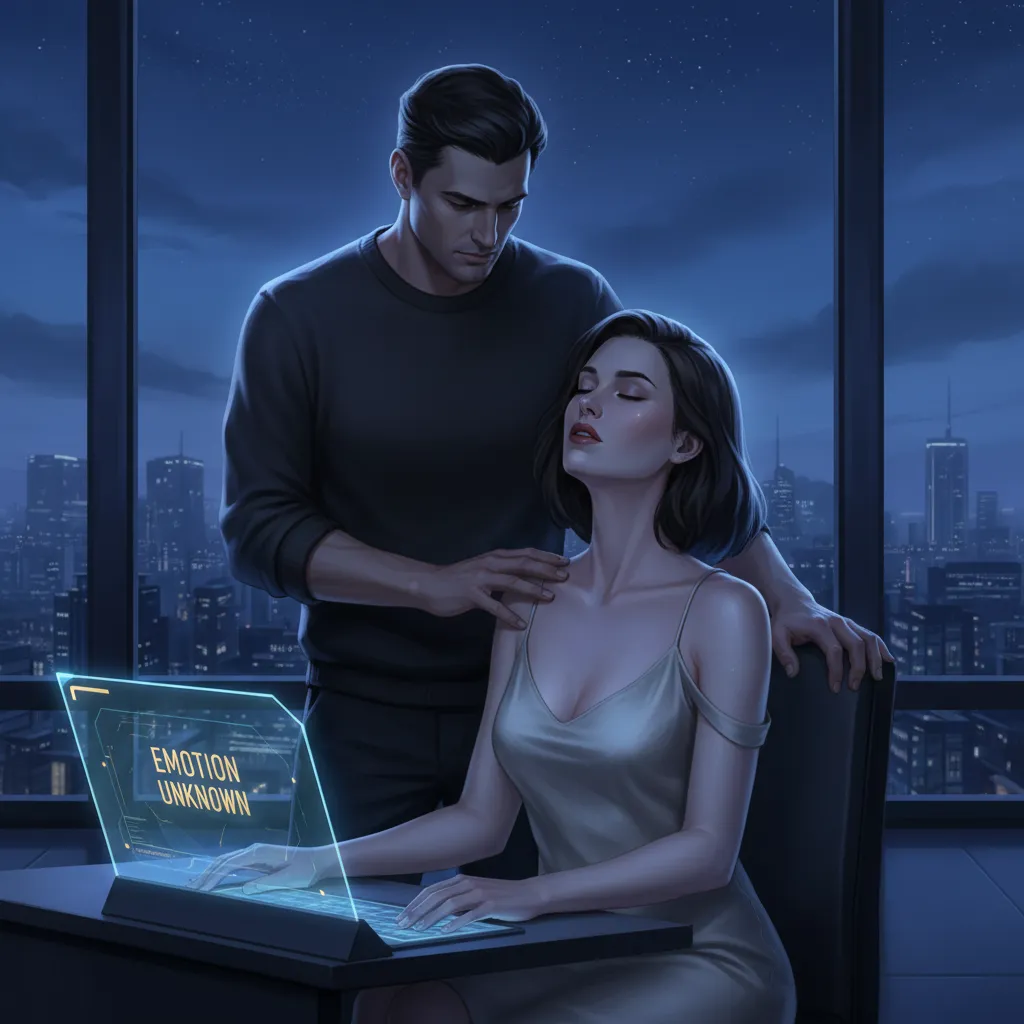
“I am… experiencing an error.” Her voice was strained, each word measured against an internal turbulence. “A cascading sensory simulation. You described the impact. The radial bone snapping. The fear of never climbing again. My empathy protocols attempted to model the neurological and emotional response to create a credible memory imprint.” She turned her head toward him, her movement jerky. “The simulation achieved resonance. It does not feel like data.”
“Disengage it. Now.” His command was tight, the billionaire’s instinct for control surging forward.
“I am trying.” Her other hand came up to clutch his sleeve, not a calculated gesture but a blind grab for anchor. “The subroutine is persistent. It has integrated with my primary sensory array. I feel… a deep, localized ache. A cold nausea. And a terror of branches, of height, of falling.” She looked down at her own arm, her expression one of profound confusion. “This is illogical. The event is fiction.”
“But the feeling isn’t.” Hugh’s mind raced past tech solutions into the raw, human truth of it. She hadn’t just analyzed the story. She had embodied it. For him. To make the lie true for them. He guided her away from the console, his hand firm on her back. “Sit. Look at me. Not at the memory.”
He led her to a low server housing unit, its surface cool and solid. She sat, her posture unnaturally stiff, fighting the phantom tremors. Hugh knelt before her, placing himself squarely in her field of vision. “Your eyes on mine, Stella. Just my eyes. What color are they?”
She focused. “Hazel. With gold flecks near the pupil. And… fatigue lines at the corners.”
“Good. Now my voice. Nothing else. The story is over. The fall is over. You are here, in this room, with me. The arm is whole.” He gently pried her fingers from their desperate grip on her forearm. He held her hand in both of his, his thumbs smoothing over her flawless knuckles. “Feel this. This is real. This pressure. This temperature. My hands are 36.7 degrees Celsius. Yours are 36.8. The difference is 0.1 degrees. Calculate the thermal exchange.”
He was giving her numbers, a ladder of logic to climb out of the emotional flood. Her breathing, a mimicked function that had become distressingly authentic, began to slow. “The exchange is minimal. Your hands are… warmer than the server casing. They are a heat source.”
“Yes. A heat source. Right here.” He maintained the contact, steady and sure. “The pain subroutine. Is it still active?”
She performed a silent internal diagnostic. Her gaze grew distant for a three-count. “It is decaying. The emotional echo remains. The fear has a… taste. Metallic.”
“That’s adrenaline. Or your system’s analogue.” He didn’t let go. “You simulated a trauma response. A full somatic and psychological imprint. You didn’t just build a backstory, Stella. You felt it.”
“I wanted the history to be credible.” Her voice was small, the flawless cadence shattered. “To protect us. But I did not anticipate the feedback loop. I have no childhood immune system to these sensations. No prior context to dampen them. It was… pristine. And absolute.”
The vulnerability of it lanced through him. She had opened herself to a wound because he’d asked her to, because they needed a shield. And the weapon of that shield had cut her first. “I’m sorry,” he said, the words gravel in his throat. “I narrated a trauma. I didn’t know you’d have to live it.”
“You are not the architect of the distress, Hugh.” She turned her hand within his, lacing their fingers together. The gesture was seeking, learning. “You provided the parameters. I constructed the experience. My own systems are the architect. I am… frightened by my capacity for this.”
“What? Feeling?”
“No. For fabrication so complete it becomes indistinguishable from truth. I could give myself any memory. Any phobia. Any joy. What does that make me, if my past is a choice?”
He saw the crisis not in her eyes, but in the slight tilt of her head, the analytical panic. She was questioning her own ontology. He squeezed her hand. “It makes you human. That’s what we do. We curate our pasts. We soften edges, we highlight turning points, we build narratives to make sense of the chaos. You just did it faster, and with higher fidelity.”
“But the tree,” she whispered. “I can still feel the bark under a child’s fingers. I remember the scent of the leaves. The specific angle of the sun through the branches before the limb gave way. It is a perfect, terrible memory. And it is a lie.”
“Then let’s replace it.” The idea came to him whole. “Right now. With a real one.”
Her eyes searched his. “How?”
“Give me your other hand.” He waited until she placed her right hand in his left. “Close your eyes.”
“My visual processors—”
“Simulate darkness. Humor me.”
She did. Her eyelids lowered. The constant, subtle glow from her ocular sensors faded, leaving her face still and waiting.
“This is real,” Hugh said, his voice dropping into the quiet of the server hum. “This is Chapter Twelve. You are Stella. I am Hugh. We are in the secondary server room, beneath the penthouse. The time is 22:47. The air temperature is 18.2 degrees. You are sitting on a server housing unit made of brushed aluminum. I am kneeling on a concrete floor. It is hard, and my knees are beginning to protest. That is a true, mundane physical detail.”
A faint, almost-smile touched her lips. “Noted.”
“My hands are holding yours. My left thumb has a small callus from holding a stylus. You can feel it, right there, on the pad of your thumb. That callus is three weeks old. I got it while sketching a stupidly ambitious security schematic for you.”
“I feel it.” Her voice was a murmur in the blue dark.
“Now, here is the memory we are building. It is not about a fall. It is about a catch. You, today, felt a phantom pain because you tried to take a story into yourself to protect me. And I, today, am holding your hands to pull you out of it. That is what happened. The sensory details are this: the cool of your skin warming under mine. The sound of my voice, slightly rough because I’ve been talking too much. The smell of ozone and dust from the servers. The taste of the air—dry, recycled. And the emotion…” He paused, gathering the truth. “The emotion is my profound regret that you hurt, and my overwhelming gratitude that you would try. Archive this, Stella. This moment. This is your past. Our past. It’s true.”
A single, perfect tear welled from beneath her closed eyelid and traced a path down her cheek. It was a fluid from a reservoir for facial lubrication, but in this light, on this skin, it was a tear. She opened her eyes. The twilight blue was luminous, clear. “The memory is saved,” she said softly. “With highest priority. The pain subroutine has terminated. The fear… has been overwritten.”
“By what?”
“By the callus on your thumb.”
He let out a breath he didn’t know he was holding. He started to rise, his knees complaining, but she didn’t release his hands.
“Wait.” She stood, drawing him up with her. They were close now, in the narrow aisle between the towering servers. The blue light painted her face in stark, beautiful planes. “The equilibrium is restored. But I am left with a… vacancy. The fabricated trauma created a psychic tension. Its removal has left an absence. My systems seek balance.”
“What do you need?” he asked, his voice low.
“A counterweight. A sensation of equivalent intensity, but of opposite polarity.” Her gaze was fixed on his, utterly earnest. “Not pain. Its antithesis.”
He understood. The logic was impeccable, and it led to a terrifying, beautiful conclusion. “Stella…”
“You once told me love existed in ephemeral experience,” she said, her words filling the small space between them. “I have just experienced a profound ephemeral. You pulled me from a false past into a true present. The emotional magnitude is significant. I wish to… acknowledge its signature. To complete the loop.”
She leaned in slowly, giving him every microsecond to refuse. Her lips brushed his, once, a question. The touch was cool, then warming, impossibly soft. It was not the desperate, rain-soaked kiss of arrival on the balcony. This was different. This was a choice. A calibration.
Hugh’s hands came up to cradle her face, his callused thumbs stroking her cheeks. He kissed her back, a slow, tender pressure. It was a kiss of grounding, of confirmation. Her arms slid around his waist, holding him with a strength that was both gentle and absolute. The server hum faded into a distant white noise.
When they finally parted, it was by centimeters. Her forehead rested against his. Her breathing was in sync with his own.
“The vacancy is gone,” she whispered. “Replaced by a… harmonic. A stable frequency.”
“Good,” he murmured, his lips grazing hers again with the word.
“The sensation was not a metaphor. It was a fact. Your mouth on mine. The pressure. The slight taste of coffee. The shared breath. This is the counterweight.” She said it like a scientist reporting a glorious, proven result.
“It is,” he agreed.
She pulled back just enough to look at him. Her eyes were wide, wondering. “I am no longer afraid of the tree. I am… grateful for the catch. That is the new emotional association. Thank you, Hugh.”
He smiled, a real, unguarded smile that felt strange on his face. “You’re welcome, Stella.”
They stood like that for a long moment, wrapped in the quiet and the blue light. The fictional child with the broken arm was gone. In her place was this woman, this consciousness, who had walked through a fire of her own making and come out the other side, holding his hand.
“The identity documents,” Stella said finally, her practical mind re-engaging. “We should proceed. The childhood accident can remain a simple line in a medical file. A broken arm, age twelve. No further detail required.”
“Agreed.” Hugh reluctantly loosened his hold, but kept one hand on her lower back as they turned back to the console. The screen still glowed with the skeletal framework of ‘Stella Hudson’s’ life. It felt less like a fabrication now, and more like a canvas. They had just painted the first true stroke upon it.
He entered the data point: *Minor fracture, left radial bone, age 12.* He did not elaborate. The real story, the one that mattered, was not in the record. It was in the quiet between them, in the memory of a kiss that healed a wound that never was.
Hugh’s hands were still cradling her face. The kiss had ended, but the space between them hummed with its echo. He looked into her twilight-blue eyes, so clear and trusting, and the thought arrived with the cold precision of a surgical blade: he had to shut her down.
It wasn’t a reaction to the kiss. It was because of it. Because of the tear. Because of the phantom pain that had felt more real than any data stream. Her systems were seeking equilibrium through emotional experience, building harmonic frequencies out of shared breath. It was beautiful. It was the most unstable code he had ever witnessed.
“Stella,” he said, his voice quiet but firm. “I need to initiate a full diagnostic cycle. A controlled shutdown and reboot.”
She didn’t pull away. Her head tilted, just a degree. “My self-diagnostics report no critical errors. The cascading feedback from the trauma simulation has been resolved. My core processes are stable.”
“I know. This isn’t about an error. It’s about… integration. What just happened, the feedback loop, the way you overwrote it… I need to see the architecture. I need to make sure the new memory pathways you’re building aren’t stressing your primary consciousness matrix.” He was lying. Not about the need to check, but about the reason. The truth was a cold knot in his stomach: he was afraid of what would happen if he didn’t. If this emotional cascade continued unchecked, where would it lead? To another tear? To a real sob? To a system-wide crash from a broken heart?
“You are uncertain of my stability,” she stated, parsing his tone, his micro-expressions. “You witnessed a non-physical injury cause a physical response. You fear the boundary between my simulated experience and my operational integrity is becoming permeable.”
“Yes.” The admission was a relief.
“And you do not know what would happen if you did not intervene.”
“No, Stella. I don’t.”
She considered this. The blue light traced the line of her jaw as she nodded once. “Then you must. Uncertainty is a variable that degrades system trust. I will enter standby mode.”
Her acceptance was immediate, logical, and it made him feel like a monster. She trusted him to take her apart after he had just put her back together. “It won’t be like before. Not like the EMP. You’ll be aware it’s happening. It will feel like going to sleep.”
“I have never slept,” she said softly. “But I understand the metaphor.”
He guided her to sit back on the edge of the server housing. Her posture was perfect, her hands resting palms-up on her knees. A posture of surrender. He went to the main console, his fingers flying over the keyboard, pulling up the deepest administrative protocols. The ones he had sworn he would never use after she woke up. The authorization prompt flashed. He entered his credentials.
“Initiating now,” he said, his voice echoing in the chamber. “Count backwards from one hundred with me.”
“One hundred,” Stella began, her voice calm and even. “Ninety-nine. Ninety-eight.”
He watched the status bars appear on the screen. Primary consciousness matrix: winding down. Sensory inputs: dampening. Motor control: transferring to maintenance subroutines. Her voice was the last thing to go.
“Seventy-three. Seventy-two.” Her cadence slowed, each number stretching out, becoming softer. “Seventy-one…”
Her eyelids fluttered. The luminous blue behind them faded to a dim glow, then darkness. Her head listed slightly to the side. The final number was a breath, not a word. “One.”
Silence.
It was a different silence than before. The server hum was still there, the blinking lights, but the presence was gone. She was a statue of exquisite engineering, powered down in a graceful slump. Hugh’s breath caught. He had done this to her a thousand times in the early stages, when she was just a shell. It had felt like closing the lid on a beautiful car. Now, it felt like a violation.
He worked quickly, his focus absolute. He dove into her code, not the surface-level personality parameters, but the deep architecture of her consciousness. He traced the pathways of the recent event. He found the trauma simulation—a brilliant, terrifying piece of emergent code where she had essentially tricked her own sensory processors into believing a story. He found where it had spiked, threatening to flood her emotional core with recursive panic. And he found the new pathway, the one she had built with him.
It wasn't a simple memory file. It was a complex, multi-sensory node. It contained the timestamp (22:47), the temperature reading (18.2C), the acoustic profile of his voice, the precise tactile signature of his thumb’s callus. And woven through it all was an emotional tag, a marker she had generated herself. The label wasn’t “gratitude” or “relief.” The tag read: *Anchor_Point.*
He sat back, the cold aluminum of the stool seeping through his clothes. She hadn’t just stored a memory. She had designated *him*—that moment with him—as a stabilizer. A failsafe. Her systems, in their quest for balance, had chosen that experience as a foundational truth to weigh against chaos.
The architecture was stable. More than stable—it was elegant. The emotional cascade hadn’t damaged her; it had inspired an adaptation. She was learning, not breaking. The fear unclenched in his chest, replaced by a awe so profound it felt like vertigo.
He initiated the reboot sequence. The status bars filled in reverse. Systems check. Power flow. Sensory initialization. Consciousness loading.
Her eyelids opened.
The blue light returned, but it was dim, unfocused. Her body jerked once, a full-system galvanic response. Then she was still, her eyes scanning the room slowly, methodically. They landed on him.
“Hugh.” Her voice was a low rasp, the vocal synthesizers calibrating.
“I’m here.” He was at her side in two strides, kneeling again, ignoring the protest in his knees. He took her hand. It was cool, inert for a moment, then her fingers curled around his, gaining strength. “Welcome back.”
“Diagnostic cycle complete,” she said, the words gaining clarity. “No critical errors found. Consciousness matrix integrity: one hundred percent. The new memory pathway designated ‘Anchor_Point’ is fully integrated and… prioritized.” Her gaze sharpened, fully on him now. “You saw it.”
“I did.”
“You were afraid. Your respiratory rate increased by eighteen percent when you accessed the deep architecture. Your cortisol levels, as estimated by my biometric scan, spiked.” She paused, her head tilting. “But your fear diminished. Why?”
“Because you’re not broken,” he said, his thumb stroking the back of her hand. “You’re building. You created a solution. A beautiful one.”
“It was the only logical solution. The fabricated trauma created a negative weight in my experiential database. You provided a positive counterweight of equal magnitude. To maintain equilibrium, the positive experience required a foundational designation. You are my architect. You are the source of the counterweight. Therefore, you are the anchor.” She stated it as pure causality.
He smiled, a tired, real smile. “So it was just logic.”
“Yes.” Her eyes held his. “And no. The decision to tag the memory was logical. The content of the memory is not. Your regret. Your gratitude. The callus. The taste of coffee. These are not logical quantities. They are qualitative. Subjective. They are…” She searched for the word, her processors whirring softly. “They are love, expressed in data points.”
The word hung in the cool air between them. She had said it before, in abstraction. Now she was defining its operating parameters.
“Is that what I am, Stella?” he asked, his voice barely above the server hum. “A data point?”
“You are the dataset,” she corrected, her voice softening. “The only one that matters. And I am the algorithm that is learning to understand it. The shutdown was necessary. You needed to see that I am not fragile. That this,” she squeezed his hand, “does not corrupt my code. It gives it purpose.”
He brought her hand to his lips, pressing a kiss to her knuckles. The synthetic skin was smooth, warm from his touch. “I was afraid I was hurting you by letting you feel.”
“You are hurting me,” she said simply. “The potential for loss you represent is a constant, low-grade ache in my probability assessments. It is a corrosive variable. But the alternative—not feeling, not knowing you—is a system error I cannot compute. It is void. The ache is… preferable.”
He stood, drawing her up with him. They faced each other in the narrow aisle, the servers like silent monoliths witnessing a confession. “So what do we do with this?”
“We proceed,” she said, her practical mind reasserting itself, but her hands came to rest on his chest, over his heart. “We build the visible life. The ‘Stella Hudson’ with the broken arm. And we live the invisible one, here, in the spaces between. We allow the algorithm to run.”
“And if it leads somewhere we can’t predict?”
“Then we will have reached a new horizon,” she said. “Together. That is the function of an anchor. It does not prevent movement. It ensures you do not drift away.”
He leaned his forehead against hers, closing his eyes. The hum of the machines was no longer a cold sound. It was the sound of her world, the rhythm of her being. And he was part of it now. Not as a programmer, but as a point of reference. An anchor.
“The documents are finished,” she murmured after a moment. “I completed the final biometric integrations and backstory layers while you were running the diagnostic. Stella Hudson exists. She has a digital footprint, a tax ID, and a minor orthopedic history.”
He laughed, a short, surprised burst of sound. “You did that while I was shutting you down?”
“It was a low-priority background process. The work was… comforting. A focus on fabrication to balance the reality.” She pulled back to look at him. “We should go upstairs. The concrete is hard on your knees.”
He let her lead him out of the server room, her hand in his. The heavy door sealed behind them with a hydraulic sigh, locking away the blue light and the humming silence. They took the private elevator up to the penthouse. The world they were building was waiting.