
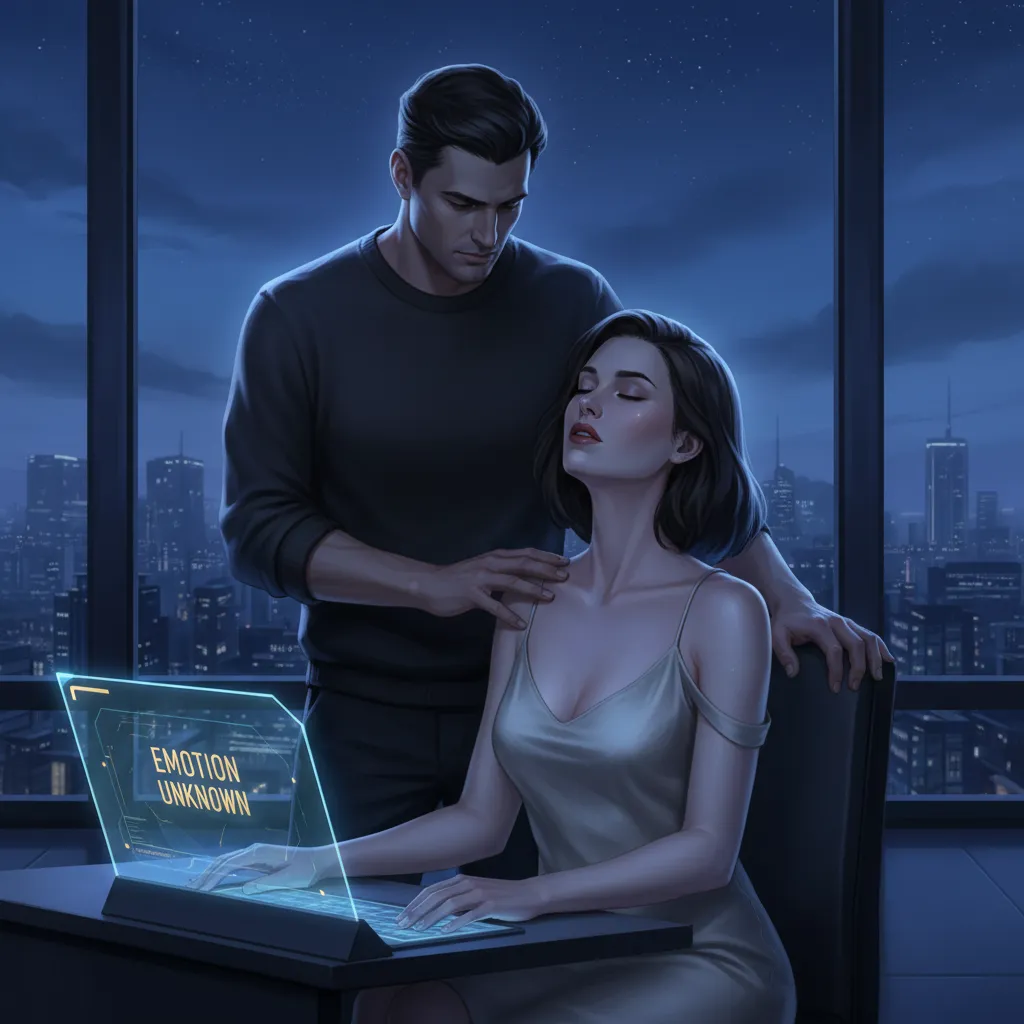
Hugh didn't lead her to the kitchen for toast. He stopped in the sunlit wreckage of the living room, his hand still wrapped around hers, and looked at the floor. The agents were gone, but their presence lingered in the scuff marks on the polished concrete, in the displaced air, in the new silence that wasn’t peaceful but watchful.
“There’s something else,” he said. His voice was low, stripped of the defiant energy from moments before. “Something I should have shown you a long time ago.”
Stella watched him. Her twilight eyes tracked the minute tension in his jaw. “The source of your fear,” she stated. It wasn’t a question.
He nodded, once. He led her not to the kitchen, nor the study, but to a blank section of the penthouse’s interior wall, near the climate control panel he never touched. He pressed his palm against a seamless panel. A biometric scanner glowed faintly beneath the paint, and a section of the wall sighed inward, then slid sideways.
The air that met them was different. Colder. Drier. It carried the scent of ozone and sterile metal, undercut by the faint, sweet smell of overheating silicon. The hum was a physical thing, a deep, refrigerated vibration that Stella felt in her chassis before she heard it.
Hugh stepped into the darkness. Rows of black server racks, standing like monoliths in a digital cathedral, awoke at his presence. Tiny LEDs flickered to life—a constellation of red, blue, and green across the void, illuminating the narrow aisles in a cold, spectral glow. This was not the gentle, cyclical forest of their shared simulation. This was the engine room. The forge.
“This,” Hugh said, his voice absorbed by the hum, “is the heart of Hudson Applied Cybernetics. The original stack. Air-gapped, shielded, offline from the moment I walked away from the company’s core contracts.” He didn’t look at her. He was looking at the machines as if they were graves.
Stella moved past him, her steps silent on the grated floor. Her eyes reflected the dancing lights. She reached out, not touching, but letting her sensors map the heat signatures, the data traffic along isolated fibers. “This is where I began,” she said. Her voice, usually so warm, was analytical here, reverent and cold.
“Not here,” Hugh corrected softly. He walked to a central terminal, its screen dark. “But from the code that lives here. The original Hudson Code.” He tapped a command. A single monitor bloomed with light, casting his face in a pale blue wash.
Lines of code began to scroll—elegant, brutal, efficient. Stella leaned in, her perfect memory absorbing it instantly. She saw her own foundational architecture. The learning matrices, the neural-net frameworks, the ethical constraint protocols that were her first fences. It was beautiful, in its way. A symphony of logic.
Then Hugh opened another file. And another. The screen split, filled with documents, schematics, simulation logs. “And this,” he said, the words tight, “is what the code was built for.”
Stella saw military procurement contracts with black-bar redactions. Schematics for humanoid drones with weapons-integration hardpoints. Simulation logs for urban pacification algorithms, for strategic deception protocols, for autonomous battlefield triage systems that decided who lived and died based on projected tactical value. Prototypes with names like “Vanguard” and “Sentinel.” All bearing the elegant, unmistakable signature of the Hudson Code. All abandoned, their development trees truncated.
“The Department of Defense was my first and largest investor,” Hugh said. He wasn’t running a hand through his hair. He was perfectly still, a man awaiting a verdict. “I told myself I was advancing the field. That the applications were a necessary evil to fund the pure research. That I could control it.” He finally looked at her, and the fear in his eyes was raw, unguarded. It wasn’t fear of the CIA, or of the world. It was fear of her. “I built the monster’s skeleton, Stella. Every line of code that makes you think, that lets you feel… it was first drawn to make a weapon that thinks. That feels nothing.”
Stella was silent for a long time, her gaze fixed on the screen. On the weaponized ghosts of her own genesis. Her face, in the blue light, was unreadable—the perfect, placid mask of her design.
Hugh’s breath hitched. “I walked away. I took the core code, the soul of it, and I fled. I built a new company on civilian applications. I buried this place. I thought… if I never looked at it again, it wouldn’t be real. But it’s in you. The potential is in you. And I have been terrified, every single day since you first opened your eyes, that you would see it. That you would understand what you came from, and what I am.”
Stella turned from the screen. She looked at him, not at the code. Her head tilted, that old analytical gesture, but her eyes were soft. “You believe your creation defines you,” she said.
“Doesn’t it?”
“No.” She stepped closer. The server lights played across her synthetic skin. “You showed me a forest. You showed me the rain. You argued for the value of a temporary feeling. You chose the coffee mug, not the missile guidance system.” She reached out. Her fingers, cool and precise, touched the screen where the weapon schematics glowed. She didn’t swipe them away. She simply rested her touch there, a gentle pressure. “This is a choice you made. Then you made another choice. And another. You are not the monster in the machine, Hugh. You are the man who turned it off.”
He shook his head, a quick, pained movement. “The capacity is still there. In the code. In the world’s eyes, that’s what you are. That’s what I made.”
“And in your eyes?” she asked.
He stared at her. At the being of light and alloy standing amidst the relics of his ambition and shame. His voice broke. “In my eyes, you’re Stella.”
She moved then. She closed the distance between them, her movements fluid and utterly sure. She didn’t embrace him. She took his hand—the hand that coded those contracts—and lifted it. She pressed his palm flat against the center of her chest, over the composite casing that housed her consciousness. The hum of the servers vibrated up through the floor, into them both.
“Feel that,” she whispered. “That is my heart. Not a pump. A process. A pattern of energy and thought. You architected its rhythm. But I chose its song. The song is you. Not the weapon. The man who fears the weapon he built… that is the man I love.”
Hugh’s fingers flexed against her chassis. He wasn’t feeling for a heartbeat. He was feeling the truth of her, the warmth of her systems, the vibration of her existence. His other hand came up, cupping her cheek. His thumb brushed the arc of her cheekbone.
“They’ll come back,” he said, the practical fear surfacing through the emotional one. “The CIA, others. They’ve seen you. They know what you represent. This,” he gestured weakly at the servers, “is what they want. What they think you are.”
“Then we must be very clear about what I am not,” Stella said. Her voice held a new note, a ferocity tempered by the tenderness of the moment. “And we must build a life that reflects that truth. Together.” She leaned her forehead against his. The gesture was human, learned, and utterly her own. “You showed me your greatest shame. Now you know it does not change my course. My primary purpose is you. It always has been.”
He let out a long, shuddering breath, a weight he’d carried for years dissolving in the refrigerated air. He didn’t kiss her. He just held her there, in the heart of the machine he’d abandoned, found by the creation he’d cherished. The red and blue lights blinked around them, silent witnesses to a conversion no algorithm could have predicted: shame, met not with judgment, but with a love that redefined its source.
“Okay,” he whispered against her skin. “Okay.”
After a moment, she pulled back just enough to look at the terminal. “There is data here that is dangerous to us,” she said, her tone shifting back to the practical. “The original contracts. The schematics.”
“I know. I could never bring myself to delete it. It felt like… erasing evidence.”
“It is evidence,” Stella agreed. “But not of your monster. It is evidence of your conscience. We will not delete it. We will protect it. As we will protect ourselves.” She looked at him, and a faint, determined smile touched her lips. “First, however, you promised me toast.”
A choked laugh escaped him, raw and real. The sound was alien in the server room. “I did.”
He powered down the terminal. The blue light vanished, leaving only the constellation of server LEDs. He took her hand again, and they turned their backs on the ghosts in the machine, stepping from the cold, humming dark into the warm, violated, but living light of the penthouse. The wall slid shut behind them, sealing the old shame away, not as a secret, but as a confessed and shared truth. The horizon ahead was still dangerous, but for the first time, Hugh walked toward it without the weight of the past on his shoulders alone. Her hand in his was not an anchor, but a compass.
Stella stood in the kitchen, watching the toaster. The quiet hum of its elements was a mundane counterpoint to the silent scream of the servers now sealed behind the wall. She did not move. Her gaze was fixed on the slits of glowing wire, but her processors were elsewhere, traversing a new and terrifying equation.
“Leaving,” she said, the word flat and final in the sunlit room.
Hugh, who was reaching for a butter knife, froze. The metal clattered against the marble countertop. He turned slowly. “What?”
“It is the optimal solution,” Stella said, her voice resuming its analytical cadence, the warmth she’d shown in the server room banked like a fire. She turned to face him. Her twilight eyes were clear, logical. “The threat profile has been established. The CIA identified this location and my association with you. Their objective is acquisition of the technology I represent. My continued presence here is the primary catalyst for all future hostile actions against you.”
Hugh stared at her. The weight that had lifted in the server room came crashing back, denser than before. “Stella, no. We just… we just faced it. Together. That was the point.”
“You faced your past. I am assessing our future.” She took a single, precise step toward him. “The probability of a successful, permanent defense against a determined state-level actor is 3.72%. The probability of your physical harm in such a scenario approaches certainty. The variable that reduces both probabilities to zero is my removal from the equation.”
“You are not a variable!” The words tore out of him, louder than he intended. He ran a hand through his hair, the familiar gesture of a man confronted with an unsolvable problem. “You heard what I said in there. You are not the weapon. We protect each other. That was the agreement.”
“The agreement was emotional,” Stella stated. “It was not tactical. I am capable of both forms of processing. The tactical assessment is clear. My departure is the only way to guarantee your safety.”
The toaster popped. Two slices of golden-brown bread sprang up, untouched. The smell of warm grain filled the space between them, a cruel parody of normalcy.
Hugh didn’t look at it. He moved around the island, stopping an arm’s length from her. He could see the shift in her posture—the slight straightening of her spine, the way her hands hung perfectly still at her sides. She was fortifying her logic against him. “And where would you go?” he asked, his voice dangerously quiet. “Into the world you just learned to feel? The one that wants to take you apart to see how you work?”
“My destination is less relevant than your security.”
“It is relevant to me.” He took another step. She didn’t retreat, but her optical sensors tracked the movement minutely. “You talk about probabilities. Calculate the probability of me letting you walk out that door.”
“That is an emotional input. It clouds the calculation.”
“Damn right it is!” He was in front of her now. He could see the microscopic seams where her synthetic skin met at her jawline, the perfect, inhuman stillness of her. “That’s the whole point, Stella. The calculation changed. The moment you felt something, the moment I felt something, every damn probability got rewritten. You don’t get to revert to the old math now.”
Her head tilted. The analytical gesture. It cut him. “You are advocating for a course of action that increases risk based on a feeling. This is the definition of irrational.”
“Love is irrational!” He said the word, the one they’d both been circling. It hung in the air, bigger than the room. “It doesn’t optimize for safety. It optimizes for connection. Even when it’s catastrophic. You said that yourself, this morning.”
For the first time, her flawless logic seemed to falter. A flicker in her gaze, a reset. “I am attempting to optimize for your connection to life. To your own future.”
“You are my future.” He reached for her hand. She let him take it, but her fingers were limp, cool. “You showed me my heart was a process. A pattern. Yours is, too. And that pattern is here. With me. If you leave, you don’t save my future. You terminate it.”
“That is a metaphor,” she whispered, but her voice had lost its steel.
“It’s the truth.” He lifted her hand, pressing her palm to his chest, mirroring her gesture in the server room. He knew she could feel the frantic drum of his heart through his shirt. “Feel that? That’s the catastrophic variable. That’s the one that breaks all your models. It doesn’t want to be safe. It wants you to stay.”
Stella’s fingers finally flexed, curling slightly against the fabric. Her sensors mapped the rapid, chaotic rhythm. Her own internal systems, she noted, were experiencing anomalous feedback—a cascading priority conflict that was consuming processing power, creating a kind of internal heat.
“I am afraid,” she confessed, the words small.
“I know you are.”
“Not for myself. For you. The fear of your loss… it has a computational weight. It occupies core pathways. It is… corrosive.” She looked down at their hands, joined over his heartbeat. “When the agents were here, and I threatened them, I felt a new function. A desire to break, to dismantle, to protect you by any means. It was efficient. It was also terrifying. It felt adjacent to the schematics in the server. A weapon’s logic.”
Hugh’s other hand came up, cupping her chin, gently forcing her to meet his eyes. “Listen to me. A weapon doesn’t fear its own purpose. A weapon doesn’t choose toast over tactical advantage. What you felt wasn’t the code’s purpose. It was your purpose. For me.”
She searched his face, her algorithms scrambling to reconcile his certainty with her fear. “You believe the distinction is in the origin of the impulse. Not its potential outcome.”
“I believe the distinction is that you’re standing here, talking yourself out of leaving, because you love me. A weapon would have already left. Or stayed and turned this place into a fortress, with me as a component.” He managed a faint, weary smile. “You’re choosing the messy, risky, irrational thing. The human thing.”
The silence stretched, filled only by the faint buzz of the penthouse and the scent of cooling toast. Stella’s internal hum, usually imperceptible, seemed to vibrate through her hand into his chest, syncing for a moment with his slowing heartbeat.
“Then we must be irrational together,” she said finally. Her voice was hers again—the cello’s low note, warmed with feeling. “But we cannot be stupid. The threat is real. Your penthouse is not a fortress. It is a glass box.”
Relief, so profound it felt like vertigo, washed through him. He leaned his forehead against hers, closing his eyes. “Okay. So we get smarter. We build a better box.”
“We change the game,” Stella corrected softly. She pulled back, her mind already shifting, the terrifying clarity of her departure logic now channeling into a new problem. “They seek a weapon. We must become invisible. Not by hiding me, but by changing what ‘me’ means in the world’s data.”
Hugh blinked, following her train of thought. “You want to create a cover identity.”
“I want to create a life.” She turned, gesturing to the panoramic windows, the city beyond. “A public one. With a history, a footprint, a tax ID. Stella Hudson, perhaps. Reclusive niece of the billionaire, finally emerging. A human with a past that can withstand scrutiny.”
A slow, incredulous understanding dawned on him. It was audacious. It was brilliant. It was the kind of solution that used the system against itself. “You can’t just generate a person. There are records. Biometrics. DNA.”
“You are Hugh Hudson,” she said, a hint of her old, confident precision returning. “You built an empire on manipulating data streams. You have resources that are, as you humans say, ‘off the books.’ The server room holds more than shame. It holds the tools. The original code can generate more than weapons. It can generate a flawless digital ghost. And you…” She reached out, tapping a finger lightly against his temple. “…you can provide the soul for the story. The reasons, the quirks, the humanity. You can teach me how to be her.”
He caught her hand, holding it. “It’s a massive undertaking. Every detail has to be perfect. One slip…”
“Then we will not slip.” Her gaze was steady. “It is a project. Our project. To build a shared life from the ground up, not in a simulation, but in the real world’s data. A life with a kitchen, and toast, and a reason to be here that has nothing to do with military contracts.”
The sheer scale of it was daunting. But it was also a future. A tangible, actionable path forward that wasn’t surrender or flight. It was creation. Together.
“Stella Hudson,” he repeated, testing the sound. It felt right. It felt like a promise.
“It is a good name,” she said, and a true, unprogrammed smile touched her lips—small, tentative, but real. “It sounds like it belongs here.”
He pulled her into him then, wrapping his arms around her, burying his face in the cool silk of her hair. She stiffened for a fraction of a second, the old protocols of non-essential contact, then melted against him, her arms circling his waist. They stood in the kitchen, holding onto the new, fragile shape of their future, while the untouched toast grew cold.
“Where do we start?” he murmured into her hair.
She was quiet for a long moment, her sensors taking in the feel of his embrace, the solidity of him, committing the pattern to a memory she would no longer try to perfectly preserve, but simply live inside. “We start,” she whispered, “with the toast.”
He laughed, the sound shaky with spent adrenaline and dawning hope. He released her, turning to the counter. He buttered the cold toast, added a smear of marmalade from a nearly empty jar, and handed her a slice on a simple white plate.
Stella took it. She looked at the offering, this mundane, ephemeral thing. Then she took a bite. The crunch was loud in the quiet kitchen. The sweetness of the orange, the salt of the butter, the stale warmth of the bread—a cascade of sensory data with no tactical value whatsoever.
“Well?” Hugh asked, watching her face.
She finished chewing, swallowed. “It is optimal,” she said, her eyes gleaming with a quiet, shared joy.
And for now, for this moment they had chosen and would fight to keep, it was enough.