
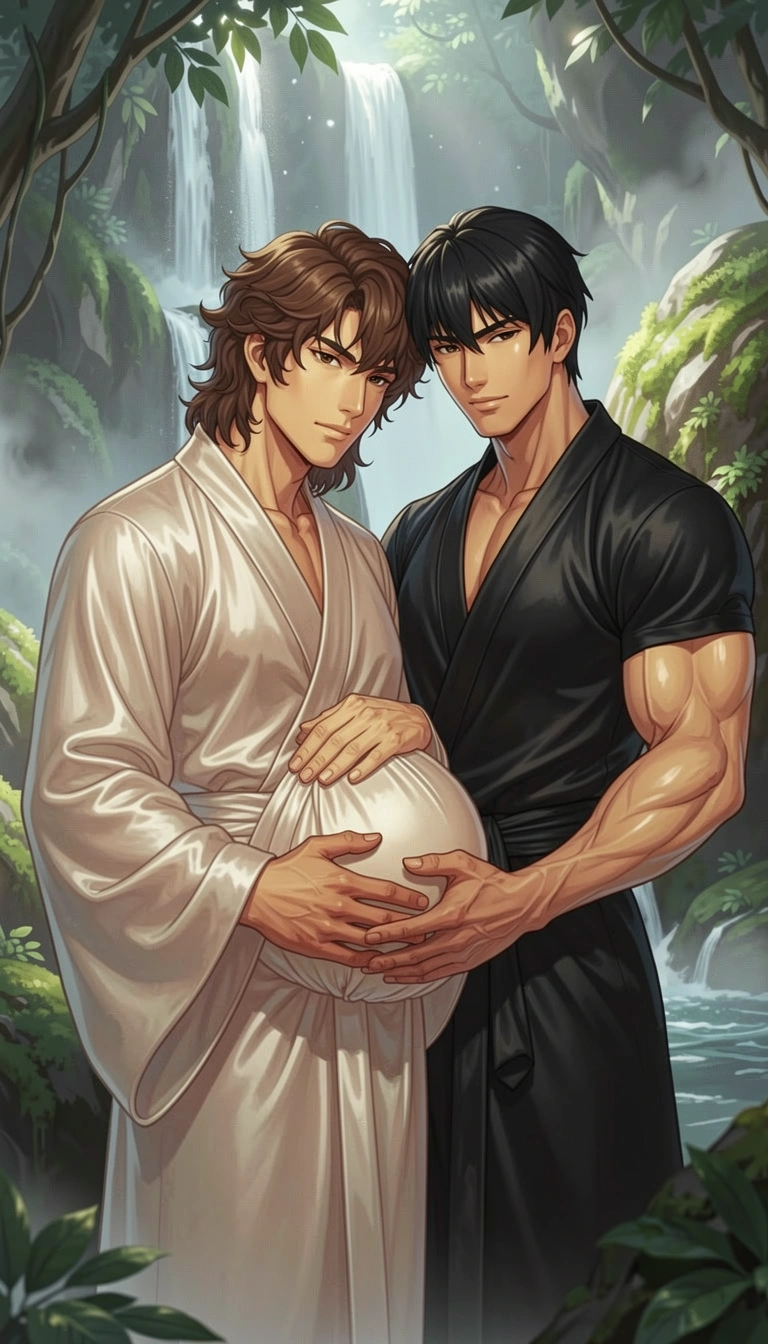
The number did not fade. It sat in the air between them, solid as stone, as the healer's hands fell still at his sides and the candle flame bent toward the open garden door. One million gold. The root grew on cliffs that had swallowed every man sent to retrieve it. Phuwin's hand stayed pressed to his belly, the baby kicking beneath his palm—once, twice, a third time, insistent, alive—and he watched his own fingers as if they belonged to someone else.
"The lantern festival," Pond said. His voice came from somewhere far away, from the bedpost where his knuckles had gone white, the carved wood groaning under his grip. "The capital's harvest celebration. That sum would fund the entire event for three years. Ovoale begged to see the lanterns this year. She drew them—she drew the paper boats in her sketchbook every night for a month."
The healer did not move. His shadow stretched long across the silk-draped floor, pooling at the foot of the bed where the damp sheet had twisted around Phuwin's ankle, and he watched his shadow too, his hands still and patient, a man who had learned to wait through silences like this one.
Phuwin's breath caught in his throat. The sound that came out when his lips parted was not a word. It was a hollow thing, a noise without a shape, and the baby kicked again—a sharp jab under his ribs—and he pressed harder against the mound of his belly as if he could press the feeling away, press the whole world away, press himself through the mattress and into the earth where nothing could reach him.
"The people depend on that money," Pond continued. His voice had gone careful now, the measured tone he used in council chambers when he was trying to bend a room without breaking it. "Ovoale herself—she talked about the red lanterns. The ones shaped like fish. She asked me if we could release one from the tower this year instead of the courtyard, and I told her—"
"You cannot be talking about a fucking festival right now."
Phuwin's voice cut through the room like a blade. It was not loud. It was worse than loud—it was flat, and cold, and final, and the hand on his belly had stopped pressing, had gone still, the fingers curling against the silk of his robe as if they had found something to hold onto in the dark.
The healer looked up. His eyes moved from Phuwin's face to Pond's, settling somewhere in the middle, a man who had learned exactly where not to stand in rooms like this one.
Pond turned. His jaw was set, that familiar line of stubbornness that Phuwin had watched harden over a decade of arguments—about the succession, about the children, about every goddamn thing that came between them. "The festival feeds the capital for a week. It funds the winter stores. The merchants plan their entire season around—"
"I do not give a fuck." Phuwin's voice cracked on the last word, and he heard it break, heard it splinter into something jagged and raw, and he did not care. He did not care if the healer heard, if the whole palace heard, if the gods themselves heard him cursing in this silk-drenched room while his daughter lay somewhere in the dark with a wound in her chest and a silence in her skull. "I do not give a single fuck about the festival. About the merchants. About the winter stores. Our daughter will not be there to see the lanterns, Pond. She will not be there to draw them. She will not be there to beg you for the red one shaped like a fish because she is lying on a cot with a blade wound in her ribs and her brain—"
His voice broke again. The baby kicked, a hard, insistent movement, and he pressed both hands against his belly now, pressing hard enough to feel the shape of a foot or a knee pushing back against his palms, and the tears that had been building behind his eyes since the healer had spoken the number finally spilled over, sliding hot and silent down his cheeks.
"The people need—" Pond started.
"Fuck the people." Phuwin said it without raising his voice, said it as calmly as he had ever said anything, and the healer's shadow jerked as the man shifted his weight from one foot to the other. "Fuck the capital. Fuck the winter stores. I have given this kingdom five daughters and two sons and I have bled for it—I have bled out on carriage seats and surgery tables and that corridor—" His voice broke again, and he swallowed, and the tears kept falling, tracking silver lines through the grime on his face, the dried blood on his neck, the salt that had crusted at the corners of his mouth. "And still you stand there talking about a festival."
Pond's grip on the bedpost did not loosen. His knuckles had gone bone-white, the tendons standing out under his skin, and when he spoke his voice had dropped to something quieter, something that might have been gentleness if it had not been so full of iron. "Phuwin. I am trying to hold an empire together while my family is—"
"While your family is what?" Phuwin's head turned, his gaze finding Pond's for the first time since the number had been spoken, and the look in his eyes made the healer take a half-step back. "While your family is lying in adjacent rooms, one with a broken ankle from climbing out a window to escape the men you were supposed to stop at the gate, and the other with a wound in her chest that has already taken her voice, her laughter, her—" He could not finish. His throat closed around the words, and he turned his face away, staring at the canopy above him, at the silk that shimmered in the candlelight, at the shape of a moth beating against the glass of the window near the garden door.
"I am going to find the root," Pond said quietly. "I am going to send men north tonight. I am going to—"
"You sent men to protect the gate." Phuwin's voice was flat again. "You sent men to guard the corridor. You sent men to watch the walls. And now Ovoale has a hole in her ribs and Xiana cannot walk and I—" He stopped. His hand found his belly again, pressing flat, feeling the roll of movement beneath his palm. "I was on my knees in that corridor, Pond. I was on my knees and you were not there. You were never there."
The silence that followed was worse than the shouting. The healer's shadow had stopped moving entirely, a dark shape on the silk-draped floor, and the only sound in the room was the distant pulse of the waterfall, a steady low thunder beneath the rustle of jasmine from the garden, and the wet, uneven sound of Phuwin's breathing.
"I know," Pond said. His voice was hoarse. "I know I was not there. And I know that is a thing I will carry for the rest of my life. But I am here now. And I am telling you that I will find the root. I will bring it back. I will—"
"It is not about the root." Phuwin's hand curled into a fist against his belly, the silk of his robe bunching under his fingers. "It was never about the root. It was about you choosing the empire over us, every single time, and I have watched you do it for thirteen years, Pond. Thirteen years of watching you weigh our family against the council, the capital, the harvest, the—" His voice broke again, and he pressed the heel of his hand against his eyes, hard enough to see stars. "I cannot do this anymore. I cannot lie in this bed and listen to you negotiate the cost of our daughter's life."
"I am not negotiating." Pond's voice had risen, the careful control cracking at the edges. "I am telling you what the root costs. I am telling you what we are facing. I am trying to—"
"You are trying to figure out how to pay for it without upsetting the merchants." Phuwin's voice had gone sharp again, a blade honed on grief, and he let his hand fall from his eyes and stared at the canopy, at the silk that swayed with every breath he took. "And while you are doing that, while you are calculating the cost in gold and grain and god knows what else, your daughter is lying in a room down the hall with her brain slowly—"
"I am aware of what is happening to my daughter." Pond's voice cracked, and the sound of it—the raw, splintering edge—made the healer's shadow jerk again. "I am aware. I carried her body into the palace. I held her hand while the healer stitched the wound. I watched her not wake up, Phuwin. I was there. I was there for all of it. And I am standing here now, in this room, trying to find a way to save her without letting the kingdom starve in the process."
"Then let it starve."
Phuwin said it quietly, his eyes still fixed on the canopy, his hand still pressed to his belly, and the baby kicked once, twice, a third time, as if answering him. "Let it all starve. Let it burn. Let the northern clans take the capital and the palace and every single gold coin in the treasury. I do not care. I do not care about any of it. I care about Ovoale, and Xiana, Imaria, Aric, The twins and this baby, and—" His voice broke, and he closed his eyes, and the tears slid from the corners, tracking down his temples, disappearing into the damp silk of the pillow. "And I care about Star. I care about the woman who held me while I bled, who brought me tea, who—"
He could not finish. The words tangled in his throat, and he turned his face into the pillow, pressing his cheek against the damp silk, and for a long moment the only sound in the room was the waterfall, the jasmine, the wet shudder of his breathing.
The healer shifted his weight. "Empress," he said quietly, his voice careful, measured, "you are still healing. Your body has been through trauma. The strain—"
"Do not tell me about strain." Phuwin's voice came out muffled, his face still pressed into the pillow, but the words were clear enough. "Do not tell me about healing. I have been healing for thirteen years. I have been healing between every birth, every loss, every—" His voice broke, and he pushed himself up onto his elbows, his body shaking with the effort, the torn robe slipping from one shoulder, exposing the pale curve of his collarbone, the fading yellow of a bruise that had bloomed there in the corridor. "I am done healing. I am done lying here. I am done."
He swung his legs off the bed before any of them could speak—before Pond could open his mouth, before the healer could reach for him, before his own body could decide it was too weak to move. The damp sheet clung to his thigh as he shifted, the cold air from the open garden door raising goosebumps across his bare skin, and his feet hit the stone floor with a sound that seemed too loud in the silence of the room.
The torn robe slipped further as he stood, the fabric gaping at his shoulder, falling in folds around his waist. His body shook. His legs trembled beneath him, the muscles screaming after days of lying still, of bleeding, of healing, and he gripped the edge of the bed frame with one hand, his knuckles white against the carved wood, feeling the baby shift inside him, a roll of movement that pressed against his ribs.
Pond took a step toward him, his hand reaching out. "Phuwin—"
"Do not." Phuwin did not look at him. His gaze stayed fixed on the garden door, on the rectangle of darkness beyond, where the jasmine scent poured in and the waterfall thrummed its endless pulse. "Do not touch me. Do not follow me. Do not—" His voice cracked, and he swallowed, and his hand tightened on the bed frame until the wood creaked under his grip. "I need to go. I need to—" He did not finish. He did not know what he needed. He only knew that he could not stay in this room, in this bed, in this body that had been taken apart and put back together so many times he no longer recognized the seams.
He let go of the bed frame. His legs held, barely, and he took a step toward the bedchamber door, the stone cold beneath his bare feet, the torn robe slipping again, sliding off his shoulder and pooling at his elbow, and he did not stop to fix it. He did not look back. He walked toward the darkness, toward the jasmine, toward the sound of water falling, and his body shook with every step, and the baby kicked, and he did not wipe the tears from his face.