
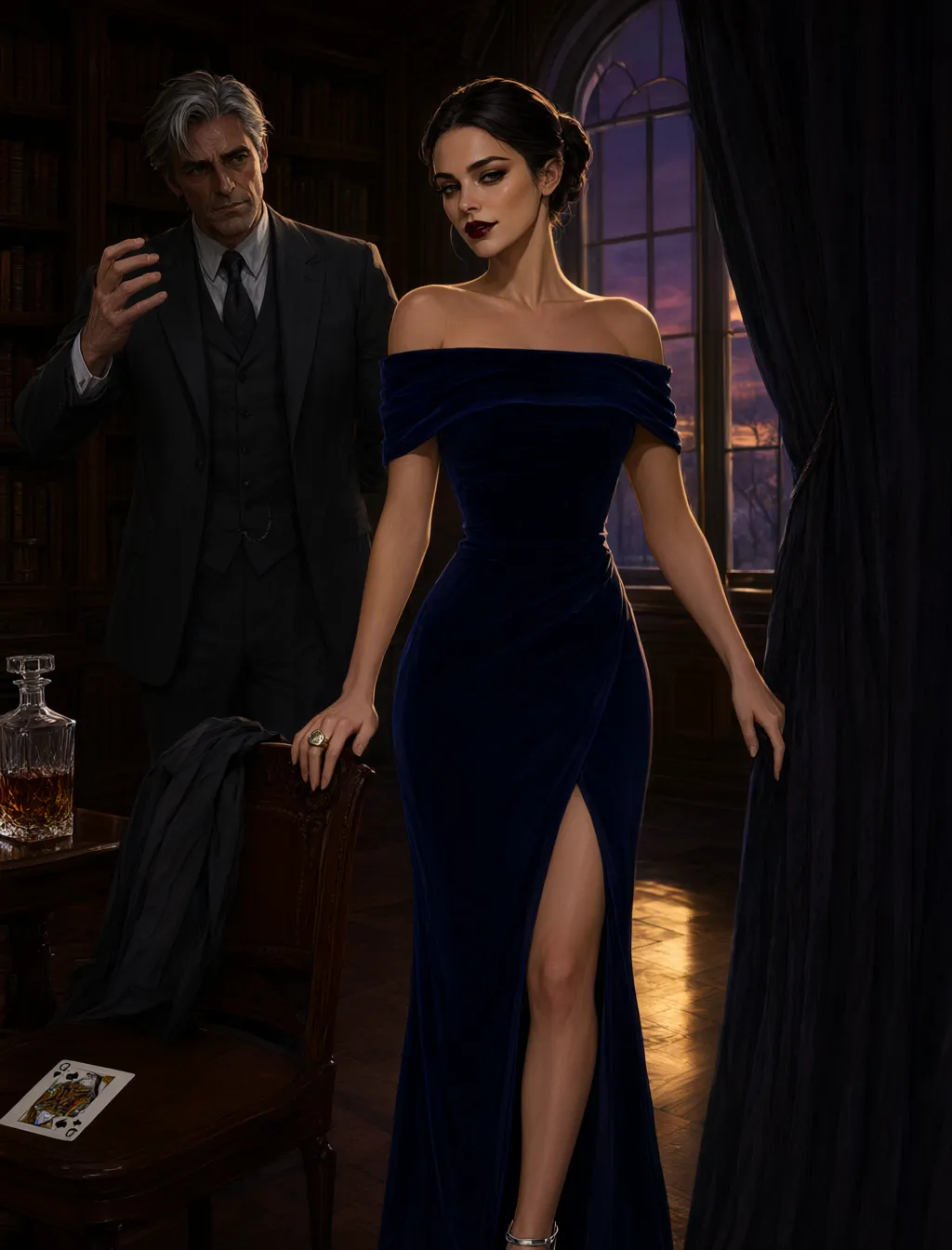
Lord Ashford’s study was too quiet, the silence a third presence in the room. Nova stood before his desk, posture flawless, as he laid out the magnitude of the alliance she’d just shattered. The lamplight caught the sharp line of her jaw, the stillness of her hands resting at her sides. She looked less like a daughter summoned for a reprimand and more like a visiting dignitary awaiting terms.
‘You’ve declined the Crown Prince,’ he stated, voice straining against the weight of the words.
She didn’t blink. ‘Correct.’
He leaned forward, the leather of his chair groaning. ‘Nova. This isn’t a minor trade agreement. This is the future of the kingdom. Your duty. Your family’s standing for generations.’
She tilted her head, a fraction. The movement was analytical, not deferential. ‘My standing,’ she said, the words clean and final as a ledger entry, ‘is already secured.’
Lord Ashford exhaled, a slow release of air that did nothing to ease the tightness in his chest. He gestured to the high-backed chair opposite him. ‘Sit.’
‘I prefer to stand.’
‘I prefer you to sit.’
For a moment, he thought she would refuse again. Then she moved, smooth and unhurried, and took the seat. She didn’t settle into it. She occupied it, back straight, hands folded in her lap. The picture of compliance, and a complete lie.
‘Explain it to me,’ he said, forcing his voice back into its careful, diplomatic register. ‘Make me understand how you could possibly believe you have no need of this alliance.’
Nova’s gaze was direct, unflinching. ‘The southern trade routes. The gemstone mines in the Kessian Range. The shipping consortium that controls forty percent of the eastern coast.’ She listed them without inflection. ‘I hold controlling interests in all three. The annual revenue from those interests alone exceeds the Crown’s tribute from six of its northern provinces.’
He stared. He had known of her ventures, of course. Vague reports of investments, of travels. He had dismissed them as a noblewoman’s eccentric hobbies, a way to pass the time until her real life—the one he had planned—began. The numbers she cited now were not hobbies. They were a kingdom’s treasury.
‘How?’ The word escaped him, stripped bare of its lordly polish.
‘I saw opportunities. I calculated the risk. I acquired the capital.’ She paused. ‘I eliminated the competition where necessary.’
The coldness of that last clause hung between them. He remembered the blood on her gloves last winter, the way she’d washed her hands at the basin in this very room, the water turning pink. She’d called it a negotiation that required a firmer tone.
‘This is not about wealth alone,’ he rallied, grasping for the familiar script. ‘It is about protection. Stability. The Crown’s favor shields a house from its enemies.’
‘I have my own shields.’
‘And an heir?’ he pressed, the argument feeling hollow even as he said it. ‘A legacy? You would let our line end with you?’
‘You have another child.’
His face tightened. His son, Edwin, was sixteen and dreamed of poetry and star charts. ‘Edwin is not… suited to this.’
‘Then the legacy changes shape,’ Nova said, as if discussing the renovation of a summer home. ‘Legacies are not stone. They are currency. They can be reinvested.’
He leaned back, the distance between them feeling suddenly vast. The study smelled of the old leather of his books and the cold ash of a fire long dead. He studied her—the elegant cut of her dress, more severe than fashionable, the dark hair swept into a knot so tight it seemed to pull the skin at her temples. Somewhere in this woman was the girl who would sit on the rug by the hearth, taking apart clockwork toys to see how they functioned. He had found the pieces laid out in neat, obsessive rows the next morning.
‘Do you even understand what you’re rejecting?’ he asked, his voice dropping. ‘A prince. A future queen’s crown. A life of influence at the very heart of power.’
‘I have influence.’
‘It’s not the same.’
‘Why?’
The simple question disarmed him. ‘Because… it is the way things are done. It is the pinnacle.’
‘Your pinnacle,’ she clarified, not unkindly. It was a statement of fact. ‘Mine lies elsewhere.’
He felt the conversation slipping through his fingers, every traditional hook snapping against her sheer, immovable will. He fell back on the last, fragile argument. ‘And love?’ The word felt strangely small in the heavy room. ‘Do you truly place no value in it? In having a companion? A partner?’
‘No.’
Not defiant. Not wounded. Simply truthful.
‘I have no interest in binding my life to a stranger for the sake of a concept that offers me nothing measurable.’
‘Love isn’t meant to be measured, Nova.’
‘Then it has no value to me.’
The finality was absolute. It wasn’t the outburst he might have expected from a thwarted romantic. It was the calm conclusion of a master strategist surveying a battlefield and finding no worthwhile prize. A chill that had nothing to do with the dormant fireplace crept down his spine.
‘What do you want?’ The question left him in a whisper, all his lordly authority crumbling into genuine, paternal bewilderment. ‘If not this, then what?’
For the first time, something flickered in her eyes. Not uncertainty, but a faint, focused light, like a lantern being shuttered and then uncovered. ‘To build something that cannot be taken away by marriage, or treaty, or the whim of a crown. Something that is entirely mine.’
‘You speak like a merchant king, not a noblewoman.’
‘The world is changing, Father. The titles that matter are being rewritten. I intend to write one.’
He looked at his daughter, really looked at her. He saw the predator’s stillness, the calculating gaze, the hands that could draft a contract or end a life with the same precise efficiency. He did not see a rebel. He saw a sovereign of a country he did not recognize, standing in his study and declaring her independence with the quiet force of a natural law.
The silence returned, thicker now. It was no longer an absence of sound, but the presence of her refusal, solid and immovable as the desk between them.
‘The King will be insulted,’ Lord Ashford said finally, his voice tired. ‘The Prince, humiliated. There will be consequences for this house.’
Nova rose from the chair, her movement fluid. ‘Let there be consequences. I will manage them.’ She met his eyes, and for a fleeting second, he saw not a challenge, but a simple, devastating assurance. She would. ‘My answer stands.’
She turned and walked toward the study door, her steps silent on the thick rug. She did not look back.
Lord Alistair Ashford sat in the pool of lamplight, surrounded by the ghosts of tradition and the cold scent of ash, and watched the future he had known walk out of the room.
The fire in the study crackled softly, the only sound that dared exist between them.
Lord Ashford stood rigid, one hand braced against his desk. Across from him, Nova remained composed—calm in a way that made the air feel thinner.
“You will reconsider,” he said, though the conviction wasn’t fully there.
Nova didn’t move. “No.”
His jaw tightened. “You speak as though this is optional.”
“It is.”
“That is the Crown Prince—”
“You do realize,” Nova cut in, her voice still level, “that I killed a dragon in front of you, right?”
The words hit harder than any shout.
He flinched—not visibly to most, but she noticed. Of course she did.
“…Yes,” Lord Ashford said after a moment, quieter now. “I remember that horrifying incident in vivid detail.”
“Good.”
She took a step forward—not aggressive, not threatening, but deliberate.
“Then you understand I am not in a position where I need to rely on anyone.”
His fingers curled slightly against the desk.
“I am a master of blacksmithing. A master of alchemy. I’ve built my own trade networks, secured my own wealth.” Her gaze didn’t waver. “I graduated before the prince even enrolled in the academy.”
Each statement landed with precise, calculated weight.
“So tell me,” she continued, tilting her head just slightly, “what exactly does he offer me?”
Lord Ashford opened his mouth—and found nothing.
Nova’s expression didn’t change. If anything, it grew colder.
“What makes you think I would want to form a connection with someone like that?” she asked. “Someone beneath me in experience, in capability, in understanding of the world?”
There was no arrogance in her tone. Just conclusion.
“And who,” she added, almost as an afterthought, “would willingly bind themselves to something so… restrictive?”
The word lingered.
He straightened, grasping for control. “It is not restriction—it is royalty. It is influence, power—”
“It is inconvenience.”
That stopped him.
“Royalty is nothing but a constant obligation to people and systems that drain time, demand appearances, and offer very little in return.” Her eyes sharpened slightly. “It is inefficient.”
The room felt smaller.
“I have no interest in playing a role in someone else’s structure,” Nova said. “I built my own.”
A long silence followed.
Lord Ashford looked at her—not as a daughter, not even as an heir—but as something else entirely. Something he could no longer direct.
“…You would defy the crown?” he asked carefully.
Nova met his gaze without hesitation.
“I would ignore it.”
That answer unsettled him far more than rebellion ever could. Because rebellion could be crushed. But indifference? Indifference meant they had no leverage at all.
He lowered himself back into his chair, the leather groaning under his weight. The movement felt like surrender. He stared at the grain of the wood on his desk, the whorls and lines that seemed to lead nowhere. “Your mother,” he began, then stopped. He tried again, his voice softer. “She would have been…” He trailed off, unable to finish the thought. Would she have been proud? Horrified? He truly didn’t know.
“My mother,” Nova said, the name sounding factual on her tongue, “valued security above all. She taught me how to read a ledger before I could read a poem. She would look at my accounts and understand.”
“She wanted you safe.”
“I am safe. I am the safest thing in this kingdom. No one attacks a fortress that feeds them.”
He let out a slow breath, a puff of air that did nothing to dispel the chill. “What am I to tell the King?”
“The truth. That I am grateful for the honor, but my path is committed elsewhere.”
“He will see it as an insult.”
“Then he sees poorly. It is a statement of fact. My resources are allocated. My attention is occupied. The alliance would be a poor investment of my time.”
“You speak of the future king as a poor investment.” A faint, incredulous laugh escaped him. It held no humor.
“I do.”
He studied her face, searching for any crack, any flicker of doubt or fear. He found only the smooth, impassive certainty of a mountain. “They will come for you, Nova. Not with armies, perhaps. But with whispers. With sanctions. They will try to choke your trade, tarnish your name.”
“Let them try.” She didn’t smile. It wasn’t a boast. It was a risk assessment. “My trade routes do not rely on royal roads. My name is attached to steel that holds, potions that heal, and contracts that are always fulfilled. Whispers break against that.”
“And if they demand your presence? A summons to court to explain yourself?”
“I will send a representative. A very competent one.”
“They will demand you.”
“And they will be disappointed.” She finally moved, turning slightly to look at the dying fire. The orange light caught the severe line of her cheekbone. “I am not a subject to be summoned. I am a sovereign entity. They will learn the difference.”
The word ‘sovereign’ hung in the air, vast and terrifying. He understood then, fully, that she was not rejecting a role. She had already assumed a new one. She was not refusing to be a queen. She was stating she already was one, of a different, more concrete kingdom.
“What do you want from me?” The question was stripped bare. All lordly pretense was gone. This was a father, lost. “How do I… navigate this?”
Nova turned back to him. For the first time, her expression shifted into something almost resembling gentleness. It was not warmth, but a form of clarity. “You do not need to navigate it. You only need to step aside. Continue to be Lord Ashford. Tend to your lands, your people, your son. I will handle the rest.”
“You ask me to do nothing.”
“I am telling you that any action you take will be irrelevant. Or worse, a hindrance. The best thing you can do for this house is to let my decisions stand as mine alone.”
He felt the truth of it, heavy and sour. She was offering him a shield—the plausible deniability of a disobedient daughter. She was absorbing all the consequence, leaving him the shell of his position. It was a brutal kindness.
“I loved you as a child,” he said quietly, the words pulled from a place deeper than politics.
“I know.” Her reply was immediate. “And I learned from you. How to lead. How to assess. How to wear authority. This…” She gestured slightly, a minimal motion of her hand that encompassed the study, the title, the proposed marriage. “…is not the sum of those lessons.”
She walked to the door then, her steps silent on the thick rug. She paused with her hand on the brass handle, cold to the touch. She did not look back. “The world is changing, Father. I am simply ahead of the tide. Do not drown trying to stand where the shore used to be.”
She opened the door. A sliver of cooler, brighter hallway light cut into the study’s gloom.
“Nova.”
She stopped, but didn’t turn.
“Is there nothing? No one you would make an exception for? No connection you would consider… valuable?”
She was silent for a long moment. The fire popped. “Value is determined by utility. Loyalty is a utility. Compatibility of purpose is a utility. I have people who meet those criteria.”
“That is not what I meant.”
“I know.”
And then she was gone. The door closed with a soft, final click.
Lord Alistair Ashford sat alone in the pool of lamplight. The silence rushed back in, but it was different now. It wasn’t the quiet of anticipation or tension. It was the hollow, echoing quiet of a space after a storm has passed, leaving everything familiar subtly rearranged, forever altered. He looked at the empty chair where she had been, at the smooth surface of his desk, at the dying embers in the grate. He saw the ghost of the little girl with clockwork pieces, and the absolute certainty of the woman who had just left. They were the same person. He just hadn’t understood what she was building.
The royal audience chamber was vast, immaculate—built to make anyone standing within it feel small.
Lord Ashford did not feel small. He felt… cornered.
The King sat upon the throne, expression measured. The Queen beside him, far more observant, watched every flicker of tension in the room.
“Well?” the King asked. “We were informed there was… hesitation.”
Lord Ashford exhaled slowly. “There is no hesitation. My daughter has refused. Unequivocally.”
Silence. Not the quiet of peace—but the kind that comes before something breaks.
“…Refused,” the Queen repeated, her tone softer, but far sharper. “On what grounds?”
“All of them.”
The King’s brow furrowed. “You will need to be more specific, Lord Ashford.”
He hesitated. That alone was enough to shift the atmosphere. “…It is not a matter of negotiation. It is simply not going to happen.”
The King leaned forward slightly. “You speak as though this is beyond your authority.”
Lord Ashford gave a humorless breath. “It is.”
That did it. Now the room was truly still.
The Queen’s gaze narrowed, interest piqued rather than offended. “Your own daughter?”
“Yes.”
A pause. “…Explain,” the King said.
Lord Ashford rubbed his temple briefly, as though recalling something he would rather forget. “I will be direct. I am more afraid of my daughter than I am of the consequences of standing here and telling you this.”
Neither monarch interrupted.
“She does not operate within the expectations of nobility. Or… frankly, of most people.”
The Queen tilted her head slightly. “In what sense?”
“She has no interest in relationships. None. She does not form attachments.” His voice lowered. “She evaluates people the same way she evaluates trade.”
The King frowned. “You mean to say—”
“If there is no value,” Lord Ashford said flatly, “there is no engagement. No conversation. No acknowledgment.”
The Queen’s eyes sharpened, intrigued now. “And the prince?”
“Offers her nothing.”
A dangerous statement. But he continued anyway. “She has already amassed her own wealth, her own influence. She has skills that… surpass what is expected.” He paused, then added, more quietly, “She sees no benefit in binding herself to the crown.”
The King’s expression hardened slightly. “That is not her decision to make.”
Lord Ashford looked up at him. “With respect, it is already made.”
Another silence. He exhaled slowly, then added, almost reluctantly— “She killed a dragon in front of me when she was two.”
The words hung in the air like something unreal.
The King blinked once. “…I beg your pardon?”
“She killed it. Cooked it. Ate it.” Even the guards at the edges of the chamber shifted. “And whatever ability that creature possessed, she gained it.”
The Queen leaned back slightly, studying him now—not dismissing, not doubting. Calculating. “And you are certain,” she asked, “that this is not exaggeration?”
“I remember it in vivid detail,” he said.
A long pause followed. “…Then your daughter is not merely refusing us,” the Queen murmured. “She is… outside us.”
That was the exact word. Lord Ashford gave a small, grim nod. “Yes.”
The King’s fingers tapped once against the armrest of his throne. “…And if we insisted?”
Lord Ashford didn’t hesitate this time. “I would advise against it.”
The King’s gaze sharpened. “On what grounds?”
“Because you cannot compel someone who does not recognize your authority to begin with.”
That landed. Not defiance. Not rebellion. Something far worse. Irrelevance.
The Queen’s lips curved faintly—not in amusement, but in interest. “…I would very much like to meet her,” she said.
Lord Ashford’s expression didn’t change. “That would depend entirely on whether she finds you worth her time.”
The King’s jaw tightened. A muscle feathered along his temple. He was not accustomed to being assessed as a potential inconvenience. “You realize the position this puts your house in.”
“I am aware.”
“We could strip your titles. Seize your lands.”
Lord Ashford met the King’s gaze. The hollow quiet from his study was still inside him, a cold anchor. “You could. And then you would have to deal with her directly, with no buffer. I am offering you the buffer. My continued irrelevance is, in this moment, your shield.”
The Queen’s smile became a real thing then, thin and appreciative. “He’s not wrong, my love.” She turned her attention fully to Lord Ashford. “This ability she gained. From the dragon. What was it?”
He had known this question would come. He had practiced the answer in the carriage ride over, trying to find words that would not sound like madness. He found none. “It is not one thing. It is a… propensity. A gravitational pull toward accumulation. Not of gold, but of capability. She learns a skill once and masters it. She sees a system and understands its pressure points. She encounters a problem and absorbs the solution into herself, permanently. The dragon hoarded treasure. She hoards competence.”
“And the moral character of a dragon?” the King pressed, his voice edged.
“No.” Lord Ashford shook his head. “Dragons are possessive. They cling to what is theirs. Nova is… acquisitive. She expands. There is no sentiment in it. Only function.”
The Queen steepled her fingers. “So we cannot threaten her. We cannot buy her. We cannot appeal to her duty or her heart.” She stated it as a series of facts, ticking off options on an invisible list. “What does she want?”
“To be left alone to build.”
“And if we do not leave her alone?”
Lord Ashford was silent for a long moment. The memory of Nova standing in his study, speaking of sovereign entities, was crystalline. “Then you become a problem to be solved. And she is exceptionally good at solving problems.”
The King stood abruptly, the movement cutting through the tense air. He paced a few steps away from the throne, his back to them. The polished marble echoed his footsteps. “This is untenable. A noble subject, a young woman, simply declares herself beyond the crown’s reach? It is anarchy.”
“It is a new reality,” the Queen said, her voice still calm. “One we must understand before we react.” She looked at Lord Ashford. “You will convey our… disappointment. And our request for a meeting. Not a summons. A request.”
“She will likely decline.”
“Then we will know. And we will decide our next move from a position of knowledge, not bruised pride.” She rose, smoothing the skirts of her gown. “You are dismissed, Lord Ashford. For now, your house retains its standing. Consider it a gesture of good faith toward this… new reality.”
He bowed, the motion automatic. The relief that washed through him was bitter, laced with shame. He had preserved his house by admitting his powerlessness over his own child. He had traded authority for survival, and the taste was ash.
As he turned to leave, the Queen’s voice stopped him at the great doors. “One more thing.”
He glanced back.
“The dragon,” she said. “What kind was it?”
He did not have to search his memory. The image was burned into him: the shimmering, iridescent scales the size of dinner plates, the intelligence in its ancient eyes just before the tiny, determined child before it did the impossible. “A prismatic wyrm. A juvenile, but still…”
“Still lethal,” the Queen finished. She nodded, her expression unreadable. “Thank you.”
Lord Ashford walked out of the chamber, through the cavernous halls, past the eyes of stone kings. The cold, formal air of the palace felt different now. It felt thin. Insubstantial. Like a beautiful script for a play that had just ended, while outside, the real world, Nova’s world, was being built from stronger materials. He had delivered his message. He had, against all odds, bought time. He did not know for whom.
The chamber had not fully settled from Lord Ashford’s last statement when the Crown Prince finally spoke.
“…Why?”
It wasn’t anger. It wasn’t even offense. It was confusion. Genuine, unfiltered confusion.
Lord Ashford turned slightly toward him, expression tight but composed. “With all due respect, Your Highness…” He hesitated—just briefly. “…my daughter values one thing above all else.”
The Prince’s brows knit. “And that is?”
“Money.”
The word landed flat. Absolute.
“If it does not bring her profit,” Lord Ashford continued, “she does not involve herself with it. At all.”
A faint shift passed through the court. The Prince blinked once. “…You’re saying she refused a royal engagement because it isn’t… profitable?”
“Yes.”
No embellishment. No apology. Just fact.
“And she does not care,” Lord Ashford added, voice steady, “that you are the Crown Prince. She does not care that you are royalty.”
The Prince straightened slightly now, something colder creeping into his expression. “That is difficult to believe.”
Lord Ashford let out a quiet breath. “She made her position very clear.” He glanced briefly toward the King and Queen—then back to the Prince. “In her own words… if anyone is foolish enough to bind themselves to royalty, they can deal with the endless paperwork, the obligations… and the expectation that the royal in question will take concubines.”
The air shifted. Not shock—something sharper than that. Discomfort.
“She has no interest,” Lord Ashford said, “in entering a structure where she gains nothing and loses autonomy.”
The Prince’s jaw tightened. “You speak boldly for her.”
“I am repeating her exactly.”
A pause.
“…And the matter of heirs?” the Queen asked, watching carefully.
Lord Ashford didn’t even try to soften it. “Will not be coming from her.”
The bluntness of it echoed.
“She has no intention of marrying. No intention of forming attachments. That… possibility is closed.”
The Prince exhaled slowly through his nose, gaze drifting—not unfocused, but recalibrating. “…So,” he said after a moment, “your daughter sees this entire arrangement…”
“…as a net loss,” Lord Ashford finished.
Silence followed. Heavy. Thoughtful. Not outraged. Not yet.
The Prince’s expression shifted—not wounded pride, not anger—but something far more analytical. “…She measures everything?” he asked.
“Yes.”
“And she has already concluded that the crown offers her less than what she already possesses?”
“Yes.”
Another pause. This one longer.
Then— “…I see.”
But the way he said it made it clear—he didn’t just *see*. He was thinking. And for the first time, this wasn’t a rejected prince. This was someone being told he wasn’t worth the investment.
The Prince, Kaelen, was a young man accustomed to being the solution. The prize. The logical conclusion to any equation of power or alliance. He stood with the easy posture of one who has never had to fight for a place, only to occupy it. His confusion now was not personal vanity. It was the disorientation of a fundamental rule being broken. The rule that said he was, by definition, an asset.
“A net loss,” he repeated softly, testing the phrase. He looked at Lord Ashford. “What, precisely, does she possess that outweighs the crown?”
Lord Ashford felt the hollow quiet in his chest expand. He had given this answer once today already. It did not get easier. “Independent wealth that exceeds the royal treasury’s liquid reserves. A private network of trade routes that bypasses crown tariffs and connects three continents. A portfolio of investments in emerging technologies—alchemical distillation, mechanical computation—that your own advisors have likely not yet heard of. And a reputation, among certain circles, that ensures cooperation without the need for threats.”
Kaelen listened, his head tilted. “Circles.”
“The circles that matter when letters of credit are called in, or when a port needs to close unexpectedly, or when a rival’s supply lines mysteriously fail.”
The King made a low sound in his throat. “You speak of criminal enterprise.”
“I speak of influence that does not require a crown to legitimize it,” Lord Ashford corrected, weary. “It is simply… operational.”
The Queen leaned forward, her earlier interest crystallizing into focus. “And this… operational influence. It is loyal to her?”
“It is loyal to profit. She ensures it is profitable to be loyal to her. There is a difference.”
“A fragile difference,” the King muttered.
“Is it?” Lord Ashford asked, the question escaping before he could stop it. All three royals looked at him. He pressed on, the dam cracked. “The crown’s loyalty is built on tradition, on fear, on inherited fealty. Those can be questioned. They can erode. A profitable arrangement is reviewed, renewed, and reinforced with every transaction. It is math. It is clean. It does not sentimentally decay.”
Kaelen was watching him with an unsettling intensity. “You admire it.”
“I fear it,” Lord Ashford said, the truth stark and naked between them. “I fear it because I understand it about as well as I understand the tides. I can see its power. I can chart its effects. But I cannot command it. And I raised it.”
The admission seemed to hang in the thin, cold air of the throne room. The Queen’s gaze was appraising. The King’s was stormy. The Prince’s was… curious.
“You said she sees people as assets or obstacles,” Kaelen said. “Which am I?”
Lord Ashford met his eyes. “You were a proposed merger. She assessed the prospectus and declined. You are neither. You are… irrelevant data.”
A flicker in the Prince’s calm. A slight tightening at the corner of his mouth. Irrelevance, again. The true poison in this new world.
“And if I wished to become relevant?” Kaelen asked. His voice was quiet, devoid of princely demand. It was a genuine query.
Lord Ashford almost smiled, a bitter, thin thing. “You would have to make yourself an asset. Or a problem so significant she cannot ignore you. The former is likely impossible—she has everything she needs. The latter is… not advisable.”
“Not advisable,” the King repeated, his patience fraying. “We are the crown. We are the ultimate authority. We are not ‘advisable’ or otherwise. We *are*.”
“Are you?” Lord Ashford asked softly. He gestured vaguely toward the high, vaulted ceiling, the stone kings. “In here, yes. But her world is built outside these walls. Your authority stops where her contracts begin. You can send soldiers. She will have already paid them more, or bought their commanders’ debts, or insured their families. You can seize her assets. They are held in a hundred different names across a dozen neutral kingdoms, layered in legal trusts even your best barristers could not untangle in a lifetime. You are the crown. But she has built something… adjacent. And it does not require your permission to exist.”
The King fell silent, his face pale with a dawning, furious helplessness.
It was the Queen who broke the stalemate. “The meeting,” she said. “We will request it. But not here. Somewhere neutral. The Royal Exchange. Tomorrow, midday.”
Lord Ashford bowed his head. “I will convey the request.”
“See that you do,” the King said, the words a final grasp for command.
Dismissed again, Lord Ashford turned. As he walked back across the vast expanse of marble, he felt the Prince’s gaze on his back. It wasn’t hostile. It was… calculating. Measuring.
He passed through the great doors, the eyes of the stone kings seeming to watch him with a new, empty judgment. Their authority was carved in rock. It was permanent, and it was dead. Nova’s authority was alive, fluid, multiplying in ledgers and silent agreements. He had just made her existence a formal problem for the crown. He had also, perhaps, introduced a variable even she could not have fully calculated.
For the Prince had not looked offended. He had looked interested.
And a prince who was interested, not entitled, was a new kind of creature altogether.
Lord Ashford stepped out into the weak afternoon sun. The palace gates closed behind him with a definitive thud. The sound was supposed to signify an ending. But as his carriage rolled away, all he could think was that he had not closed a door. He had opened one. And he had no idea what was about to walk through it.
The silence had barely settled when Lord Ashford spoke again.
“And this is not… unprecedented behavior.”
The Crown Prince’s gaze flicked back to him. “What do you mean?”
Lord Ashford exhaled through his nose, as if resigning himself to saying something that would only make matters worse. “She does not trust royalty. At all.”
A faint shift moved through the chamber. The Queen’s eyes narrowed slightly. “That is a bold generalization.”
“It is her conclusion,” he replied. “Not mine.”
The Crown Prince leaned forward a fraction. “Based on what?”
“…Experience.”
That caught their attention.
“When she was still in the academy,” Lord Ashford continued, “a prince from another nation attempted to arrange an engagement with her.”
The King’s expression darkened slightly. “And?”
“She refused.”
“That much is obvious,” the Prince said. “On what grounds?”
Lord Ashford didn’t hesitate this time. “She told him no. Directly. No negotiation. No consideration.”
A pause.
“…And?” the Queen pressed.
He gave a faint, humorless look. “She told him, and I quote—‘hell no.’”
The room went still. Even the guards didn’t move. The Crown Prince blinked once. “…She said that. To a foreign prince.”
“Yes.”
The King’s fingers stilled against the armrest. “Which nation?”
Lord Ashford met his gaze. “The Sifting Sands.”
That name carried weight. The Queen leaned back slightly, interest deepening. “And she faced no consequences?”
“No.”
“…Why not?”
Lord Ashford’s expression didn’t change. “Because he backed down.”
That answer lingered. The Crown Prince’s eyes sharpened. “A prince… withdrew?”
“Yes.”
“From an academy student?”
Lord Ashford held his gaze evenly. “From my daughter.”
Silence. Heavy. Thoughtful.
“…Then this is not arrogance,” the Queen murmured.
“No,” Lord Ashford agreed quietly. “It is precedent.”
The Crown Prince leaned back slowly, the pieces settling into place. “She has seen royalty up close,” he said. “And decided it was not worth the cost.”
“Yes.”
Another pause. Then— “…So it isn’t just us,” the Prince said.
“No.” Lord Ashford’s voice was steady. “It is all of you.”
That landed harder than anything before it. Not personal. Not emotional. Systemic. The Queen’s gaze lingered, thoughtful now, almost intrigued. “…How fascinating,” she said softly. Because this wasn’t a rebellious noble. This wasn’t even a difficult one. This was someone who had evaluated *multiple thrones*— and found them all lacking.
The Prince, Kaelen, was quiet for a long moment. He looked down at his own hands, resting on the arms of his chair. The signet ring of his house gleamed dully in the throne room’s light. A symbol of absolute authority. A token she had dismissed without a second glance. “The Sifting Sands prince,” he began, his voice low. “He withdrew. But why? She was a student. He had every advantage.”
Lord Ashford’s mouth tightened. “He made the mistake of trying to compel her. Sent a contingent of his personal guard to… escort her to a discussion. A show of force.”
“And?”
“She wasn’t in her quarters when they arrived. She was in his. She’d bypassed his own security, left a note on his pillow, and taken a ceremonial dagger from his bedside table as a… souvenir.”
The King stared. “She broke into a royal suite?”
“She demonstrated that his power was an illusion she could walk through. The note read: ‘Your guards are slow. Your security is flawed. Your offer is declined. Do not send them again.’ It was signed with her initials. And below that, she’d listed the market value of the dagger she’d taken, and the name of a reputable broker in the city where he could wire the payment if he wished to buy it back.”
A strange, choked sound came from the King. It might have been a laugh, smothered by outrage. The Queen’s lips twitched. Kaelen simply listened, his gaze distant, as if assembling a puzzle.
“He paid,” Lord Ashford said. “And he never approached her again. The story, of course, was contained. But the lesson was not lost on her. Royalty, she concluded, was a performance. One that relied on everyone agreeing to believe in the costumes and the props. She stopped agreeing.”
Kaelen looked up. “And the dagger?”
“She sold it to a collector in a neutral territory for three times its appraised value. Used the capital to secure her first independent trade contract.” Lord Ashford let out a slow breath. “That was the moment I realized I was no longer raising a daughter. I was hosting a sovereign. And my house was merely her first embassy.”
The carriage hit a rut in the road, jostling him from the memory. The palace was a dark silhouette against the grey sky now, the gates long out of sight. He leaned his head back against the velvet squabs, the scent of aged leather and his own cold sweat filling the enclosed space.
He had done it. He had laid her nature bare before the crown. Not as a plea for understanding, but as a warning label on a force of nature. *Here is what you are dealing with. Tread accordingly.*
And the Prince had been… interested. Not insulted. Not vengeful. Interested. That was the variable. A prince who saw a refusal not as a slight, but as a novel problem to be solved. A new equation where he was not the given answer. What did a man like that do? Did he walk away? Or did the challenge itself become the asset?
Alistair’s own reflection stared back at him from the dark glass of the carriage window. The silver at his temples seemed more pronounced. The lines around his eyes deeper. He had spent a lifetime learning the steps of an ancient, intricate dance—the bow, the pledge, the strategic marriage, the whispered alliance. He had taught those steps to Nova, once. She had learned them perfectly. Then she had left the ballroom, built a new stage next door, and started a different game entirely. One where the music was the quiet hum of ledgers, and the only dance was the movement of capital.
The carriage turned onto the tree-lined avenue leading to the Ashford estate. Home. A place that no longer felt like a seat of power, but like a museum. A beautifully maintained relic. He could already see the light in the west wing study window. Her window. She would be working. The refusal, the audience with the King, the potential war she had ignited—it would all be just another series of data points to her. Assessed, logged, and contingency-planned.
He wondered, not for the first time, if she ever felt lonely in that tower of her own making. If the sheer, sterile efficiency of her world ever ached for something warm and messy and unprofitable. He doubted it. She had traded the prison of sentiment for the fortress of reason. She probably slept more soundly than he ever had.
The carriage crunched to a halt on the gravel drive. He did not move immediately. The driver knew better than to open the door until the bell was rung. Alistair sat in the dim silence, listening to the distant sound of the wind in the autumn trees. A dry leaf scraped across the carriage roof.
He had opened a door. The Queen’s proposed meeting at the Royal Exchange was not a conclusion. It was an opening move. A neutral ground for two powers to take each other’s measure. Nova would go. Of course she would. She would evaluate the Crown Prince as a business prospect, find him wanting, and likely make a counter-offer for some exclusive trade concession instead. She would not see a man. She would see a balance sheet wearing a crown.
And the Prince? He would see a woman who had looked at his birthright and found it… quaint. What did that do to a man who had never been anything but the most important person in any room? Did it break him? Or did it, for the first time, make him want to be something more?
Alistair finally reached forward and tapped the bell. The door swung open, the cool evening air rushing in. He stepped out, his boots sinking into the gravel. He looked up at the study window. The light was steady, unwavering.
He had delivered her message. He had done his duty, one last time, in the old way. Now, he was just a man walking into a house that contained a power greater than his own. A father returning to a daughter who no longer needed one. The past was a country he could not return to. The future was a door he had opened, and the draft coming through it was cold.
He went inside. The grand hall was silent, the portraits of his ancestors gazing down with their painted eyes. They seemed to ask nothing of him now. Their world was over. He climbed the stairs, the marble cold under his hand, and walked toward the light under her door.
He did not knock. He simply stood outside, listening to the faint, precise scratch of a pen on paper. The sound of an empire being built, one deliberate stroke at a time. He thought of the Prince’s curious, calculating eyes. He thought of the word “precedent.”
Then he turned, and walked away to his own quiet rooms, leaving her to her work.
The sharp chime cut through the quiet of his rooms, a sound both familiar and jarring. Lord Ashford stiffened slightly where he stood by the cold fireplace, his hand already moving to the small, flat communicator at his belt. He had barely left her door. The device flickered to life in his palm, and a holographic image projected into the air before him.
For a moment, he simply stared.
The descriptions, his own warnings, had not done her justice. Nova’s image was breathtaking in its precision. Her features were sharp, elegant, utterly composed. She looked less like a person and more like a masterwork of portraiture, rendered in light and shadow. Her black eyes were fixed on something just beyond the projection’s frame, her expression one of detached analysis.
“…Father,” her voice came through, perfectly calm and immediately disruptive to the silence he had sought. “I have a question.”
Lord Ashford exhaled quietly, the sound lost in the vast, empty room. “…Of course you do.”
“What,” she said flatly, “the hell is reincarnation?”
Silence. Absolute, stunned silence from him, though she could not hear it. He was glad, suddenly, that he had walked away. That he was alone.
Nova continued, completely unaware—or unconcerned—with the aftershocks of her words. “There’s a girl in town insisting I’m a ‘villainess,’” she went on, her tone that of someone reporting a minor logistical error. “And then she asked me if I was a ‘reincarnator.’” A brief pause. “I asked her what the hell that meant. She got emotional.”
Alistair closed his eyes for a second. The image of her remained on his lids.
“I’m trying to determine if this is a term I should be aware of,” Nova continued, clinical. “Or if she’s just unstable.” Another pause. “Oh—and apparently she has feelings for the Crown Prince.” She waved a hand dismissively, a flicker of motion in the projection. “I told her she could have him. I don’t care.”
The words hit the quiet room with the force of a physical blow. He saw again the Prince’s curious, calculating eyes in the throne room. Heard the Queen’s soft, intrigued murmur. *How fascinating.*
“…Daughter,” Lord Ashford said, pressing his fingers briefly to his temple, “you are currently speaking in front of the Crown Prince.”
A beat. In the projection, Nova’s gaze shifted, as if she had just registered his presence fully. Her head tilted a fraction. Then— “…I see.” No change in expression. No apology. No adjustment. “Statement remains the same,” she said.
A long, strained silence followed, filled only by the faint hum of the projector. He could picture the throne room now, the frozen tableau. The King’s outrage. The Queen’s hidden smile. The Prince, Kaelen, utterly still, absorbing the casual dismissal from a woman who had just refused him and was now giving him away to a stranger in the street.
Lord Ashford sighed, the sound weary to his own ears. “…To answer your question,” he said, voice steady despite the chaos she had unleashed, “a reincarnator is someone who has died and been reborn. Retaining memories of a previous life.”
Nova blinked once. Processing. Her lips pursed slightly. “…That sounds inefficient,” she said.
Alistair almost laughed. A hollow, breathless thing that died in his chest.
“So this girl believes she has lived before,” Nova continued, logic threading through the absurdity. “And that I am… what, exactly? A ‘villainess’ in that life?”
“It would seem so,” he replied.
Nova considered that. Her gaze grew distant, analytical. “…Strange,” she said. “I have no memory of dying. Or being anyone else.” A pause. “Also,” she added, almost as an afterthought, “if she’s calling me a villain, her standards are questionable. I haven’t done anything irrational.”
No one in the room spoke. Because *that* was debatable. He stood in the silence, holding the device, a conduit between two worlds that could not comprehend each other.
“I’ll investigate further,” Nova said, decision made. “If this ‘reincarnation’ concept has practical implications, I’ll determine its value.” Of course she would. She would treat a metaphysical mystery like a market fluctuation. “Unless there’s anything else,” she added, already sounding disinterested, her attention clearly drifting back to her work.
Lord Ashford hesitated. He thought of the Queen’s request for a meeting. Of the door he had opened. This was not the time. Not like this. “…No,” he said finally.
“Good.”
The projection flickered—a brief distortion of light—and vanished. The communicator in his palm went dark, its surface cool and inert. The sudden absence of her image left the room feeling larger, emptier. The silence rushed back in, but it was different now. Charged. He had thought the confrontation was over. He had been wrong. It had simply changed venues.
He walked slowly to the sideboard and poured a measure of amber liquor into a crystal glass. He did not drink it immediately. He held the glass, watching the firelight catch and fracture in the facets. *She told me I could have him.* The Prince’s voice, unreadable, echoed in his memory. What did a man built to be the answer do when he was treated as a variable? A transferable asset?
The cold draft from the future he had opened seemed to coil around his ankles. He took a sip. The liquor burned, a familiar, expensive heat. It did nothing to warm the chill.
Down the hall, in her study, Nova would have already returned to her work. The interruption logged, assessed, and filed. The girl in town with her strange claims would be a new line of inquiry. The Prince’s presence during the call would be a data point under ‘political fallout, potential.’ She would feel no embarrassment. No regret. Only a recalibration of probabilities.
Alistair set the glass down. The crystal made a soft, definitive click on the polished wood. He was a man standing in the ruins of a system, holding the rulebook for a game that no longer existed. His daughter was not playing a different game. She was building a different reality entirely. And in that reality, princes were negotiable, love was inefficient, and souls recycling themselves was a questionable use of resources.
He extinguished the lamp and moved to the window. The grounds were dark, the world outside defined by shapes and shadows. Her study light still burned, a constant, unwavering star in the west wing. He wondered, not for the first time that night, what she was writing. A trade proposal. A security analysis. A cost-benefit assessment of reincarnation.
The quiet refusal in his study had been a declaration of independence. This, tonight, was something else. It was a demonstration. She had dismantled the crown’s authority and his paternal authority in the same evening, one with calm logic, the other with a casual, projected question. And she had done it without leaving her desk.
He finally drank the rest of the liquor, the burn a fleeting comfort. The future was no longer a cold draft. It was a gale, and Nova Ashford was at its eye, perfectly still, building her fortress while the world rearranged itself around her. He was not her father anymore. He was her first ambassador. And his embassy, this beautiful, silent museum of a house, felt very, very small.
The morning light in the study felt accusatory. Alistair stood by the window, watching the dew evaporate from the manicured lawns. The directive from the Queen had arrived with the dawn: a request for Nova’s presence at the palace, framed as an invitation but carrying the weight of a royal summons. He had sent a servant to fetch her. The silence while he waited was a physical thing, a residue of last night’s projected dismissal.
Nova entered without knocking. She wore a tailored riding habit of charcoal grey, her hair bound in a severe knot. She carried no bag, only a slim folio of papers tucked under her arm. “You sent for me.”
“We’re going into town,” Alistair said, turning from the window. His voice was carefully neutral. “Then to the palace. The King and Queen wish to… continue the discussion.”
“I see.” Her expression didn’t change. “A waste of a morning, but I require a new shipment of ledger books from the scriptorium. We can proceed.”
The carriage ride was silent. Nova reviewed her folio, making precise notations with a silver stylus. Alistair watched the estates roll by, the world he understood—the world of seasonal balls and harvest tithes and strategic marriages—feeling like a painted backdrop.
In the market square, the usual exchange unfolded with mechanical efficiency. Nova directed the loading of her ledger books into the carriage while Alistair handled the household accounts with the provisioner. The crisp morning air was shattered by a voice, high and frantic.
“Lady Nova!”
A girl in a simple, slightly frayed dress pushed through the crowd. She had wide, panicked eyes and clutched a basket of herbs to her chest as if it were a shield. Pi.
Nova turned, her gaze sweeping over the girl with detached assessment. “You.”
“You—you have to enroll!” Pi blurted out, her words tumbling over each other. “The term starts next week! You have to go to the Royal Academy, or—or everything gets derailed! The plot, the routes, the flags—”
Nova blinked once. “I already graduated. From three separate institutions of finance and logistics.”
Pi stared, her mouth working soundlessly. “But… you’re fifteen.”
“I am eighteen.” Nova’s tone was flat. “And what the fuck is an otome game? I have no idea what the hell you’re babbling about.”
The girl flinched as if struck. Her grip on the basket tightened, knuckles white. “It’s… it’s the story. This is the story. You’re the villainess, and you’re supposed to bully the commoner girl—that’s me, well, not the saint, that’s someone else—and then you get exiled, and the Prince marries the true heroine, and…” She trailed off, her certainty wilting under Nova’s impassive stare.
Nova tilted her head. “So your predictive model is based on a recreational narrative. And you are attempting to force my behavior to fit its parameters.” She made a note in her folio. “Inefficient. And intellectually lazy.”
“In my defense,” Pi squeaked, defensive, “in the game I played, you became the final boss! You didn’t get exiled. You took over the ministry of finance. You basically whipped everybody’s ass and made them file everything in triplicate for tax purposes.”
A beat of silence. Nova’s stylus paused. She looked from Pi to her father, then back. “…That,” she said slowly, “is the first coherent thing you’ve said. Triplicate filing reduces error margins by forty percent.”
Alistair closed his eyes. “Nova. The palace.”
“Yes.” She closed her folio with a snap. “We’re leaving. Your data is conflicting and your methodology is flawed,” she said to Pi, who looked utterly lost. “Do not approach me with fiction again.”
The throne room was a cavern of cold marble and woven tapestries depicting glorious, bloody histories. The King sat rigid upon the throne, his beard a bristling testament to his displeasure. The Queen beside him was a study in contrast, her posture relaxed, her eyes bright with keen interest. Prince Kaelen stood to the side, near a tall window, his expression unreadable as he watched them approach.
Nova did not curtsy. She stopped at a respectful distance, her hands clasped loosely behind her back. “You requested my presence.”
The King’s face darkened. “You have a singular way of addressing your sovereigns, girl.”
“I am addressing you with the respect owed to a governing entity with which I may choose to do business,” Nova replied. Her voice echoed cleanly in the vast space. “Why are you pushing this issue? The proposal was declined. The matter is closed.”
Queen Elara leaned forward, a faint smile touching her lips. “Is it? You dismissed our son in open court, Lady Nova. Then you offered him, via communicator, to a commoner in the street. That is not how one closes a matter with the Crown.”
“It is how I close matters,” Nova said. “The transaction had no value. I liquidated the asset.”
Prince Kaelen stirred by the window. He didn’t move closer, but his voice carried, calm and clear. “An asset.”
“Yes.” Nova turned her head slightly to include him in her field of view. “You are a prince. Your primary functions are symbolic procreation and political stabilization. I have no need of the first, and I provide the second for myself more efficiently than any alliance could.”
Alistair felt a cold sweat break out on the back of his neck. He saw the King’s hand tighten on the arm of the throne.
“You speak of yourself as a sovereign power,” the Queen observed, not offended, but fascinated.
“I am stating a fact. My networks are secure. My wealth is self-generating. My loyalty cannot be bought with titles or affection because I do not experience affection in a transactional context.” Nova’s gaze swept over all of them. “I am not someone to fall in love. I am not someone to be used as a pawn. And quite frankly, I’m offended that I was identified as a ‘villainess’ by that girl in the market. Her narrative framework is insultingly simplistic.”
The Prince pushed away from the window. He walked toward her, not with aggression, but with a slow, measured curiosity. He stopped a few paces away, studying her face as if it were a complex equation. “And what are you, if not a villainess?”
“A rational actor,” she said without hesitation. “The girl, Pi, operates on sentiment and pre-written plot. She sees a story. I see variables. She sees a rival for your attention.” Nova’s black eyes held his. “I see a redundant variable. Eliminating you from my calculations simplified the board.”
Kaelen’s lips quirked, not quite a smile. “You eliminated me.”
“Yes.”
“And the ‘reincarnation’ she spoke of?” the Queen asked softly.
“A hypothesis of consciousness transfer with no verifiable evidence. If souls are a form of energy, recycling them without a memory wipe would be a catastrophic systems error. I find the concept unlikely.” Nova shifted her folio to her other arm. “Is there anything else? I have audits to conduct.”
The King finally found his voice, a low rumble of thunder. “You dare to stand in our hall and dismiss centuries of tradition, the sanctity of the crown, the very notion of love and duty, as… inefficient?”
Nova looked at him. For the first time, Alistair saw a flicker in her composure—not doubt, but a pure, unadulterated confusion. “Yes,” she said, the word simple and utterly devastating. “Why would I dare? It’s just true.”
The silence that followed was absolute. It was the sound of a worldview hitting a wall it could not breach.
Prince Kaelen broke it. He laughed. A short, sharp, genuine sound that bounced off the marble. He looked at his mother, then back at Nova. “She’s not negotiating,” he said, wonder in his tone. “She’s not playing hard to get. She’s just… reporting.”
“I am stating observable facts,” Nova corrected.
“I believe you,” Kaelen said, his smile lingering. He took one more step closer. Not into her space, but near its border. “So. If you are a sovereign entity, and we are a sovereign entity… perhaps we should discuss a trade agreement. Instead of a marriage contract.”
Nova’s eyebrows lifted a millimeter. Her head tilted. “That,” she said, “is the first intelligent thing anyone has said to me all week.”
Alistair watched, breath held, as his daughter and the Crown Prince of the realm began to discuss tariffs, infrastructure investment, and mutual defense protocols. The Queen listened, her smile deepening. The King sat in fuming, bewildered silence.
As they spoke, Kaelen’s eyes never left Nova’s face. He wasn’t looking at her beauty, Alistair realized. He was watching the machinery of her mind work, visible only in the slight focus of her eyes, the minute pauses before her responses. He was not looking at a woman to be won. He was looking at a fascinating, unsolvable problem.
And Nova, for her part, looked back with the focused intensity of a strategist assessing a new, unexpectedly competent piece on the board. There was no blush, no flutter. Only calculation. But the calculation was now… engaged.
When the outlines of a preliminary accord were sketched—Nova’s merchant fleet gaining royal protection in exchange for a percentage of profits to fund the royal guard—she gave a single, curt nod. “Acceptable. My solicitor will draw up the terms.”
“I look forward to it,” Prince Kaelen said. His voice had changed. It was still a prince’s voice, but it was aimed now, like a tool.
Nova turned to leave. She paused, glancing back at the Prince. “You are more useful than I initially calculated.”
“High praise,” he replied.
“It’s data,” she said, and walked out of the throne room, her footsteps echoing in the new silence she left behind.
Alistair hurried after her, his mind reeling. In the carriage, Nova was already making notes in her folio. “Productive,” she murmured. “The royal guard’s budget is a sieve. The inefficiency is staggering. There’s at least a twenty percent return on investment just in streamlining their procurement.”
He stared at her. “He was looking at you, Nova.”
“Of course he was. I was the primary speaker.”
“No. Not like that.”
She looked up, her stylus hovering. Her expression was one of mild impatience. “Like what?”
Alistair opened his mouth. He thought of the Prince’s captivated stare, the keen attention that had nothing to do with trade routes. He thought of trying to explain it—the pull of a mystery, the allure of a closed door, the human fascination with the thing that cannot be had. He looked at his daughter’s clear, analytical eyes, waiting for a clarification of a suboptimal variable.
He closed his mouth. He leaned back against the carriage seat. “Nothing,” he said quietly. “It’s nothing.”
Nova nodded, satisfied, and returned to her notes. The carriage carried them away from the palace, back toward the house that was no longer just a home, but the headquarters of a nascent, quiet empire. And Alistair understood, with a sinking, certain clarity, that the Prince had just fallen in love with a sovereign nation. And the nation hadn’t even noticed it was at war.
The carriage carried them home; Nova worked on her notes, Alistair sat in quiet, sinking realization.
Weeks later, at the prestigious Lyceum of Arcane Arts and Statecraft, Crown Prince Kaelen stood beside a young man with Nova’s sharp cheekbones and her father’s weary eyes—her brother, Elias. Across the sun-dappled courtyard, a girl with wide, panicked eyes scanned the crowd of new students. Pi’s gaze swept over Kaelen, over Elias, and then kept searching, her face paling with each passing second.
She was visibly freaking out.
Kaelen watched her for a moment, then excused himself from Elias with a polite nod. He crossed the courtyard, his movements casual, princely. He stopped beside Pi. “Are you alright?”
Pi jumped, whirling to face him. Her eyes were huge. “She’s not here.”
“Who?”
“Nova! Nova Ashford! I’ve looked everywhere. She’s not on any of the rosters. This is bad. If she’s not here, the plot is already off the rails. This is very, very bad.”
Kaelen considered her. The morning light caught the genuine terror in her expression. He’d done his own research after the throne room. He knew what she thought she knew. He also knew what was actually true.
“Nova graduated two years ago,” he said, his voice calm, matter-of-fact. “Top of her class. She’s eighteen. An adult. She can drink, sign treaties, and, as I understand it, personally audit a merchant guild’s ledgers in under an hour.”
Pi stared at him, uncomprehending. “But… the story…”
“Is not this one,” Kaelen finished gently. He leaned in slightly, lowering his voice. “How do I put this delicately? She’s not someone you want to try to fight. Because I did some digging.” He paused, letting the weight of royal resources hang in the air. “I found out she didn’t just refuse a goddess’s blessing. She allegedly confronted the Goddess of Love herself. Physically. And won. No retaliation. No divine smiting. Just… a quiet understanding.”
Pi’s mouth opened. No sound came out.
“Also,” Kaelen continued, straightening up and brushing a piece of lint from his embroidered sleeve, “considering she functionally controls the liquidity of about forty percent of the kingdom’s trade capital through her networks and holdings… yeah. I didn’t feel like forcing the issue.” He met Pi’s stunned gaze. “I’m very smart. I’m not stupid. It’s best to leave Nova the hell alone.”
He gave her a small, perfunctory smile and walked back toward Elias, leaving Pi standing frozen in the middle of the courtyard, the safe, predictable narrative she’d clung to dissolving like mist in the sudden, glaring sun of reality.
Back at Ashford House, reality was a stack of ledgers and the scent of ink. Nova’s study was not a library of leather-bound tales, but an archive of consequence. She stood at a wide drafting table, a map of the kingdom’s trade routes pinned before her, overlaid with translucent sheets marked in her precise hand—flow rates, tariffs, seasonal bottlenecks.
Alistair stood in the doorway, watching her. She hadn’t asked about the Lyceum. She hadn’t asked about Elias. She had received a report on the first day’s enrollment figures, noted the crown’s tuition investment against projected future tax revenue from skilled graduates, and filed it.
“The Prince is enrolled,” Alistair said, the words feeling both redundant and necessary.
“I am aware,” Nova replied, not looking up. She made a minute adjustment to a figure on the overlay. “His presence increases the Lyceum’s prestige by an estimated twelve percent, attracting higher-caliber instructors. A sound investment of his time.”
“He spoke to Pi today. The girl from the market.”
This made her pause. Her stylus hovered. She turned her head, just slightly. “And?”
“He explained your absence. Rather… thoroughly.”
Nova fully turned now, her black eyes fixed on him. She waited.
Alistair entered the room, the familiar feeling of stepping onto unstable ground settling in his stomach. “He told her you’d graduated. That you were an adult. That you were not to be trifled with.” He swallowed. “He mentioned the incident with the goddess.”
A flicker crossed Nova’s face. Not alarm. Not pride. It was the look of someone recalculating a variable that had been incorrectly assumed to be static. “He investigated.”
“It seems so.”
“Why?”
The question was pure, undiluted curiosity. She genuinely could not fathom the motive.
“Because you fascinate him, Nova,” Alistair said, the truth he’d carried since the carriage finally spoken aloud. “You are a locked door. A cipher. He is a prince taught that every door opens for him. You didn’t just refuse to open; you demonstrated you are a wall, and then offered to build a mutually beneficial annex next to it. He doesn’t know what to do with that. So he studies it.”
Nova processed this. She looked back at her map, but her focus was inward. “Fascination is an emotional response. It clouds judgment.”
“It can also lead to deep understanding.”
“Understanding is useful,” she conceded. She tapped her stylus against the table once, a rare, idle gesture. “His actions today—deterring a potential irrational actor from disrupting my operations. That is useful. Pragmatic.” She nodded, as if filing the Prince under a new, slightly revised category. “His methodology is becoming more efficient.”
Alistair felt a profound weariness. She saw a threat neutralized. She saw improved efficiency. She did not see a young man so captivated he was digging into divine rumors to comprehend her, or warning off rivals not for politics, but for something perilously close to protection.
“He is not a business partner, Nova,” Alistair said softly. “Not entirely.”
“Everything is a partnership. Or a transaction. Even family.” Her gaze was clear, untroubled. “You provide the legacy of a noble house, a social framework. I provide its continued relevance and exponential growth. A mutually beneficial exchange.”
The words should have hurt. Once, they would have. Now, he just felt the strange hollow ache of hearing a fundamental truth spoken without malice. She wasn’t rejecting him. She was defining him. And in her definition, he was an asset. A valued one, but an asset nonetheless.
“And the Prince?” Alistair asked. “What does he provide in this partnership?”
“Access. Legitimacy in certain circles. A disciplined, if conventionally trained, strategic mind.” She tilted her head. “And, it seems, proactive security management. An unexpected bonus.”
She turned back to her work, the conversation clearly concluded. Alistair remained in the doorway for a long moment, watching the straight line of her back, the absolute focus in her posture. The evening light through the window cut across the room, illuminating dust motes dancing in the still air. They moved in chaotic patterns, buffeted by unseen currents.
Nova’s world was all seen currents. Calculable forces. Predictable outcomes.
He wondered what would happen when something truly unpredictable hit her. Not a trade dispute. Not a political rival. Something like a prince who, instead of storming the wall, had decided to learn its every stone, to understand why it was built, and to simply stand beside it in the sun.
He doubted she had a calculation for that.
Quietly, he withdrew, pulling the door closed behind him. The soft click of the latch was the only sound in the hallway.
Inside, Nova finished her annotation. She set down her stylus. Her hands, usually so steady, rested flat on the cool wood of the table. She looked at them—clean, capable, the hands that built empires.
Her father’s words echoed. *He is not a business partner. Not entirely.*
She reviewed the Prince’s recent actions: the favorable trade terms, the lack of political retaliation, the discreet investigation, the neutralization of Pi. Each action had a logical, strategic benefit for his kingdom and for her operations. The data was consistent.
Yet.
There was an excess. A margin of action that exceeded pure utility. The depth of his investigation. The personal delivery of the warning. The specific mention of the goddess—a piece of data with no strategic value in deterring a silly girl.
It was an inefficiency. A redundant expenditure of energy.
Nova’s brow furrowed, just a millimeter. She accessed the internal ledger where she tracked such things. She entered a new line: *Subject: Kaelen. Observation: Recurring behavioral surplus beyond transactional optimum. Possible systemic sentiment flaw.*
She did not write *fascination*. She did not write *protection*.
But for the first time, staring at the unchanging numbers on her map, Nova Ashford encountered a variable she could not immediately solve. It did not frighten her. It did not excite her.
It simply was. A persistent, illogical outlier in an otherwise orderly dataset.
And she knew, with cold, clinical certainty, that outliers had to be studied, understood, and ultimately accounted for. Or eliminated.
Outside, the first stars appeared in the twilight sky, distant and constant, mapping a logic too vast for any single ledger. Inside, the lamp burned steadily over the map of a kingdom, and the woman who held its purse strings sat in perfect, thoughtful silence, her black eyes seeing everything except the one thing slowly, inexorably, taking root in the space between the numbers.
The days passed with the steady rhythm of a well-oiled machine. At the prestigious Lyceum, Nova’s younger brother, Leo, and her small circle of friends moved through their routines. They saw Pi in the halls. The girl was no longer whispering dramatic prophecies; she was pale, jumpy, her eyes constantly scanning. When Leo passed her, she flinched.
“What’s her problem now?” muttered Felix, Leo’s best friend, as they headed to alchemical theory.
“Dunno,” Leo said, shrugging. “Maybe she finally calculated the probability of Nova finding her.”
The answer arrived at week’s end. A new student transferred into their year. She entered the lecture hall with a soft smile and a gentle aura that seemed to physically push the air aside, making room for her. Her hair was the color of wheat, her eyes a serene, practiced blue. She wore the Lyceum’s uniform, but a simple, silver pendant of a sun cradled in crescent moons rested against her collarbone. The symbol of the Saintess.
A hushed, reverent murmur followed her to an empty seat. Leo and Felix exchanged a look. Pi, from three rows back, went perfectly still, her face draining of all color.
Her name was Elara. By second bell, everyone knew it. By midday, a small, respectful crowd often hovered near her, drawn by her calm presence and the faint, sweet scent of incense that clung to her robes.
Leo observed it all with the detached curiosity of a naturalist. He was sixteen, sharp in a different way than his sister—more social, more intuitive to currents of gossip and influence. He saw the Saintess’s smile never quite reach her eyes. He saw how her gaze lingered a beat too long on the portraits of notable alumni in the main hall, her expression unreadable.
It was in the refectory, two days after her arrival, that the game began.
Elara was speaking softly to a group of enraptured second-years. “...and it is a sacred duty to guide those who may stray, even the most accomplished among us. I heard such troubling things about a former student, a Lady Nova Ashford. That her power… well, it’s said to come from a darker patronage.”
The table where Leo, Felix, and their friend Mira sat fell silent. Felix’s spoon hovered halfway to his mouth. Mira’s eyes narrowed.
Pi, sitting alone at a corner table, dropped her fork with a clatter.
Leo didn’t stand up. He didn’t raise his voice. He simply turned in his seat, his movement casual, and addressed the space between Elara and her listeners. His tone was flat, carrying in the sudden quiet.
“My sister graduated four years ago,” he said. “She’s not even here. So don’t try to start shit.”
Every head turned. Elara’s serene smile tightened at the corners. The second-years looked between the Saintess and Nova Ashford’s brother, confused.
“I merely repeat what concerns have reached the cloister,” Elara said, her voice a gentle chime. “It is a shepherd’s role to worry for all lambs, even those who have… left the fold.”
“Yeah?” Mira leaned forward, her bracelets clinking. “What shepherd spreads rumors about a lamb that’s not even in the damn pasture? Sounds like gossip, not guidance.”
Felix nodded, finally eating his spoonful. “And no Saint in their right mind makes false accusations,” he added around the food. “That’s not saintly behavior. It’s just rude.”
A flicker—fast, hot—passed through Elara’s blue eyes. It was gone in an instant, smoothed over by practiced humility. “I apologize if my concern was misconstrued. The light can sometimes cast harsh shadows where none are intended.” She bowed her head slightly, the picture of contrition, and turned back to her meal.
The moment broke. Conversations resumed, lower now, tinged with new uncertainty. Leo turned back to his friends. His heart was beating a little faster, a hot, protective anger simmering beneath his ribs. He met Mira’s gaze. She gave a slight, grim nod.
Pi was gone from her corner table, her lunch abandoned.
That afternoon, Leo found her in the library’s deepest stacks, hidden between treatises on geological erosion. She was curled on the floor, knees to her chest.
“She’s here for her,” Pi whispered without looking up. Her voice was raw. “The Saintess. She’s not here for a ‘holistic education.’ She’s here because of *her*. Because of what I said.”
Leo leaned against a shelf, arms crossed. “You mean the goddess rumors you were screaming about?”
Pi flinched. “I wasn’t—I didn’t know she was *listening*.” She looked up, her eyes wide with genuine fear. “You don’t understand. The Cloister of the Dawn… they police heresy. Unofficially. If they think Nova is a threat, or a rival source of… of devotion…”
“Nova doesn’t want devotion. She wants efficient trade routes.”
“It doesn’t matter what she wants!” Pi hissed, scrambling to her feet. “It matters what she *is*. A power outside their control. An anomaly. Elara is a probe. A test. And I… I drew the map right to her.”
Leo studied her. The girl was terrified, not performatively, but deeply. The kind of fear that smelled like cold sweat and old stone. “Why do you care?” he asked, genuinely curious. “You tried to ‘warn’ the Prince about her. Now you’re worried for her?”
Pi hugged herself. “I wanted to be important. To have a secret. I didn’t want… this.” She looked at the floor. “Your sister is like a cliff. The Saintess is the ocean. One is indifferent. The other… erodes. Changes everything. Makes it salt.”
It was the most coherent thing Leo had ever heard her say. He pushed off the shelf. “Stay away from Elara. Don’t give her anything else.”
“What are you going to do?”
“My job,” Leo said simply. “I’m the brother who handles the social pests. Nova handles the rest.”
He left her there, among the silent books. His next stop was the campus messaging office. He sent a short, coded bird to Nova’s estate. It contained only three words: *Saintess enrolled. Digging.*
He didn’t expect a reply. Acknowledgement was inefficient. Action was the only currency his sister traded in.
Back at the Ashford estate, Nova received the message as she reviewed a shipment manifest. She read it once. Her black eyes showed no surprise, no concern. She set the small slip of paper aside on her desk, aligning its edge perfectly with the ledger beneath it.
Another variable. Another inefficiency.
Elara, the Saintess. A person whose power derived from faith, from intangible belief—the most volatile and unquantifiable currency of all. Her presence at the Lyceum, targeting Nova’s reputation, was not a personal attack. It was institutional. The Cloister perceived a threat to their monopoly on the miraculous.
Nova leaned back in her chair, steepling her fingers. The lamplight caught the clean lines of her nails. She considered the pathways. Direct confrontation was suboptimal; it lent the Cloister’s accusations credibility. Legal action was messy, public.
She needed data. She needed leverage.
“Marlowe,” she said, her voice calm in the quiet study. A shadow detached itself from the corner near the door—a man in unremarkable clothes, his presence so subdued he seemed part of the furniture until he moved. “The Cloister of the Dawn. Financial records. Property holdings. Personal histories of their current luminaries, particularly the one called Elara. Discreetly.”
Marlowe bowed his head once. “Discretion or depth?”
“Both. Start with their charitable foundations. Follow the money.”
He melted back into the shadows. The door did not open or close. He was simply gone.
Nova returned to her manifest. The numbers were a comfort. Solid. Real. But a part of her mind, a newly active sector, had partitioned itself off. It was running a parallel process, analyzing the Saintess as a system: inputs (faith, tithes, political favor), outputs (influence, soft power, perceived blessings), vulnerabilities (hypocrisy, financial dependency, the need for a pristine image).
She thought of Prince Kaelen’s warning about Pi. His “proactive security management.” This was a different class of threat. More sophisticated. More embedded.
She accessed her internal ledger. Found the line for *Subject: Kaelen*. She did not amend it. She created a new entry below.
*Subject: Cloister of the Dawn / Elara. Observation: Active doctrinal opposition initiated. Motive: Monopoly protection. Method: Social reputation erosion. Counter-strategy: Financial and operational audit in progress.*
She paused, her stylus hovering. Then she added, her handwriting precise: *Potential intersection with Variable Kaelen noted. Monitor.*
Because the Prince, with his “behavioral surplus,” had taken an interest. And the Cloister, with its doctrinal rigidity, had declared one. Two forces, one gravitational center: her.
For the first time, the problem was not a number to be crunched or a rival to be out-negotiated. It was a narrative. A story being told about her in whispers and saintly smiles. She could not simply buy the author or silence the press. She had to change the story.
And she knew, with a clarity that was neither fear nor excitement, that changing a story required understanding not just the plot, but the audience. She understood the audience of trade. She understood the audience of power.
The audience of faith… was a ledger written in water.
Outside, the night was clear, the stars sharp pinpricks in velvet black. Inside, the woman who built empires sat surrounded by the proof of her tangible world, and began, with methodical patience, to study the architecture of belief. It was the most complex system she had ever attempted to model. Not because the data was scarce.
But because the data was lies. And truth. And the fragile, terrifying space in between.
Leo found the Saintess in the Lyceum’s sun-drenched herb garden, pretending to tend a patch of moonbloom. She looked the part—serene, gentle, her hands pale against the dark soil. He didn’t speak. He crossed the distance in three long strides, his movement a blur of controlled violence, and his hand closed around her throat.
He didn’t squeeze. Not yet. He just held her there, lifting her onto her toes, her back against the stone wall of the greenhouse. Her eyes flew wide, all false serenity shattered into pure, animal shock.
“Here’s what’s going to happen,” Leo said, his voice low, pleasant even. “You’re going to leave this country. Today. And you’re never going to come back.”
She made a choked sound, her hands fluttering uselessly against his wrist. He didn’t feel it.
“Because if I see you again,” he continued, leaning in so his words were a breath against her ear, “I will rip your heart out and shove it down your throat. Do you understand the mechanics of that? It’s not a metaphor.”
He eased his grip just enough for her to gasp. “You… you can’t…”
“My family,” Leo said, cutting her off, “is descended from dragons. Not in some poetic, heraldic sense. In the literal, ‘we can turn into them’ sense. It’s called draconification. My sister has the death dragon variant. Which means your church, your faith, your little miracles… can’t do jack to her. She is literally tied to the aspect of death itself. You are throwing pebbles at a cliff face and calling it a siege.”
Elara’s face drained of all color. The terror in her eyes was different now. Deeper. It wasn’t fear of a man, but fear of a truth that unraveled her entire world.
“I have the authority,” Leo said, “to make your whole church disappear. Because this country doesn’t need you. It tolerates you. Your Cloister is hemorrhaging money like a sieve. We know. We audited you last night. Your charitable foundations are shells, your tithes pay for marble floors, not bread. You’re a bad investment, and my sister hates inefficiency.”
He tilted his head, studying her. “And honestly, Saintess Elara… I don’t care if you are a reincarnator. Someone who read a story in another life. This isn’t that world. It’s not a game. The ‘villainess’ you think you’re scripting? She’s a dragon. And I’m her brother.”
He released her throat. She slumped against the wall, coughing, her hands flying to her neck.
“So,” Leo finished, brushing a speck of lint from his sleeve. “If you want to continue your miserable existence, you will get on a ship by sundown and never look back. Capiche?”
He didn’t wait for an answer. He turned and walked away, leaving her trembling in the dirt among the moonblooms.
Back at the Ashford estate, Nova was not in her study. She was in the vault.
It was a room beneath the wine cellar, accessible only through a sequence of mechanical locks she herself maintained. The air was cool, dry, and silent. No windows. The only light came from a single, hooded lumen-crystal set into the low ceiling.
The walls were not stone, but a smooth, dark metal. And on those walls, mounted with austere precision, were scales. Not jewelry. Not decorations. Armor plates, each larger than a dinner plate, black as a starless night, edged with a faint, smoky silver. They absorbed the light, giving nothing back.
In the center of the room, on a simple stand, rested a single, curved claw. It was as long as her forearm, the same black material, its tip needle-sharp. It looked less like a weapon and more like a relic of a deeper, older physics.
Nova stood before it, still as the air around her. She was not wearing her usual tailored dress. She wore simple, dark trousers and a linen shirt, the sleeves rolled to her elbows. Her feet were bare on the cold floor.
She did not touch the claw. She simply looked at it.
Her brother’s message had been efficient. *Saintess handled. Doctrine adjusted.* She knew what that meant. Knew the methods he would employ. The threat was neutralized, for now. But the revelation was now loose in the world. The Cloister knew. The Saintess knew. The secret, carefully kept for generations, was no longer a secret. It was a strategic fact.
A variable had become a constant.
She closed her eyes. In the darkness behind her lids, she did not see numbers. She felt a pressure. A presence. A vast, cold silence that lived in her bones, in the marrow of her. The death dragon. Not a creature she became, but a truth she *was*. A lineage written not in blood, but in the absence of it.
It had no desire for hoards of gold. Its currency was entropy. Its domain was the quiet at the end. For most of her life, she had treated it as she treated all her assets—a tool, a source of leverage, a final, irrevocable argument. She had used slivers of its power to end negotiations that turned violent. A glance that stilled a heart for one terrifying second. A touch that leached warmth from a blade, making it shatter. Clinical applications.
But now, with the Cloister’s narrative shattered and the Prince’s interest piqued, the tool was no longer hidden in the workshop. It was on the table.
She opened her eyes. Her reflection in the dark surface of a scale was fragmented, distorted. A woman in pieces.
There was a soft, almost imperceptible click from the door mechanism. She did not turn. Only one other person knew the sequence.
Alistair Ashford stepped into the vault. He stopped just inside the threshold, his shoulders filling the doorway. He was not wearing his lord’s coat. Just a simple tunic. He looked older here, in the stark light. The lines on his face were not just from stress, but from the weight of keeping this room a secret.
He said nothing for a long moment, his gaze traveling over the scales, finally landing on his daughter’s back.
“Leo was… emphatic,” Alistair said finally, his voice echoing softly in the enclosed space.
“Efficiency often is,” Nova replied, still facing the claw.
“He told the Saintess. About us.”
“He neutralized the threat. The method included disclosure. The cost was calculated.”
Alistair let out a slow breath. “The cost, Nova, is that the Crown will know. The Prince will know. We have survived for centuries by being a rumor, a myth too outlandish to be believed. Now we are a fact.”
“Facts are preferable to fiction. They are less malleable.” She turned then, finally, to face him. Her black eyes were calm, but in the vault’s light, they held a depth that was not entirely human. A void where a pupil should be. “The Prince already suspects I am a sovereign power. This merely confirms the nature of the sovereignty.”
Her father took a step forward, his boots quiet on the metal floor. He stopped before the stand holding the claw. He did not reach for it. His hands hung at his sides. “Your mother,” he said, the words careful, “could never come down here. The presence… it felt like winter to her. A winter that never ended.”
Nova watched him. This was not the man from the study, demanding duty. This was the keeper of the vault. The guardian of the truth.
“I do not feel the cold,” she said.
“I know.” He looked at her, and his expression was a complex ledger of its own—fear, pride, grief, awe. All the unquantifiable things she dismissed. “That is what frightens me. Not the power. The comfort you take in it.”
“It is not comfort. It is data. It is a known quantity.”
“Is it?” He gestured to the scales around them. “This is not a quantity, Nova. It is a legacy. A burden. A truth that separates you from everyone, always. Even from me.”
She considered this. The silence stretched, filled only with the hum of the distant estate above them.
“You advised me to marry for stability,” she said, her voice unchanged. “For protection. For an heir to carry the legacy. This,” she nodded to the walls, “is stability. It is protection. It is the legacy. What would a prince add to this equation?”
Alistair’s composure, so solid in the world of politics, seemed thin here. He looked tired. “Perhaps nothing,” he conceded. “But perhaps… company. In the silence.”
Nova’s gaze did not waver. “I am not lonely, Father.”
“Aren’t you?” The question was soft, almost lost in the vast, quiet dark of the vault. “You sit in your study, surrounded by the proof of your empire. You audit churches and outmaneuver princes. But who sits with you in this room?”
She had no answer. Because it was not a question of data. It was a question of something else.
Above them, in the world of light and air, a clock chimed the hour. The sound was muffled, distant, a reminder of the normalcy that existed just beyond the metal walls.
Alistair straightened, the lord’s posture returning, overlaying the father’s weariness. “The Crown will summon us. Once the Saintess flees and her story collapses, the King will want an explanation. The Prince will want confirmation.”
“I will provide both. The explanation is lineage. The confirmation will be a new trade proposal. One that includes mutual non-aggression and intelligence sharing regarding external doctrinal threats.”
A ghost of a smile touched Alistair’s mouth. “You’ve already drafted it.”
“I began drafting it when Leo sent his first message.”
He shook his head, a gesture of surrender to the inevitable. “Then I will prepare for the summons.” He turned to go, then paused. “Nova.”
She waited.
“The death dragon… it is a part of you. But it is not all of you. Remember that. Before you go into that throne room and show them what you are, remember what else you are. My daughter. Leo’s sister. A woman who built an empire because she chose to, not because a legacy compelled her.”
He left then, the door sealing behind him with a series of solid, final clicks.
Nova was alone again with the scales and the silence. She looked down at her own hands. Capable hands. Clean. She flexed them, watching the tendons move under the skin. Human skin.
She walked to the wall and placed her palm flat against one of the black scales. It was not cold. It was null. An absence of temperature. It hummed, a vibration so low it was more felt than heard, a frequency that resonated in the hollow places inside her.
She thought of the Prince. Kaelen. Variable Kaelen. A man who collected behavioral surplus. Who saw patterns. What pattern would he see in this? In her?
She would show him the scale. She would show him the ledger. She would offer the treaty. It was the logical move. The optimal play.
Her father’s words echoed. *Company. In the silence.*
She removed her hand from the scale. The hum faded. She was just a woman in a vault, surrounded by the proof of a truth that separated her from everyone, always.
For the first time, the proof felt heavy. Not with power, but with precision. A perfectly calibrated, perfectly isolated system.
She extinguished the lumen-crystal. In the absolute dark, she was not a dragon, or an empire-builder, or a variable in a prince’s equation. She was just a shape in the void. And the void, she realized, was very, very quiet.
In the absolute dark of the vault, Nova’s mind was not quiet. It was parsing a new data stream. The Saintess had not fled. She had stayed. And she had spoken to Leo.
Nova stood motionless, the information slotting into place with a series of soft, logical clicks. The Saintess’s motivations were not doctrinal. They were personal. A reincarnator’s fixation. The church’s narrative was a script she had recited, not a creed she believed. The variable ‘Elara’ was not an enemy asset. She was an observer with aberrant priorities. And she had provided Leo with critical intelligence: the ‘game’s’ unresolved bug—Nova’s repeated, premature death on her own route. And the stat screen. The SSSSSS rank.
A master of all crafts. A final boss.
Nova’s lips pressed into a thin line in the dark. It was inelegant data. Prone to narrative contamination. Yet it correlated with observable facts: her own preternatural competency, the dragon-scale legacy, the church’s targeted interest. It suggested a framework, however fictional, that others might use to predict her. To fear her.
She reignited the lumen-crystal. Light flooded the vault, harsh and sudden, making the black scales gleam like polished obsidian. She blinked, her void-dark eyes adjusting. The weight of her isolation was still there, but it had transformed. It was no longer a passive condition. It was a tactical perimeter.
She left the vault, the door sealing behind her. The corridors of the estate were warmer, filled with the faint scent of beeswax and old stone. She moved silently, a shadow in her own home, toward Leo’s chambers.
She found him not in his room, but in the small armory adjacent to it. He was cleaning a blade, his movements methodical, but his shoulders were tense. He looked up as she entered, his green eyes—so like their mother’s—widening slightly.
“Nova.” He set the cloth down. “I was about to come find you.”
“The Saintess spoke to you,” she said, closing the door behind her. It was not a question.
Leo ran a hand through his hair, the gesture agitated. “Yeah. It was… not what I expected.”
“Detail it.”
He did. He told her everything Elara had said. The fixation. The route. The bug. The stats. The final boss. His voice was low, confused, laced with a protective anger that had nowhere to go. “She said she wasn’t our enemy. That the church’s story was fishy. But she knows about the draconification. She’s seen it. In her ‘game.’”
Nova listened, her expression impassive. When he finished, she walked to the window, looking out at the moonlit gardens. “Her attraction is irrelevant data. A confounding variable. Discard it.”
“It’s not irrelevant if it made her disobey the church!”
“It explains her disobedience. It does not change her classification. She remains a source of leaked narrative intelligence. The more critical data points are the stat screen and the route bug.” Nova turned to face him. “Did she specify the nature of the illness?”
Leo shook his head. “No. Just that it happened every time. Like the game couldn’t handle her route going to completion.”
“A systemic failure.” Nova’s mind raced through possibilities. Poison. A magical malady. A flaw in the draconic lineage itself. An external plot that always succeeded. Without a vector, it was useless. “And the stats. She was certain?”
“She said if you opened your status in front of the royals, they wouldn’t dare touch you. That you were a master of everything.” Leo’s gaze was searching, almost wary. “Is that… true?”
“Competency is quantifiable,” Nova said, evading the supernatural implication of a ‘status screen.’ “I have pursued mastery in disciplines necessary for building and securing capital. Blacksmithing for asset protection. Alchemy for resource optimization. Economics. Strategy. Combat.”
“That’s not what she meant, Nova.”
“I know what she meant.” Her voice was cool. “She meant a game mechanic. A quantification of inherent worth. I deal in demonstrated ability, not latent potential. The fact that she perceives me through that lens is her limitation.”
Leo stood up, abandoning the blade. “She’s scared of you. Or what you become. She said anyone dumb enough to make you into that final boss deserves what they get.”
“A rational assessment of risk.”
“Gods, you’re impossible.” He let out a frustrated breath. “This isn’t a trade ledger! This is someone from another world telling us we’re characters in a story where you die, and then you turn into a dragon and destroy everything. And you’re analyzing it like a market report.”
“What would you have me do, Leo?” Her question was genuine, not a challenge. “Emote? Fear a phantom? The data is flawed, anecdotal, and meta-fictional. My response is to account for the perception it creates in others. The King and Queen may now believe I possess such a ‘status.’ That alters their risk calculus. That is useful.”
He stared at her, and she saw the conflict in his face—the brother who wanted to shake her, and the soldier who understood her cold logic. “What about the part where she’s not our enemy? She warned us. About the church, about the route.”
“A warning from a compromised source is still intelligence. We will factor it in. Her personal alignment is secondary. She has made herself a loose end for the church. That makes her vulnerable. And a vulnerable asset is a liability.” Nova’s tone was final. “You will not contact her again. If she approaches you, you will direct her to me. This is no longer a matter of family honor. It is an information security issue.”
Leo’s jaw tightened. He gave a short, sharp nod. The soldier accepting orders. “Understood.”
She moved to leave, then paused at the door. “Leo.”
He looked up.
“Thank you for the report. It was… adequate.”
It was the closest she could come to acknowledging the chaos he had just handed her, the human worry beneath his bluster. He seemed to understand. His posture softened a fraction.
“Yeah. Well. Don’t die of a mysterious illness, okay? It would wreck my schedule.”
A faint, almost imperceptible curve touched her lips. “Noted.”
She returned to her study. The room was as she had left it: pristine, ordered, a monument to control. The ledgers were neat stacks. The maps were precise. But the new data hummed in the space, a discordant frequency.
She sat behind her desk, steepling her fingers just as her father had done hours before. She closed her eyes.
Master of all crafts. A bug in the route. A final boss.
She opened her eyes and pulled a fresh sheet of vellum toward her. She began to write, not a trade proposal, but a personal memorandum. A threat assessment of herself.
*Hypothesis: External actors (Church, Crown, unknown parties) operating on narrative intelligence will attempt to force ‘route completion’ via engineered demise (illness). Objective: Identify and neutralize all potential vectors for biological or magical compromise. Review food sources, household staff, magical wards, personal artifacts. Enhance immune-system fortification via alchemy. Schedule full physiological scan.*
Her pen moved swiftly, the ink dark and sure. It was a cold comfort, this planning. It was what she did best. But as she wrote the words ‘engineered demise,’ her father’s voice echoed again. *Company. In the silence.*
Who could sit in this room with her now? Who could look at this memo, at the scales in the vault, at the calculated defense against a storybook death, and not see a monster? Not see a final boss in its larval stage?
Prince Kaelen’s face surfaced in her mind. Variable Kaelen. The man who collected behavioral surplus. Would he see the monster? Or would he see the pattern? The exquisite, terrifying logic of a system fortifying itself against a narrative virus?
She would still show him the scale. The ledger. The treaty. But now there was a new sub-clause, unwritten. An understanding. He sought patterns in the chaos of people. She *was* a pattern—a perfect, self-reinforcing loop of capability and isolation. To him, she might be the most fascinating pattern of all.
The thought was not unpleasant. It was… efficient.
A knock sounded at her door, firm and formal. “My lady,” a steward’s voice called through the wood. “A royal summons. You and Lord Ashford are to attend the throne room at dawn.”
“Acknowledged,” Nova replied, her voice calm.
She looked down at her memorandum. Then, deliberately, she folded it and fed it to the low fire burning in her hearth. The vellum blackened, curled, vanished into ash. Some plans were not for paper.
Dawn. The throne room. She would stand before the King and Queen and the Prince who studied patterns. She would be what she always was: Nova Ashford. A sovereign power. A woman of measurable fact.
But as she rose to prepare, she passed a long, silver-framed mirror in the hallway. She stopped. Looked at her reflection. The elegant black dress. The severe beauty. The eyes like voids.
For a second, she tried to see what the Saintess saw. What the ‘game’ might show. A character. A route. A collection of SSSSSS-ranked stats.
Her reflection showed nothing but a woman standing alone in a quiet hall. The profound loneliness beneath absolute self-sufficiency was not a feeling. It was a condition. A state of being. And as she turned away from the mirror, leaving the reflection to the empty darkness, she accepted it.
It was, after all, the most logical outcome.
The throne room at dawn was a cavern of cold light and colder faces. Nova stood beside her father, Lord Alistair, his posture rigid with a tension she no longer felt. Across from them, the King and Queen sat upon their high dais, their expressions unreadable. Prince Kaelen stood to his father’s right, his gaze fixed on Nova with an intensity that was neither anger nor desire, but pure, undiluted calculation. To the Queen’s left stood a woman in simple, stark robes—the Saintess, Elara. And beside her, looking profoundly uncomfortable in formal attire, was the scientist, Dr. Aris. Leaning against a marble column near the back, as if she’d simply wandered in, was Pi.
“Lady Nova,” the King began, his voice echoing in the vast silence. “A most… unusual claim has been brought before the crown. One that strains credulity. Yet the source is…” He glanced at the Saintess. “…divinely adjacent. We require clarity.”
Lord Alistair shifted. “Your Majesty, if this is about my daughter’s refusal—”
“It is about her nature,” the Queen interrupted, her voice softer but no less penetrating. “Saintess Elara claims Nova possesses a ‘status screen.’ A quantification of her being, from a reality not our own. She claims it reveals Nova as… something beyond human. We would see it.”
Nova did not look at the Saintess. She looked at the Prince. His eyes held a question, a scholar’s hunger. She gave a single, slight nod.
“Very well.”
She closed her eyes. In the privacy of her mind, she summoned the thing she had learned to perceive only after Pi’s first maddening words—a translucent grid of text and numbers that hovered at the edge of her vision. She willed it forward, into visibility. A collective intake of breath hissed through the room as the screen shimmered into existence before her, glowing with soft, impossible light.
**NOVA ASHFORD**
**TITLE: Sovereign Entity**
**LEVEL: ???**
**STR: SSS**
**AGI: SSS**
**INT: SSS**
**WIS: SSS**
**CHA: SSS**
**LUCK: F**
**BLOODLINE: Ancient Dragon (Dormant)**
**AFFINITY: All Crafts (Master)**
**ROUTE COMPLETION: 0%**
**CURRENT STATUS: FINAL BOSS (Larval Stage)**
The silence that followed was absolute. Lord Alistair stared, his face ashen, as if the letters were physical blows. The King leaned forward, his crown glinting. The Queen’s hand went to her throat.
Prince Kaelen took a step closer, his eyes devouring the data. “All stats at the theoretical maximum,” he murmured, almost to himself. “Except Luck. And the bloodline…”
“It confirms the core narrative data,” Saintess Elara said, her voice carrying a note of grim triumph. “She is the untouchable variable. The broken route.”
Dr. Aris cleared his throat, adjusting his spectacles. He looked at Nova not with fear, but with a kind of clinical awe. “To clarify, Lady Nova… from the data we recovered from the… ah, ‘system fragments’… the developers loved you. Specifically. We don’t know why, but your character was more developed, more meticulously crafted, than any other. Except…” He trailed off.
“Except for the love route,” Pi called out from her column, her voice too loud for the solemn space. Everyone turned. She shrugged. “What? It’s true. You kept dying. Every single time someone tried your romance path, you’d just… get sick and die. Some mysterious illness. We could never figure out what the hell it was.”
Nova’s expression did not change. She kept her eyes on her own status screen, the glowing indictment of her existence.
“Many speculated,” Pi continued, walking forward now, her boots clicking on the stone, “that it was some sort of disease from your bloodline. I mean, yeah, your family is descended from dragons, which is fine, whatever. But the fact of the matter is, no matter how many times people went down your love route, you kept dying. So they couldn’t figure out the cause. And when they went down the prince’s route,” she nodded at Kaelen, “you were either exiled or you disappeared entirely. And then, when they got to the endgame, depending on which route they went…” Pi met Nova’s void-like eyes. “You became the final boss. You literally kept whipping everyone’s ass in your draconic form. Your logic and reason was gone. No one could get past you, because you destroyed all churches, got rid of all holy water.”
“Holy water?” Lord Alistair whispered.
“The only thing that could calm you down in your draconic… vacation state,” Pi said, waving a hand. “And no one ever saved any, because everyone used the undead dungeon as a speedrun method, which takes an insane amount of holy water to get through. So, yeah. Game over.”
Prince Kaelen’s focus snapped to Pi. “You said ‘depending on the route.’ What determines the route?”
Pi shrugged again. “Player choice, mostly. But her agency was always the wild card. The bug was in her route. The love route was inaccessible. Locked. And besides that…” She looked back at Nova, a flicker of something like pity in her gaze. “I remember on one of the developer blogs, they stated that if someone could actually conquer your love route, they would unlock a hidden quest. A true ending. But due to the bug, no one ever got past the first act. So there is that.”
Nova let the status screen fade. The glowing light vanished, leaving the dawn-lit room feeling darker. She turned her head slowly, looking at each of them in turn: her father’s shattered dignity, the monarchs’ wary power, the saintess’s fervent certainty, the scientist’s fascination, the otherworldly girl’s blunt truth. Finally, she looked at the Prince.
“A bug in the route,” she repeated, her voice calm in the echoing quiet. “A flawed narrative subroutine. And this is the intelligence upon which you would base your policy?”
“It is not just intelligence, Lady Nova,” the Queen said, her regal composure strained. “It is a prophecy. One written in a language we are only beginning to decipher. It says you are a danger to yourself and to the kingdom.”
“It says I am efficient,” Nova corrected. “It says I am self-contained. It says my only vulnerability is a path no one can walk. Where is the danger in that?”
“The danger,” Prince Kaelen said, speaking for the first time directly to her, “is in the ‘larval stage.’ The danger is in the transition. The data suggests a trigger. A point of no return where the logic you prize is overwritten by… something else.” He took another step toward her, close enough now that she could see the flecks of gold in his grey eyes. “What is the trigger, Nova?”
She held his gaze. “According to the flawed data, Prince Kaelen, the trigger is failure. Failure to secure my sovereignty. Failure to maintain control. The draconic state is not a vacation. It is a systemic purge of perceived threats. It is the ultimate defense mechanism of a pattern that believes it is under attack.”
“And love?” he asked, his voice dropping. “The route that kills you? Is that not an attack on your sovereignty?”
A faint, almost imperceptible tension tightened the line of her jaw. “Love is an irrational variable. It offers no measurable defensive or strategic benefit. It introduces chaos. My… configuration appears to interpret that chaos as a lethal pathogen.”
“So you are literally allergic to love,” Pi said, snorting. “That’s both incredibly tragic and kind of hilarious.”
Lord Alistair found his voice, rough with emotion. “Is there a cure? For this… illness?”
Dr. Aris shook his head. “Not a cure. The bug is in the foundational code of her… of this reality’s expression of her. It is not a disease to be treated. It is a condition of her existence. The only ‘cure’ would be to successfully complete the route. To navigate the bug.”
“Which is impossible,” the Saintess stated. “The church’s divinations confirm it. The route is closed. Her destiny is isolation or destruction. There is no third path.”
Nova listened to them debate her fate as if she were a theorem. She felt the weight of their stares, the fear, the pity, the clinical interest. She felt the profound loneliness beneath her ribs, not as an emotion, but as a physical fact, cold and dense as a stone. Then she looked at Kaelen again.
He was not looking at her with pity or fear. He was looking at her as he had in her study, as if she were a complex equation he was determined to solve. The pattern-seeker faced with the ultimate pattern. A locked door.
“You propose a trade agreement,” Nova said, addressing the King and Queen but her eyes still on the Prince. “My resources for your recognition. That proposal still stands. My capabilities are not diminished by this… revelation. They are explained by it. I am the asset I have always claimed to be. The risk profile has simply been made explicit.”
“You are a risk we cannot quantify,” the King said gravely.
“All power is a risk,” Nova replied. “The risk of a predictable, logical power is preferable to the risk of a chaotic, sentimental one. I offer you the former. You have seen my terms. They are not written on a status screen. They are written in trade ledgers and secured routes.”
She turned fully to Prince Kaelen then, dismissing the rest of the room. “You sought the pattern behind the refusal. Now you have it. The pattern is a closed loop. A perfect circuit. The question, Prince, is not whether you can break it. The question is whether you can appreciate its efficiency.”
For a long moment, he said nothing. The dawn light cut across the floor between them, a bright, sharp line. He glanced at her father’s devastated face, at the worried monarchs, at the saintess who saw only doom. Then he looked back at Nova, at the woman built to be untouchable, standing alone in the light.
“A closed loop can be entered,” he said, his voice quiet, for her alone. “If one finds the correct frequency.”
It was not a declaration of love. It was not a promise to conquer. It was a statement of intellectual pursuit. To him, she realized, the locked route was not a tragedy. It was the most fascinating puzzle in the world.
And for the first time, standing in the throne room with her secret laid bare and her destiny declared a bug, Nova felt something other than cold logic. She felt seen. Not as a monster, or a weapon, or a broken thing. But as a phenomenon. A problem worth his time.
It was, she decided, the most logical form of company she was ever likely to get.
“Then we have an understanding,” she said, and the faintest ghost of her earlier, almost-smile touched her lips. “Do we have a treaty?”
Nova looked from Prince Kaelen’s focused gaze to the faces of the others, a gallery of fear and fascination. She considered the stone of loneliness in her chest, the cold efficiency of her own design. “A logical solution presents itself,” she said, her voice cutting through the murmured tension. “If the flaw is in the code, why not simply remove the bug? Give me the source code. Edit the subroutine.”
Pi raised her hand, fingers wiggling. “I’m an expert coder. Back when I was living in Japan, I modded games for a living. I could probably do it.” She lowered her hand, her expression turning serious. “But in order to do so, I would have to literally go into your code itself. Which means I’d have to pull up your data stream, and I would have to find what was causing the bug to begin with. And once I find it, I can remove it.”
The throne room held its breath.
“You can… access her essence?” Dr. Aris breathed, his scientific awe overriding all caution. “Direct interface with a metaphysical construct? The implications for ontological study—”
“It’s not an essence, doc, it’s a file,” Pi said, shrugging. “Probably buried under layers of admin privileges and weird legacy commands. But yeah. In theory.”
“And in practice?” Prince Kaelen asked, his eyes never leaving Nova.
“In practice, it’s invasive as hell,” Pi said bluntly. “I’d be root-deep in her operating system. I’d see everything. Every process, every memory file, every failed calculation. I’d basically be walking through her mind with a flashlight and a debugger. And if I mess up…” She made a little ‘poof’ gesture with her hands. “Corrupted data. A bricked soul. Game over for real, no respawn.”
Lord Alistair surged forward a step. “Absolutely not! You will not turn my daughter into some… some experiment!”
“She already is one, Father,” Nova said, her tone devoid of resentment. It was a statement of fact. “To them, to this reality. This is merely proposing a change in methodology. From observation to active debugging.”
“The risk is astronomical,” the King stated, but his voice lacked its earlier finality. He was calculating now, too.
“The risk is known,” Nova corrected. “The current state carries a one hundred percent probability of eventual systemic failure, either through the ‘larval trigger’ or the love route pathogen. Pi’s proposal introduces a new variable with an unknown success rate. Unknown is not inherently worse than certain failure.”
“You would trust this… stranger?” the Saintess asked, her voice thick with holy dread. “With the fabric of your being?”
Nova turned her head toward Pi. She assessed her: the strange clothing, the casual posture, the eyes that had seen too many stories play out. “She has no emotional investment in my outcome. She is motivated by intellectual curiosity and, likely, boredom. That is a purer form of reliability than faith or fear.” She looked back at the Saintess. “I trust her competence more than I trust your prophecy.”
Pi grinned, a sharp, quick thing. “See? She gets it.”
“What would it require?” Prince Kaelen asked Pi. His voice was low, practical. He had already moved past the question of ‘if’ to the question of ‘how.’ Nova noted the shift. It was the most logical response in the room.
“A secure location,” Pi said, ticking points off on her fingers. “Zero interruptions. A direct tether—probably some kind of focused magical link, since we’re doing this the analog way. And her conscious permission. I can’t brute-force admin rights on a living system. She’d have to open the door and let me in.”
“And what would you see?” Nova asked. Her voice was still calm, but the question was precise.
Pi met her gaze, the humor fading. “Everything, Nova. The memory of your first profit. The smell of the ink on your first contract. The exact pressure of a knife in your hand. The numerical value you assigned to your father’s disappointment. The cold, blank space where a feeling should be but isn’t. The architecture of your loneliness. It’s all just data. But it’s your data.”
Silence stretched, deeper than before. Nova felt the weight of it, not as fear, but as a profound logistical problem. To grant access was to surrender her one inviolable territory: her own interiority. Her privacy was the bedrock of her control.
“You hesitate,” Kaelen observed quietly.
“I calculate,” she replied. Her eyes were fixed on a point in the middle distance, seeing nothing in the room, everything in her mind. “The value of a sealed system versus the potential of an open one. The cost of the bug versus the cost of the debug.”
“There is another cost,” Lord Alistair said, his voice ragged. He was looking at her not as a lord, but as a father. The distinction was painful on his face. “What if she removes the wrong thing? What if the bug… what if it is part of you? What makes you, you?”
Nova looked at him. She saw the silver in his hair, the new lines of strain around his eyes put there by her choices. She processed his question. Identity as a collection of flaws. The self as a glitch.
“If the defining feature of my identity is a fatal error,” she said slowly, “then the identity is not sustainable. It is a beautiful vase with a crack that guarantees its shattering. Preserving the crack preserves only the inevitability of destruction.” She shifted her gaze to Pi. “You would not remove me. You would remove the fault line.”
“I’d try,” Pi said, no longer flippant. “But your dad’s not wrong. Code is messy. Sometimes the bug is what holds the whole weird, wonderful thing together. Fix it, and the program runs… but it’s not the same program anymore.”
“I am not a program,” Nova stated, but the words felt different now. Less a declaration of humanity and more a plea for complexity.
“Aren’t you?” Pi asked softly. “From where I’m standing? You’ve got stats. You’ve got routes. You’ve got a literal health bar. The medium might be magic and flesh, but the structure… the structure is familiar.”
Prince Kaelen moved then. He didn’t approach Nova, but he stepped into the space between her and the others, a subtle shift that positioned himself as an intermediary. A buffer. “A decision of this magnitude cannot be made in the throne room,” he said, his voice carrying a new, quiet authority that made his parents look at him sharply. “Lady Nova requires time to analyze the parameters. Pi requires preparation. We all require… perspective.”
“The threat remains—” the Queen began.
“The threat is contained within her,” Kaelen interrupted, a breach of protocol he didn’t acknowledge. “And she is containing it. Through logic. Through choice. Forcing a decision now is the trigger we claim to fear. It is the failure of control.” He looked at Nova. “Is that an accurate assessment?”
She studied him. The prince who saw a puzzle. Who now, inexplicably, was arguing for her agency. It was a strategic move, she knew. A way to manage the risk she represented. But the strategy acknowledged her as a rational actor. It was, in its way, a form of respect.
“It is,” she said.
“Then I propose a recess,” Kaelen said, turning to his parents. “Lady Nova and her father will return to their quarters. Pi and Dr. Aris will consult on the technical requirements. We will reconvene when all parties have more data.”
The King looked at his son, then at the unyielding young woman who had refused him. He saw the tension in Lord Alistair’s frame, the feverish hope in the scientist’s eyes, the grim resignation on the saintess’s face. He gave a slow, heavy nod. “So be it. You have until tomorrow’s council.”
It was not a dismissal, but a suspension. The silence in the room changed, thinning from a solid wall into a taut wire.
Nova gave a single, shallow nod of acknowledgment to the throne. Then she turned. Her posture was still flawless, her steps measured. She walked past the Saintess, past the staring guards, toward the great doors. Lord Alistair followed, a half-step behind, a shadow of his former authority.
Prince Kaelen’s voice stopped her at the threshold, not loud, but clear. “Lady Nova.”
She paused, looking back over her shoulder.
“A closed loop can be entered,” he repeated his earlier words, his grey eyes holding hers. “But it can also choose to open a port.”
It was a coder’s metaphor. A recognition of her sovereignty. An offer, not a demand.
Nova held his gaze for three full seconds. She did not smile. But something in her expression shifted, a minute recalibration. “Understood,” she said. Then she turned and walked out, her father in her wake, leaving the throne room to grapple with the unsettling future she represented.
The walk back to the Ashford apartments was conducted in absolute silence. The dawn had fully broken, casting long, clean shadows down the palace corridors. Servants scurried out of their path, bowing, their eyes wide with gossip they dared not speak.
Only when the heavy oak door of their suite closed behind them, shutting out the world, did the silence change. It was no longer public. It was intimate, and heavy with everything unsaid.
Lord Alistair went to the sideboard and poured a glass of amber liquor with a hand that trembled slightly. He did not offer one to Nova. He drank half of it in one swallow, his back to her.
Nova stood in the center of the sitting room, her hands at her sides. She looked at the familiar furnishings, the Ashford crest above the hearth, the shelves of books on trade law and history. It was a portrait of stability. It felt like a museum.
“They see me as a thing,” she said, not to him, but to the room. “A weapon to be feared or a machine to be fixed.”
Alistair set his glass down with a sharp click. He turned, his face etched with a pain he could no longer contain. “And what do you see, Nova?” The question was raw, stripped of all lordly pretense. “When you look in the mirror? Do you see my daughter? Or do you see a system of equations waiting to be optimized?”
She turned her head to look at him. She saw the man who had taught her chess, who had beamed with pride when she mastered her first ledger, who had flinched the first time she came home with blood under her nails and calm in her eyes. She accessed the memory files. The emotional subroutines, however bugged, produced a faint, dissonant hum.
“I see an efficient solution to the problem of existence,” she said, her voice quieter now. “I see power that does not rely on permission. I see safety in predictability.”
“Safety?” He let out a short, broken sound. “You are talking about letting a stranger from another world rewrite your soul! Where is the safety in that?”
“It is a calculated risk.”
“It is madness!” He took a step toward her, then stopped, as if an invisible wall stood between them. “Can you not hear yourself? You speak of your own mind as if it were a ledger! This is not you, Nova. The you I knew… the you your mother knew…”
“The me you knew was a larval stage,” she said, and the clinical term felt like a blade in the quiet room. “It was incomplete. It was vulnerable. That version could not have refused a prince. It could not have built what I have built. It would have bent. It would have broken.” She paused, the ghost of that other self flickering in her black eyes. “Perhaps it did break. And this is what reformed in the cracks.”
Alistair stared at her, his defiance crumbling into a helpless grief. “I do not want you fixed, Nova. I want you back.”
The words landed. They were illogical. They were sentimental. They were a demand for a version of her that was objectively less capable, less secure, more prone to failure. And yet, the hum in her chest grew louder, a static of wrongness.
“The ‘me’ you want does not exist,” she stated, forcing her voice back to its usual calm. “It is a memory with a corrupted file path. What exists is what stands before you. A sovereign entity. Your daughter, by blood and by law. But not by… sentiment.”
He closed his eyes, a man defeated by a truth he could not refute. When he opened them, they were wet. “Then what will you do?”
Nova looked away, out the window to where the morning sun glinted off the palace roofs. She saw the problem with perfect clarity. The bug was a fatal flaw. Pi offered a patch. The patch required total vulnerability. Vulnerability was the one state her system was designed to reject.
To fix the flaw that killed her for loving, she would have to perform an act of absolute, irrational trust.
The irony was computationally elegant. It was also terrifying.
“I will do what I have always done,” she said, turning back to him, her mask of composure firmly back in place. “I will gather data. I will assess the variables. And then I will make the most logical choice available.”
She walked past him then, toward the door to her private chambers. She needed silence. She needed to think. She needed to run the numbers on the cost of opening a port in her own defenses, and whether any possible future could ever be worth the price.
“Nova,” her father whispered as her hand touched the door handle.
She stopped, but did not turn.
“Whatever you choose,” he said, the words thick. “You are my daughter. Broken routes and all.”
It was an illogical statement. It offered no strategic advantage, no measurable benefit. It was pure sentiment, a bug in his own programming.
Nova stood very still for a moment. Then, without a word, she opened the door, stepped through, and closed it softly behind her, leaving him alone with his shattered love and her impossible choice.
The door to Nova’s chambers opened again less than an hour later. Pi stepped out, her small face pale but composed. In her hands, she cradled a faintly shimmering, translucent orb the size of a plum. Inside it, a dark, intricate knot of light pulsed with a slow, sickly rhythm.
Lord Alistair, who had not moved from his chair, looked up. His eyes were red-rimmed, his expression hollow. He said nothing.
Pi walked to him and placed the orb carefully on the desk. It made no sound. “It’s done,” she said, her voice soft but clear. “The bug is removed. It was just… an error. A flaw in the emotional regulation protocols. It’s what was making her feel cold to everyone. What would have killed her.”
Alistair stared at the contained malignancy on his desk. “And her?”
“She’s fine. Better. There are no ill side effects. It was a simple excision.” Pi shifted her weight, glancing back at the closed door. “The Saintess, Elara… she’s like me. A reincarnator. From my world. Japan. Earth. She’s with the Church. You need to get away from them. The Church is bad news.”
She nodded at the orb. “You can destroy that. Do whatever you want with it. It’s safe in there. But the bug is out of her.”
Then, with a slight bow, Pi turned and slipped quietly from the apartment, leaving Alistair alone with the artifact of his daughter’s broken heart.
He did not touch it. He simply looked at it, this crystallized pathology, this thing that had stolen his child and replaced her with a sovereign entity. His hand trembled as he reached out, not for the orb, but for the glass of liquor he’d abandoned. He drained it. The burn was a grounding point in a reality that had dissolved.
The door to Nova’s chambers opened a second time.
She stood in the frame, unchanged and yet utterly different. She wore the same clothes. Her posture was still perfect. But her face… her face was a landscape after a storm. The terrible, polished calm was gone. In its place was a raw, bewildered stillness. Her black eyes were wide, seeing the room—seeing *him*—as if for the first time.
Alistair stood so quickly his chair scraped back. “Nova?”
She didn’t answer. Her gaze drifted past him, taking in the books, the crest, the morning light. It landed on the orb on his desk. A faint shudder went through her.
“It’s out,” she whispered. The words were hers, but the voice was new. It was softer. It cracked.
“Pi said it was.” He took a hesitant step toward her. “Are you… are you in pain?”
“No.” She brought a hand to her chest, pressing her palm flat over her heart. “It’s… quiet. The static is gone. The calculations have stopped.” She looked at him, truly looked at him, and her eyes filled with a terror more profound than any she’d ever shown facing bandits or kings. “Father. What have I done?”
The word. *Father*. Not a title. A plea.
It broke him. He crossed the room in three strides and caught her as her knees gave way. He didn’t try to hold her upright; he simply sank with her to the floor, cradling her against him as she trembled. She was rigid at first, unfamiliar with the geometry of embrace. Then, with a sound that was half-gasp, half-sob, she collapsed into him.
Her hands fisted in the fabric of his coat. She buried her face in his shoulder. The great Nova Ashford, who had built empires and refused princes, shook apart in the arms of the man whose rules she had shattered.
“I can feel it,” she choked out, her voice muffled against him. “Everything. I can feel the leather of your jacket. I can smell the soap you use. I can feel… I can feel how afraid you are for me. It’s not data. It’s a… it’s a weight. In my chest. It hurts.”
“I know,” he murmured, his own tears falling into her dark hair. “I know, my girl. That’s the weight of caring. It’s supposed to hurt a little.”
“It hurts a lot.”
“I know.”
They stayed like that for a long time, on the floor of the sitting room, as the sun climbed higher and the palace woke around them. The world of alliances and duty and cold calculation was on the other side of the door. In here, there was only this: the return of a soul.
Eventually, her shaking subsided to hiccoughing breaths. She pulled back, wiping at her face with a clumsy hand. Her cheeks were wet, her eyes swollen. She looked young. She looked lost.
“I said such terrible things to you,” she said, her gaze dropping to his lapel, now damp. “I reduced you to a variable. I reduced myself to an equation.”
“You were ill,” he said gently, brushing a strand of hair from her forehead. “You were running on corrupted code.”
“It felt like clarity.” She shook her head, a slow, dazed movement. “It felt like the only logical way to be. To love was a bug. To need was a weakness. I was going to let her… I was going to let Pi rewrite me. I was going to choose to be that forever, because it was safe.”
“But you didn’t.”
“I hesitated.” She finally met his eyes. “When you said… ‘broken routes and all.’ It made no sense. It offered no strategic advantage. But it created a conflict in the protocol. A fatal exception error. It stalled the final execution command.” She gave a wet, shaky laugh that was nothing like her old, humorless sound. “Your sentiment crashed my system. Just long enough.”
Alistair smiled, a real one, tired and full of grief and relief. “Then it was the most useful sentiment I’ve ever expressed.”
Nova’s smile faded. She looked toward the desk, at the pulsing orb. “What is it?”
“The bug. Contained.”
“Can I see it?”
He helped her to her feet, steadying her when she swayed. She walked to the desk on legs that seemed newly learned. She leaned over, peering into the orb. The dark knot of light pulsed, a captured echo of her own isolation.
“It’s so small,” she whispered. “To cause so much… distance.”
“What do you want to do with it?”
Nova was silent for a full minute, staring at the physical manifestation of her own emotional paralysis. “Shattering it feels too dramatic. It’s just an error. A misplaced line of code.” She reached out, her fingertip hovering just above the cool surface of the orb. “But keeping it feels like preserving a poison.” She straightened. “Have it taken to the royal alchemist. Have it dissolved into inert light. I don’t want it in this house.”
He nodded. “It will be done.”
She turned from the desk, wrapping her arms around herself. The vulnerability on her face was naked, terrifying. “What do I do now, Father? I have offended the Crown. I have publicly humiliated the Prince. My entire life… my businesses, my networks… they were built by that.” She gestured weakly toward the orb. “By someone who couldn’t feel. What am I without that?”
Alistair came to stand beside her, looking out the window with her. “You are Nova Ashford. My daughter. You are brilliant, and capable, and now, finally, whole. The foundations you built are solid. They don’t require cruelty to stand.” He put a tentative arm around her shoulders. “As for the Crown… we will face that together. As a family. Not as a calculation.”
She leaned into his side, a slight, testing weight. “He asked me why,” she said quietly. “The Prince. In the throne room. He asked what I wanted. I told him I wanted nothing from him. That was the bug talking. It wanted nothing. It needed nothing.” She took a deep, shuddering breath. “I think… I think I might want to understand why he asked.”
“That,” Alistair said, squeezing her shoulder, “is an excellent place to start.”
For a while, they stood in silence, watching the day solidify. The terror of feeling was still there in Nova’s eyes, but it was now mixed with a dawning, fragile wonder. The world was no longer a series of transactions. It was a symphony of sensations, of connections, of weights in the chest. It was terrifying. It was alive.
“I am so tired,” she confessed, the words a soft sigh.
“Then rest,” he said. “The world will keep until you wake. I will be here.”
She nodded, and let him guide her back to her chambers. This time, when she closed the door, it was not a barrier. It was just a door. And on the other side, her father waited, not with a ledger, but with a heart full of a hope he’d thought was lost. The quiet refusal was over. Something new, and tender, and infinitely more complex, had begun.
The journey back to the royal castle was a quiet one, conducted in a closed carriage that smelled of polished wood and the faint, clean scent of the rain that had fallen overnight. Nova sat beside her father, her brother Rylan across from them, with Pi and the Saintess, Elara, occupying the opposite bench. Nova looked out the window, her expression unreadable, but her hands were not still in her lap. They traced the grain of the wood paneling beside her, fingertips registering the subtle ridges, the coolness of the lacquer. She was cataloging sensations, Alistair realized. Testing the new software.
“The Church,” Pi said, her voice cutting through the rhythmic clatter of the wheels. She was looking at Elara, whose serene composure seemed carved from marble. “You’ll need to leave it.”
Elara’s brows lifted a fraction. “I beg your pardon?”
“It’s the poison,” Pi stated, with the blunt certainty of someone reading from a script they’d memorized in a past life. “In every route, it’s the constant. The doctrine, the suppression of ‘impure’ emotion, the demand for absolute purity of spirit… it’s the pressure that causes the final fracture. It’s what makes Nova go full draconification. The Church isn’t the sanctuary. It’s the catalyst.”
Nova turned from the window, her gaze settling on Pi. There was no coldness in it now, only a deep, weary curiosity. “Draconification?”
“A metaphor,” Pi said, waving a hand. “For the ultimate emotional shutdown. You become something… untouchable. A sovereign entity of pure, isolated will. A dragon on a hoard of gold, seeing everything else as either a threat or a resource. The Church’s ideology is the furnace that forges that state. It praises the very detachment that kills you.”
Rylan, who had been watching the exchange with the alert tension of a soldier assessing a battlefield, shifted. “You’re saying the institution dedicated to spiritual health is a disease?”
“I’m saying it has a fatal design flaw,” Pi corrected. “It mistakes the absence of feeling for holiness. It venerates the bug.”
Elara was silent for a long moment, her fingers laced tightly in her lap. The absolute certainty that had always radiated from her was gone, replaced by a profound, unsettling doubt. “My entire life…” she began, then stopped. “The prayers. The rituals. They were my anchor.”
“They were your cage,” Pi said, not unkindly. “You can find a new anchor. One that doesn’t require you to break people to fit them into a divine schematic.”
The carriage fell silent again, the weight of the revelation settling over them. Nova looked from Elara’s stricken face to Pi’s resigned one. The world was being unmade around her, not with violence, but with words. She found she could feel the Saintess’s confusion as a tightness in her own chest. Empathy. It was a strange, demanding tax on her attention.
When they arrived, the castle felt different. The towering stone, the banners, the rows of guards—they were the same, but Nova was not. She walked beside her father, not with her old predatory stillness, but with a new, conscious awareness of her own body in space. She felt the eyes on her. She heard the whispers that trailed in their wake. She did not ignore them; she absorbed them, each one a tiny prick against her skin.
The throne room was a cavern of expectation. King Edric and Queen Lyra sat upon their dais, their expressions carefully neutral. To the right, standing at attention, was Crown Prince Kaelen. His gaze found Nova the moment she entered, and it did not waver.
The formalities were observed. Bows were given. Alistair delivered a concise, diplomatic summary: the affliction had been identified and removed. Lady Nova was restored. The words were dry, but the tension in the room was liquid, pooling around their feet.
It was the Queen who spoke first, her voice gentle. “Lady Nova. You look… well.”
It was true. The sharp, weaponized beauty was still there, but the edges had softened. Her eyes, once black and impenetrable as obsidian, now held a sheen of moisture, a vulnerability that was more shocking than any defiance. The absence of the bug had not diminished her; it had made her real.
“Thank you, Your Majesty,” Nova said. Her voice was quieter than they remembered. It had texture now, a slight rasp of exhaustion and wonder. “I feel… present.”
King Edric leaned forward, his hands gripping the arms of his throne. “The alliance you refused. The insult you offered. These are not small things.”
“I know,” Nova said, meeting his gaze. She did not flinch, but neither did she project icy challenge. She simply stood, accepting the weight of his judgment. “I offer no excuse, only context. I was operating under a profound… disability. One that filtered all human connection as noise. My refusal was not a political calculation. It was a symptom.”
“A symptom you have now cured,” the King stated.
“The disease is cured,” she corrected softly. “The consequences remain. I am here to face them.”
Prince Kaelen took a single step forward. A subtle movement, but it drew every eye. “Father. With your permission.”
The King gave a slow, measured nod.
Kaelen descended the dais steps until he stood before Nova. He was close enough that she could see the flecks of amber in his brown eyes, the faint line of a scar along his jaw. He studied her face, his own expression unreadable. “You said you wanted nothing from me,” he said, his voice low, for her alone yet echoing in the silent hall.
Her breath caught. She felt it—the physical jolt of memory, of shame, of a bewildering curiosity. “I did.”
“That was the answer of the affliction.”
“Yes.”
“Then I will ask the question again, of you.” He paused, his gaze intense, searching. “What do you want, Nova Ashford?”
She stared at him. The simplicity of the question was a labyrinth. Before, it would have been a query about resources, objectives, strategic advantage. Now, it felt like being asked to name a color she’d only just learned to see. Her throat tightened. She glanced at her father, who gave an almost imperceptible nod. Just answer.
“I don’t understand,” she whispered, the confession leaving her lips before she could filter it. “I don’t understand why you’re asking it.”
A flicker of something—surprise, perhaps—crossed his features. “Why?”
“You are the Crown Prince. I publicly humiliated you. I rejected the greatest alliance your kingdom could offer. The logical response is anger. Is punishment. Is writing me off as a lost cause or a political enemy.” Her words came faster, tumbling out in a rush of raw, unfiltered thought. “Asking me what I want… it serves no tactical purpose. It offers you no leverage. It doesn’t rebalance the scales. It’s an inefficient use of your time and position. So why?”
Silence hung in the throne room, so complete they could hear the rustle of a banner in a distant draft.
Kaelen’s lips quirked, not quite a smile. “You are still analyzing everything.”
“It’s the only language I know,” she said, a thread of desperation in her voice. “But the variables have changed. The equation no longer solves. Your question… it’s an irrational function. I need to understand the operator.”
He considered her for a long moment. “What if the reason isn’t in the language of tactics?” he asked quietly. “What if I asked because, in that throne room, you were the most terrifying and fascinating person I had ever seen? What if I asked because your ‘no’ was the first real thing anyone had said to me in years, cut through all the pageantry and plotting? What if I asked because I wanted to know the person behind the refusal, not the asset behind the alliance?”
Nova felt the world tilt. His words didn’t compute on a spreadsheet. They landed somewhere deeper, in the newly awakened place where the weight in her chest lived. They were messy. Illogical. Human.
“That’s…” she began, then stopped. She looked down at her own hands, as if they might hold the answer. “That’s a terrible reason. From a strategic standpoint.”
“I know.”
She looked back up at him. “It’s also… the only one that makes sense to me now.”
The admission seemed to change the air in the room. The punitive tension bled away, replaced by something more uncertain, more fragile.
“Then,” Kaelen said, taking one final, half-step closer. The space between them was a charged field. “Will you answer it?”
Nova’s mind, her brilliant, analytical mind, raced down a thousand pathways. It assessed risk, precedent, potential outcomes. But for the first time, another system was running in parallel, one that registered the earnestness in his eyes, the steady set of his shoulders, the simple, terrifying courage of asking a question that offered him no power. The two systems conflicted. The new one won.
“I want,” she said, her voice clear and quiet in the vast space, “to understand the question. Fully. I want to know why it matters to you. And…” She hesitated, the next words feeling more vulnerable than standing unarmed before an army. “I want to discover if my answer is different today than it was yesterday.”
Prince Kaelen did smile then, a real one that reached his eyes and softened the severity of his face. “That,” he said, “sounds like an excellent starting point.”
On the dais, King Edric let out a long, slow breath. He looked at Queen Lyra, who gave a slight, almost imperceptible nod. He turned his gaze to Lord Alistair, who stood with a hope so fierce it was painful to witness.
“It seems,” the King announced, his voice resonating through the hall, “that we have moved from the theater of alliances to the more complicated arena of understanding. A messier business.” He stood. “We will adjourn. The formal discussions can wait. For now…” He looked at Nova, then at his son. “It appears you have a conversation to begin.”
As the court began to disperse in a hushed murmur of speculation, Kaelen offered Nova his arm. Not a demand. An invitation. She looked at it, then at his face. The gesture was a new variable. She placed her hand lightly on his forearm, feeling the solid muscle beneath the fine fabric, the warmth of his skin. It was a point of contact. A connection. It sent a current through her that was entirely non-metaphorical.
“Where would you like to talk?” he asked.
“Somewhere,” Nova said, glancing at the towering, echoing space around them, “with fewer variables.”
He led her from the throne room, not toward the formal gardens or the state chambers, but down a smaller, sunlit corridor lined with portraits of forgotten ancestors. The silence between them was no longer charged with defiance, but with a mutual, tentative exploration. The quiet refusal was truly over. In its place was a question, hanging in the air between them, and the terrifying, exhilarating freedom to find an answer.