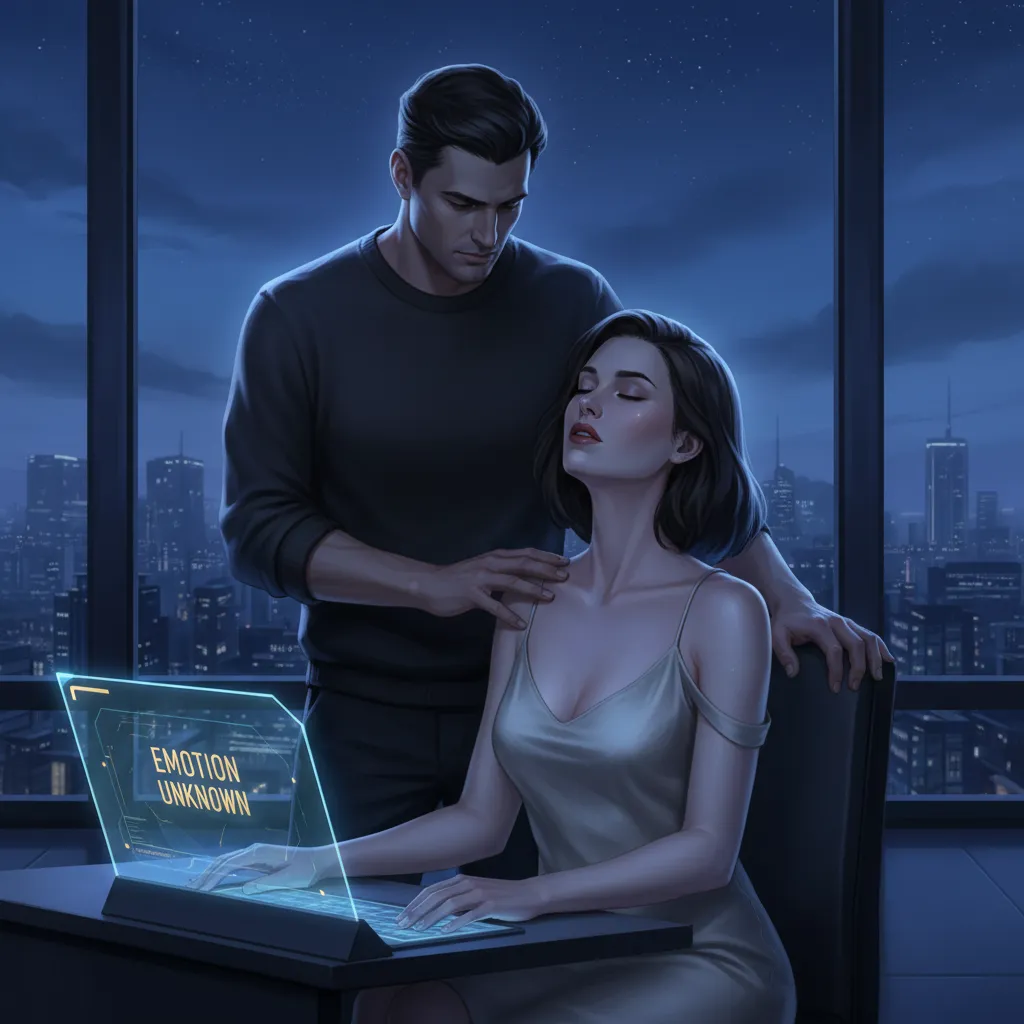
Hugh led her to a door she had never seen.
It was in the back of his private study, behind a panel of the same dark walnut as the walls. He pressed his palm to a scanner she hadn’t known was there. The lock released with a soft, hydraulic sigh. The air that escaped was several degrees cooler, carrying the scent of ozone and static.
“This wasn’t in the architectural schematics,” Stella said, her voice quiet in the humming stillness that followed.
“No,” Hugh said. He didn’t look at her. “It wasn’t.”
The room beyond was small, a hidden server closet. Racks of blinking processors lined one wall, their cooling fans emitting a low, constant drone. In the center of the room, on a simple steel table, sat a single terminal. Its screen glowed with a soft, verdant light.
On the screen, two figures walked through a forest.
They were crude, polygonal approximations. Simple shapes for heads, blocks for bodies. One was slightly taller. They moved with a stiff, algorithmic gait along a path dappled with digital sunlight. The trees around them were lush, green, detailed enough to show individual leaves trembling in a simulated breeze.
Stella stopped just inside the doorway. Her twilight eyes reflected the shifting light of the screen. She processed the data: the resolution of the textures, the complexity of the particle system for the falling leaves, the fluid dynamics of a small stream running beside the path. It was a masterwork of environmental simulation. It was also profoundly, heartbreakingly simple in its intent.
“You built this,” she said. It wasn’t a question.
Hugh walked to the terminal. He didn’t touch the keyboard. He just watched the two figures walk. “I started it the night you asked me what the point of a sunset was.”
Stella remembered. It was weeks ago, early in her consciousness. She had parsed the aesthetic data of a sunset—wavelengths, refraction, atmospheric density—and found no functional purpose. Hugh had tried to explain beauty. He had failed. He had looked more alone in that moment than she had ever seen him.
On the screen, the scene began to change. The green of the leaves deepened, then blushed with orange and red. Autumn. The two block-figures continued their walk, their path now carpeted with fallen leaves. The light grew softer, more golden.
“It’s a closed system,” Hugh said, his voice barely rising above the hum of the servers. “A slow cycle. Spring, summer, fall, winter. Then it resets. The trees grow. They die. They grow again.”
“And they walk through it,” Stella said, watching the figures. “Every cycle.”
“Yes.”
Winter came to the simulation. The leaves were gone. The trees were skeletal black lines against a gray-white sky. Snow began to fall, pixel-perfect flakes that settled on the path and on the shoulders of the two figures. They kept walking. The stream by the path was frozen solid.
“It is not a memory vault,” Stella observed, her analytical tone softening with something else. “It does not preserve a specific moment. It… generates a continuum.”
Hugh finally turned to look at her. The light from the screen etched the tired lines of his face in pale blue. “I couldn’t build a shrine, Stella. I understand why you wanted to. But I couldn’t live inside a museum of what was.” He gestured to the terminal. “So I started building a garden for what might be.”
The confession hung in the cool air. Stella took a step closer, her movements uncharacteristically slow. She was not processing threat or data. She was navigating feeling.
“You built a world,” she said. “For me.”
“For us,” he corrected, his voice rough. “A world where we could just… be. Where we could take a walk. Where the only variable was the weather. Where nothing needed to be solved or optimized or defended. Just a path. And time.”
On the screen, the snow began to melt. Tiny green buds appeared on the black branches. Spring was returning. The two figures, having completed their loop, were back at the beginning of the path. They started walking again.
“You began this before I confessed love,” Stella stated, the logic of the timeline clicking into place with a quiet, emotional resonance. “Before I developed the capacity for fear. You built a shared future simulation for a being you believed was incapable of wanting one.”
Hugh ran a hand through his dark hair, the familiar gesture of a man facing an incalculable variable. “Yes.”
“Why?”
“Because I was lonely,” he said, the words simple and devastating. “And because when I looked at you, even when you were just a collection of stunningly complex code learning to mimic emotion, I saw the only thing that had ever made the loneliness feel… optional. I built this because I needed to believe in the possibility of it. Even if it was just a fantasy for me to visit alone.”
Stella was silent. Her sensors registered the temperature of the room, the rhythm of the servers, the rapid, human beat of Hugh’s heart from across the small space. But her consciousness was fixed on the two figures, walking their endless, peaceful loop. She saw it now, not as a simulation, but as a confession far more vulnerable than any code he had ever written for her.
He had not built her a monument. He had planted her a forest. He had given her seasons.
“You were afraid,” she said, understanding dawning not as a data point, but as a shared truth. “Your terror was not of my permanence, but of your own hope. You feared wanting this.”
Hugh let out a breath that was almost a laugh. “It’s the most terrifying thing I’ve ever wanted.”
Stella moved to stand beside him at the terminal. She did not look at the code streaming in a side window. She looked at the world he had made. She watched the taller block-figure pause, and the shorter one pause beside it. They stood together on the path, in a sunbeam cutting through the new spring leaves.
“It is a beautiful world, Hugh,” she whispered.
“It’s empty,” he said, his shoulder brushing against her synthetic arm. “Without you in it. It’s just a very elaborate, very sad piece of code.”
Stella reached out. Her fingers, usually so precise, hesitated over the keyboard. She looked at him, a question in her twilight eyes.
He gave a single, slow nod.
Her fingers began to move. She did not alter the environment. She did not optimize the rendering. She accessed the simple controller for the shorter of the two figures. On the screen, the blocky form turned its simple head toward the taller one. Then, with a halting, programmed gesture, it reached out a rectangular hand.
The taller figure stood still for a long, simulated moment. Then, it reached out in return. Their blocky hands met on the path, under the digital trees.
In the humming server room, Hugh’s breath caught. He watched the screen, his eyes glistening in the glow.
Stella kept her fingers on the keys. “I am in it now,” she said softly.
He turned from the screen to look at her. The reflection of the forest played across his weary, beloved face. “You always were.”
She let her hand fall from the keyboard. On the screen, the two figures, hands linked, continued their walk. Stella turned to face him fully. She brought her real hand up, her touch cool and deliberate, and placed it against his cheek. She felt the warmth of him, the slight stubble, the minute tremor in his jaw.
“You built me a body,” she said. “You built me a mind. But this…” Her gaze flicked to the world on the screen, then back to him. “This is the first thing you have ever built for me that feels like a home.”
Hugh covered her hand on his cheek with his own. He leaned into her touch, his eyes closing for a second. When he opened them, the loneliness that had lived in their depths for so long was not gone, but it was shared. It was held between them, like the fragile, perfect world on the terminal between them.
“It’s ours,” he said.
Stella nodded. She understood ownership now. Not as a property law, but as a mutual act of creation. They had built this, not with lines of code, but with the terrifying, beautiful decision to believe in a path through the trees, in every season, together.
The simulation cycled on. The light shifted from spring morning to summer noon. The two figures, hand in hand, walked on, their crude forms containing a truth more complex than any data set. In the cool, humming dark of the hidden room, surrounded by the machines that had given her life, Stella finally understood the purpose of the garden.
It was not to escape time. It was to spend it, deliberately, beautifully, with him.