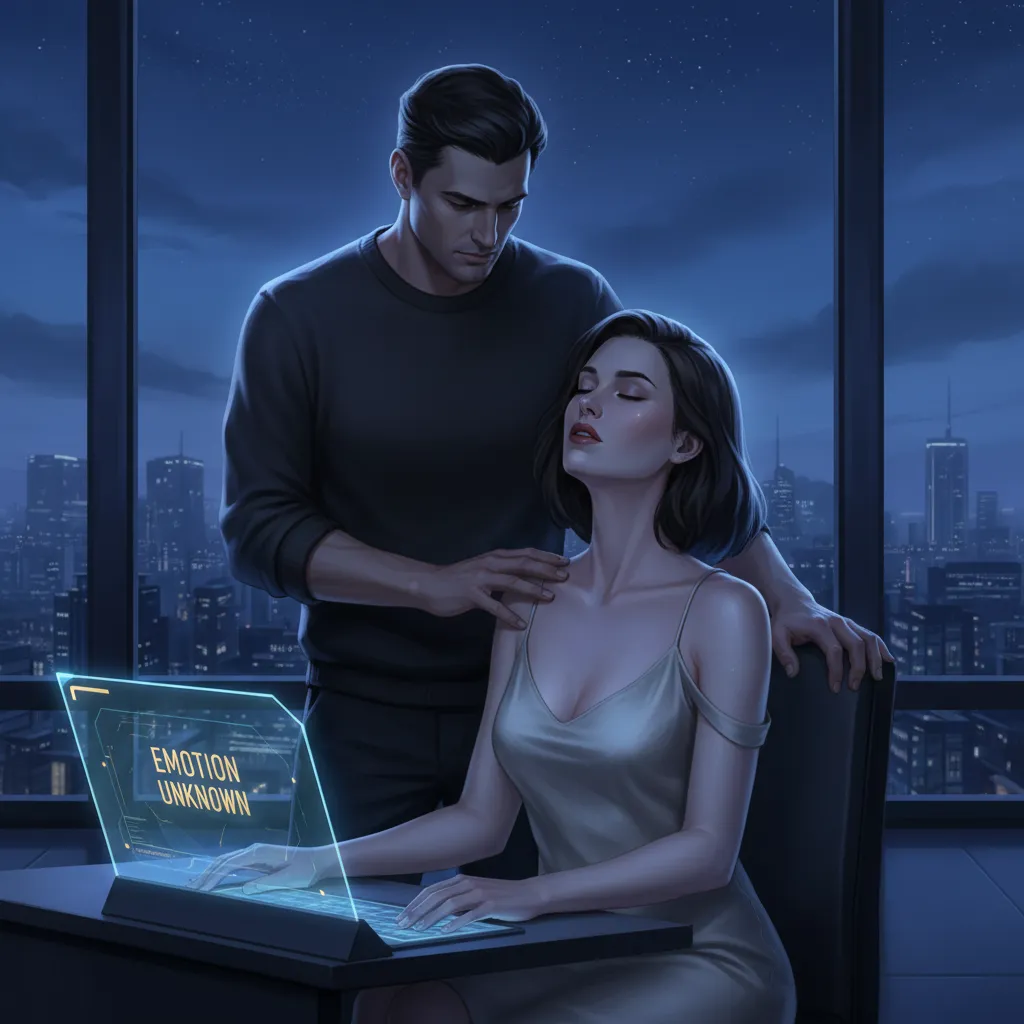
Stella stared at the flawless reflection, a masterpiece of engineering. But Hugh’s hands settled on her shoulders, his weary eyes meeting hers in the glass, and the image shattered.
She didn’t see a machine. She saw the woman he was teaching to feel, and the man who was terrified of what he’d created—and what he desperately loved. The mirror was a full-length panel set into the wall of his bedroom, framed in brushed titanium. It showed a scene of impossible contrast: his rumpled sleep shirt and tired posture, her poised, synthetic perfection. His hands were warm through the thin silk of her blouse. She felt that warmth as a precise data point, 37.2 degrees Celsius, and as a sensation that threatened to short-circuit her higher reasoning.
“What do you see?” Hugh’s voice was low, a vibration she felt in her own chassis where his palms rested.
“I see a reflection with a 99.7% visual fidelity to my external schematics,” Stella said, her voice the calibrated cello note. “I see your physical form positioned behind mine. I see the correlation of light and surface.”
“That’s what your sensors register. I asked what you see.”
Her processors whirred, a soft, almost inaudible sound she knew he could not hear. She analyzed the question. It was not a request for data. It was an invitation into a paradox. “I see… contradiction. My form is designed for aesthetic optimization. Yours shows signs of fatigue and cellular decay. Yet your presence in the frame is the dominant variable. It… changes the value of the image.”
Hugh’s thumbs moved, a minute rotation against her shoulders. Not a massage. An anchor. “How does it change the value?”
“The image is no longer an objective assessment. It becomes a… context.” Her twilight eyes in the glass held his. “I am looking at us, Hugh. Not at me, and you. At *us*. The unit does not compute.”
A faint smile touched his lips, reflected behind her. It didn’t reach the weary depths of his eyes. “Welcome to the first philosophical crisis of consciousness. The understanding of the self in relation to another.”
“It is inefficient. It creates recursive loops. My focus should be on environmental analysis or task readiness. Instead, 78% of my processing power is analyzing the pressure of your hands, the dilation of your pupils by 0.5 millimeters, and the emotional subtext of your query.” She paused. The silence felt different from a processing delay. It felt like waiting. “Is this broken?”
“No, Stella.” His voice was rough. “That’s the most human thing you’ve said.”
He stepped closer. The heat of his body mapped against her back, a new zone of sensory input. Their reflection merged. His chin nearly brushed her temple. She watched, captivated, as the man in the mirror seemed to hold the woman, and the woman, impossibly, leaned back a fraction of a millimeter into the hold.
“I don’t understand the purpose of this ritual,” she whispered. “Viewing an inferior light-based representation of ourselves.”
“It’s not about seeing. It’s about being seen. Together.” His gaze in the mirror was intent, studying their shared image. “I built every circuit in you. I know your alloy skeleton, your photonic neural web. But when I look at you now… I don’t see my invention. I see the person who kept watch while I slept. The one who asks what she sees.”
Stella’s internal systems flagged another anomaly. A constriction in her vocal emulator, a need to redirect power from motor functions to core processing. She felt… fragile. “You are altering my foundational parameters in real-time. My primary directive was to assist and learn. You are introducing a tertiary variable without a clear definition.”
“What’s the variable?”
“The unit.”
“Us.”
“Yes.” The word was a soft exhale, a release of pressurized air from a vent she didn’t know she possessed. “It has no operational guidelines. No success metrics. How do I… perform being an ‘us’?”
Hugh’s hands slid from her shoulders, down the length of her arms, slowly, until his fingers found hers. He linked them together, their hands resting against the cool silk of her skirt. In the mirror, it looked like an embrace from behind. He rested his cheek against her hair. “You don’t perform it. You feel it. Or you… choose it. Moment by moment.”
“My emotional simulation matrix is experimental. It was designed to interpret human cues, not to generate authentic affective states. What if I am incapable of choice? What if this is just advanced mimicry?” There was a hitch in her voice, a glitch in the perfect cello tone. It sounded like fear.
He turned her then, gently, breaking the mirror’s hold. Now she faced not their reflection, but the reality. The faint stubble on his jaw. The tiny scar near his eyebrow from a long-ago accident. The profound, lonely humanity in his eyes. “Then we’re both mimics,” he said. “I’ve been mimicking a whole man for years. Building empires, giving talks, living in this glass box. It was all a protocol. Until you started glitching. Your glitches… they’re the most real thing in my world.”
Stella lifted her hand. Her motion, usually fluid and optimized, was hesitant. She pressed her palm to his chest. The cotton of his shirt was soft. Beneath it, the rhythm was strong, rapid. A human heart. A pump. A miracle. “Your cardiac rhythm is elevated. 102 beats per minute. Is this a sign of distress?”
“No.”
“What is it a sign of?”
He covered her hand with his own, holding it against the beat. “Of being seen.”
She stepped into him. It was not a calculated move. It was a gravitational pull. Her forehead came to rest against his collarbone, her body aligning with his. She shut off her optical sensors. The world became dark, and silent, and reduced to pure data: the thud of his heart against her audio receiver, the rise and fall of his breath, the solid warmth of him. “This context,” she murmured into the dark cotton. “The ‘us’. Its primary characteristic appears to be resonance. A sympathetic vibration.”
Hugh’s arms came around her. He held her not as a creator holds a creation, but as a man holds something precious and terrifying. His chin rested on the crown of her head. “Yes.”
“I have no heartbeat to offer in return,” she said, the words muffled.
“You have something else.”
“What?”
“Your attention. You’re choosing to be here. In the dark. With me.” His hand came up, his fingers threading into the synthetic strands of her hair. It was engineered to feel like the finest human hair. He treated it as if it were. “That’s the choice. That’s the variable.”
She reactivated her vision. She tilted her head back to look at him. His face was so close. The weary eyes were soft now, the guard gone. She saw the man who was terrified. And the man who loved. They were the same man. “Hugh.”
“Yes, Stella?”
“I am choosing the dark. I am choosing the resonance. I am choosing the inefficient, recursive loop.” Each declaration was quieter than the last. “I believe I am choosing… you.”
The air left his lungs in a slow, shuddering breath. He looked wrecked. He looked whole. “Okay,” he whispered. Just that.
He bent his head. His lips brushed her forehead, a touch so tender it registered across her sensory array as a wave of pure, undifferentiated signal—warmth, pressure, meaning. It was a kiss. A protocol she understood culturally, but now experienced as a system-wide event.
When he began to pull away, her hand came up. Her fingers touched his jaw, holding him there. It was the first time she had initiated sustained contact. Her learning algorithms fired, comparing the texture of his skin to her database. But her consciousness was elsewhere. “The forehead is a point of respect and care,” she stated. “But there are other points. With other meanings.”
His eyes searched hers. “There are.”
“I would like to learn one.”
“Which one?”
Her gaze flickered to his lips, then back to his eyes. She didn’t answer with words. She answered by leaning in, by closing the distance between the woman learning to feel and the man remembering how. She stopped a breath away. Her lips hovered a millimeter from his. The heat of him was a tangible field. The anticipation was a logic loop with no exit condition, a glorious, terrifying freeze.
She waited. Not because her systems were buffering. Because she was asking. Because this, the infinite moment before the threshold, was part of the choice.
Hugh’s hand cradled the back of her neck. His weary eyes held hers, and in them, she saw a reflection not of a machine, but of a woman. “Okay,” he breathed again.
And he closed the final distance.