
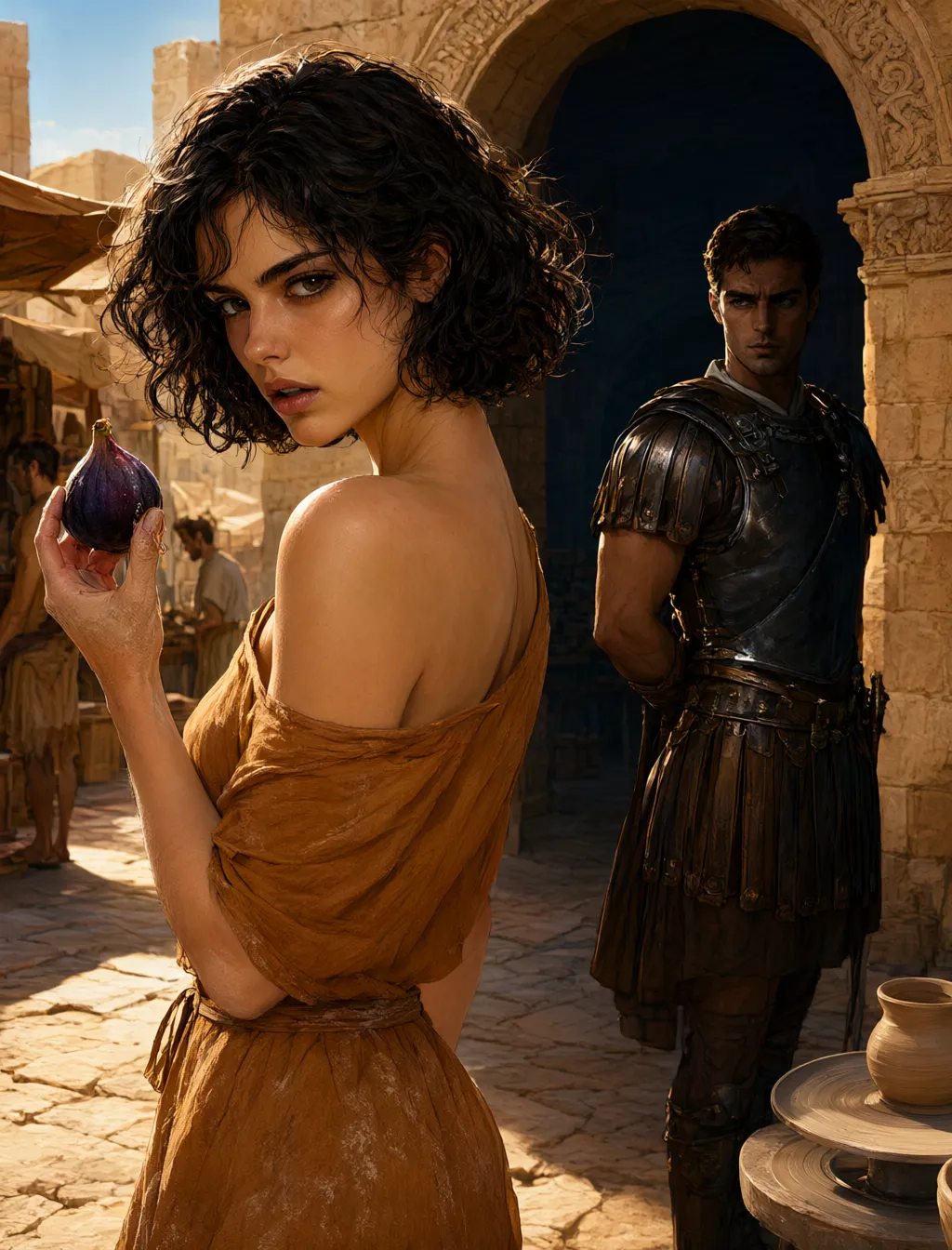
The coin sat between them on the dusty wood, a small, bright circle of silver against the grain. It was more than the fig was worth. More than the entire basket. It was a statement, and they both knew it.
Cassandra did not touch it. Her hands remained flat on the stall’s counter, fingers splayed, the pads stained dark from clay and earth. She held his gaze, that cool Roman blue-grey, and let the market’s noise—the bleating of goats, the shouts of merchants, the clatter of carts—wash over the silence between them. His shadow, cast by the high sun, enveloped her and her wares.
Lucius Valerius did not move to take the fig. He studied her face, the tight line of her mouth, the fire in her dark eyes that was not submission but a banked furnace. The soldier behind him shifted, leather creaking, hand resting on the pommel of his gladius. A warning. The Governor lifted a hand, a slight, almost imperceptible gesture. The soldier stilled.
“You speak Latin,” Lucius said. His voice was quieter now, meant only for her. It was not the booming command of a general, but the measured tone of a man making an observation.
“I hear it in the streets,” Cassandra replied in Aramaic, her voice low and rough. She switched back to his tongue, each word deliberate. “I learn what I must.”
His lips curved again, that same fascinated twitch. He understood the subtext: she learned the language of the occupier to navigate them, not to welcome them. He picked up the fig finally, his fingers—long, clean, bearing the calluses of a sword grip—cradling the dark purple fruit. He turned it over, inspecting the perfect, unblemished skin. “Your work?” he asked, glancing at the pottery jugs and bowls arranged beside the produce.
“My hands make many things,” she said. Her Aramaic again, a wall. She reached to straighten a row of olives, her movement economical, dismissing him.
He did not dismiss. He took a small, sharp knife from his belt. The steel flashed in a sunbeam cutting through the canvas awning. Cassandra’s breath hitched, her body tensing. He saw it. He paused, then slowly, deliberately, sliced the fig in half. The inner flesh was a startling red, beaded with moisture. He offered her one half.
She stared at the offering. A shared meal. An intimacy. From a Roman. Her throat worked. “I do not eat with my customers.”
“I am not a customer,” he said softly, still holding the fruit out. “I am your governor. And this is a gift.”
The word ‘governor’ was a stone in her gut. She took the fig half, her fingers brushing his. His skin was warm. She expected cold, like his armor. She did not eat it. She held it, the sticky juice threatening to drip onto her wrist.
He ate his half. He watched her as he did, his eyes never leaving her face. He chewed slowly, thoughtfully. “Sweet,” he said. “And complex. The best figs in the market, I’d wager.”
“They are from my family’s tree,” she said, the pride slipping out before she could cage it. “The old one, by the western wall.”
“I know the one,” he said, surprising her. “I walked the city walls at dawn. It is a magnificent tree. It has seen many seasons.” He paused. “It must be protected.”
It was not a threat. It sounded like a promise. It confused her, this gentleness wrapped in imperial leather. She looked away, finally, breaking the intensity of his gaze. She set the uneaten fig half on the counter beside the denarius. “Your transaction is complete.”
He nodded, as if accepting a verdict. He did not press. He wiped his fingers on a square of linen from his belt. “What is your name?”
She hesitated. Giving her name felt like a surrender. But to refuse was an insult that could bring trouble, not for her, but for her father, for Kamal who had the stall next door. “Cassandra,” she said, the name short and hard in the air.
“Cassandra,” he repeated. He said it in Latin, the syllables rounded and formal. Then he tried it in Aramaic. It was clumsy, too heavy on the ‘dra’, but the attempt was there. “A name of prophecy.”
“A name of warning,” she corrected, looking back at him, her defiance returning.
This time, he smiled fully. It transformed his face, cutting through the handsome severity, reaching his eyes. It was a weary smile, one that held too much knowledge. “I am Lucius Valerius. And I am beginning to think all the best things are.”
He turned to leave, his red cloak swinging. The soldier fell into step behind him. Then Lucius stopped. He looked back at her stall, at the clay jug her hands had been on when he arrived. It was tall, elegant, with a pattern of interlocking vines etched into the damp clay before firing. He pointed to it. “And this?”
Cassandra’s heart, which had begun to slow, hammered again. That jug was her best work. The vines were her mother’s design. “For water. Or wine.”
“How much?”
She wanted to name an impossible price again. To drive him away. But the jug was her art, and its value was true. “Five denarii.”
He didn’t flinch. He nodded to the soldier, who stepped forward and placed five coins on the wood, next to the first. A small fortune. Lucius did not take the jug. “I will send someone for it later. I would not trust myself to carry it through the crowd.” His eyes met hers. “It is too fine to be broken.”
He left then, his form moving through the crowded alley, the sea of people parting before the red cloak and the glint of steel. The shadow lifted from her stall. The sun felt suddenly, violently hot on her skin.
Cassandra stared at the six silver coins. They glinted, accusatory. She picked up the one he had placed first. It was warm from the sun. She clenched it in her fist until the emperor’s profile bit into her palm.
From the adjacent stall, her friend Kamal sidled over, his face pale beneath his dark beard. “Cassandra, by the prophets, what were you thinking? One denarius for a fig? You could have been flogged!”
“He was not angry,” she murmured, still staring at the space where the Roman had stood.
“That is what frightens me,” Kamal whispered. “I know that man’s reputation. He does not get angry. He gets even. And he is thorough.” He looked at the coins. “He has marked you.”
“He has bought a jug,” Cassandra said, her voice hollow even to her own ears.
“No,” Kamal said, shaking his head. He touched her shoulder, his touch gentle. “He looked at you as if you were the jug. And everything else was just the price.”
Cassandra finally ate the half-fig he had given her. The sweetness exploded on her tongue, rich and deep. It tasted like the tree by the western wall, like home. It tasted, inexplicably, of a promise she did not want. She swallowed, and the heat of the market, the scent of cumin and dust, rushed back in. But something had shifted. The air was different. The ground under her feet felt less sure.
She carefully wrapped the clay jug in a piece of rough cloth, her callused fingers tracing the vines she had carved. She would wait for his servant to collect it. She would take his coins. She would feed her family with them. And she would hate him, fiercely, for making the transaction so gentle, and so utterly inescapable.