
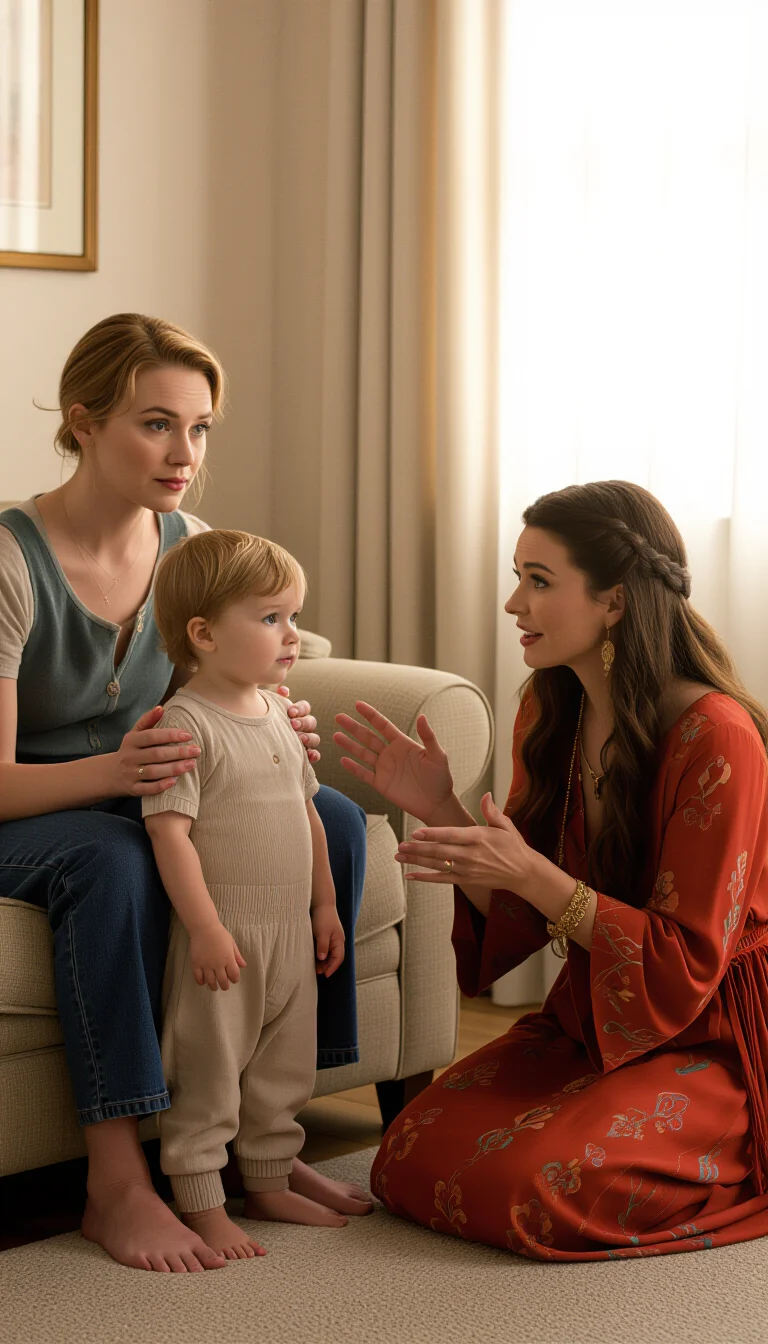
Connie’s coffee cup hovered in mid-air, her eyes fixed on Leonard where he sat quietly on the rug. Shirley’s hand stilled on her son’s fine hair. The living room air thickened with the unspoken weight of all the doctor’s visits, the growth charts, the careful handling. Connie leaned forward, her voice dropping to a conspiratorial stage whisper. ‘The part’s for an infant. A six-month-old girl.’
Shirley’s fingers tightened, just for a second, in Lenny’s silken strands. He didn’t flinch. He was tracing the geometric pattern of the rug’s border, his index finger following a line of ochre diamonds.
‘An infant,’ Shirley repeated. The word sat in the room, small and demanding.
‘The script calls for a bundle of joy,’ Connie said, her hands painting the air. ‘A cooing, gurgling prop in the mother character’s arms. But a real baby… well. They cry. They need changing. They’re unpredictable.’
‘Lenny is five,’ Shirley said, but her voice lacked its usual defensive edge. It was a fact, not a shield.
‘I know, honey. I know.’ Connie’s gaze was clinical now, appraising. ‘But look at him. The size of him. He sits so still. He listens.’
Lenny looked up then, his wide hazel eyes moving from his mother’s tense face to Connie’s eager one. He understood he was the subject. He always understood.
‘They need someone who can hold a position,’ Connie continued, leaning closer to Shirley, her perfume cutting through the coffee scent. ‘Someone who won’t fuss under lights. The costume is a simple christening gown. Bonnet, booties. The audience will be twenty feet away.’
‘A gown,’ Shirley whispered.
‘It’s a period piece. The character is a baby girl named Rose.’
Shirley’s nervous laugh escaped, a short, dry sound. ‘You want my son to play a girl.’
‘I want a solution to a problem,’ Connie corrected gently. ‘And I see a remarkable little boy who might enjoy it. It would be three nights. He’d be carried on, held, carried off. No lines. Just… being.’
Shirley’s hand finally left Lenny’s hair and came to rest on her own knee, gripping it. She looked at her son. He had returned to his tracing, but his head was tilted, listening to every word. He absorbed conversations most children ignored, a silent archivist of adult worries.
‘Lenny,’ Shirley said, her voice soft. ‘Did you hear what Auntie Connie is asking?’
He nodded without looking up. ‘To be a baby in a play.’
‘A baby girl,’ Shirley added, testing the words.
‘Rose,’ Lenny said, perfectly pronouncing the name. He looked at Connie. ‘Would I have to cry?’
Connie beamed, as if he’d delivered a soliloquy. ‘No, sweetheart. No crying. You just have to be very peaceful. Can you be peaceful?’
Lenny considered this. He glanced at the large window, at the dust motes dancing in a sunbeam. ‘I can be still,’ he said finally. ‘Like when I get my blood drawn.’
The reference was a tiny knife in Shirley’s heart. His stillness during those clinical violations was not a skill she ever wanted to be useful.
Connie, either missing or ignoring the ache in Shirley’s expression, clapped her hands softly. ‘See? A professional. He already understands stage direction.’
‘It’s… it’s a lot to consider, Con,’ Shirley said, pulling her cardigan tighter around herself. ‘His health. The strange environment. The… the costume.’
‘Of course. Absolutely.’ Connie reached out and touched Shirley’s arm. ‘But think of it. For once, his size isn’t a limitation. It’s the qualification. It’s the special thing.’
The room went quiet. The refrigerator hummed in the kitchen. Lenny had finished his tracing and now simply sat, his small hands palm-up on his thighs, waiting. He was so used to waiting while adults decided things about him.
Shirley saw it all then, not as a mother’s worry, but as a series of images. The carrying. The holding. Her son, swaddled in lace, being presented as something precious and new. Not a sickly preemie, not a worry, but a baby. A wanted baby. The fantasy of it was so profound it stole her breath.
‘Who would hold him?’ she asked, her voice barely audible.
‘Martha Phillips. You know Martha. She plays the mother. She’s got three grandchildren. Hands like a safe.’ Connie’s eyes were bright. ‘And you’d be right backstage. In the wings. Every second.’
Shirley looked at Lenny. ‘Would you want to try it, bunny? It might be scary. Bright lights. Lots of people.’
Lenny uncurled his legs and stood up. The movement was careful, a slow unfurling. He walked to his mother and leaned against her knee, his body a slight weight she knew down to the ounce. He looked up at her. ‘Would you be there?’
‘Every second,’ she promised, echoing Connie.
He nodded, a single, solemn dip of his chin. ‘Then it’s okay.’
His trust was absolute. It was a country she lived in, and its borders were defined by her own fear. She cupped his cheek, her thumb stroking the incredible softness just below his eye. He leaned into the touch.
Shirley lifted her gaze to Connie. The words felt foreign in her mouth, a script she hadn’t rehearsed. ‘Yes.’
Connie’s face broke into a brilliant smile. ‘Oh, Shirley. It’s going to be wonderful. You’ll see.’
‘Yes,’ Shirley said again, firmer now, as if convincing herself. ‘We’ll try it.’
‘Marvelous!’ Connie stood, energy crackling off her. ‘We have our first read-through tomorrow night. Just a casual thing. Bring Lenny so he can meet everyone, see the space. No pressure.’
After Connie left in a whirl of scarves and enthusiastic promises, the living room felt too still. Shirley sank back into the couch. Lenny climbed up beside her, not sprawling like other children might, but sitting upright, his feet not reaching the edge of the cushion.
‘Mama?’ he whispered.
‘Yes, love?’
‘Will I have to wear a dress?’
She put her arm around him, her hand spanning the entire width of his back. ‘Just a very long, pretty gown. Like a… a sleeping bag made of lace.’
He seemed to ponder this. ‘Will it be soft?’
‘I’ll make sure it’s soft,’ she said, and the ferocity in her own voice surprised her.
He nodded, satisfied. He rested his head against her side, his breath warm through her blouse. She stared at the empty coffee cups on the table, the ghost of Connie’s lipstick on the rim. She had just agreed to have her five-year-old son swaddled and presented as an infant girl to an audience. The absurdity of it should have made her rescind the offer immediately.
But beneath the absurdity ran a deep, forbidden current. For three nights, the world would see not what he lacked, but what he perfectly was: small enough to hold. Small enough to cherish. For three nights, he would be the baby she sometimes still saw when she closed her eyes—the one who fit in the crook of her arm, whose entire hand would wrap around her thumb. The one before the charts and the comparisons.
Her hand found his, and his fingers, delicate as bird bones, laced through hers. He was already halfway to sleep, his body a familiar, trusting weight against her. She held on, and in the quiet living room, she began the silent, terrifying work of untangling protection from possession, and love from fear.
Two days before the play, the special doctor’s office smelled of antiseptic and lemon polish. Lenny sat on the edge of the examination table, his sneakers dangling a full foot from the floor. Shirley stood beside him, one hand on his knee, her thumb rubbing small, anxious circles on the denim of his overalls. Connie waited in the corner, her presence a vibrant, watchful splash of color against the sterile white.
The doctor, a brisk woman with kind eyes, explained the procedure in soft, technical terms. A temporary modification. For authenticity. A special medical adhesive. It would wash off with warm water and oil after the final curtain. Shirley nodded, her throat too tight to speak, her eyes fixed on Lenny’s calm, upturned face as he listened.
“Okay, little man,” the doctor said. “Let’s get you ready.”
Shirley helped him out of his overalls and his soft cotton t-shirt. The room was cool. His skin prickled with goosebumps. He didn’t shiver. He lay back on the crinkling paper of the table, small and pale against the expanse of it, his hazel eyes tracking the fluorescent lights overhead.
“A little pinch first,” the doctor said, her voice a gentle hum. She swabbed a spot of cold liquid low on his abdomen. Lenny’s breath hitched. Shirley’s hand found his, their fingers lacing together. The needle was quick, a sharp sting that made his toes curl. A numbness began to spread, a strange, heavy nothingness.
He felt pressure then. A gentle, insistent pushing. His tiny penis was guided upward, the skin folded neatly, carefully. He watched his mother’s face. Her expression was still, a mask of fierce concentration, but her eyes were glistening. Connie leaned forward, her hands clasped under her chin as if witnessing a sacred ritual.
The doctor worked with a sculptor’s precision. There was a brush, a cool gel, the faint chemical scent of the special glue. Lenny felt the pressure hold, then set. The doctor smoothed the area with her thumb once, a final, sealing touch.
“All done,” she announced, her voice returning to its normal volume. She helped Shirley guide him to sit up. “Take a look.”
Shirley helped him stand on the table, her hands firm around his waist. A full-length mirror was mounted on the wall opposite. Lenny turned. He looked.
What he saw was a baby girl between his legs. The familiar landscape of himself was gone. In its place was a smooth, seamless innocence. The medical adhesive held the illusion perfectly. He stared. He didn’t touch. He just looked, his head tilted slightly.
“Well?” Connie breathed from the corner. “What do you think, Lenny?”
He was silent for a long moment. The numbness was a cloud, separating him from the truth of the image. He looked at his mother in the mirror’s reflection. Her cheeks were wet. He looked back at his own small body, transformed.
“It’s different,” he whispered finally.
Shirley made a sound, a swallowed sob. She pulled him gently against her, his bare skin cool against her sweater. She dressed him with trembling hands, easing the soft t-shirt over his head, guiding his legs into the overalls, fastening the buckles with a click that sounded too loud in the quiet room.
Connie drove them home. The car was filled with her optimistic chatter about lighting cues and rehearsal schedules, a stream of words that washed over the silent pair in the backseat. Lenny leaned against his mother, watching the world blur past the window. He felt the strange, flat absence where the numbness was, a quiet secret held against his skin.
That night, during his bath, Shirley knelt beside the tub. She tested the water with her elbow, the way she had when he was an infant. She washed his hair, her fingers massaging his scalp, and he closed his eyes. The warm water lapped at the edges of the modification, but she was careful, so careful, to avoid it.
“Does it feel funny?” she asked, her voice barely above the sound of the water.
He opened his eyes. Water droplets clung to his lashes. “It feels like air,” he said.
She didn’t know what that meant. She wrapped him in a towel big enough to swallow him whole, lifting him from the water and cradling him against her chest. In his room, she dressed him in his footed pajamas, the ones with the dinosaurs. She paused, her hand hovering over the snap at the crotch. She left it unsnapped.
He climbed into bed. She sat on the edge, brushing the damp hair from his forehead. “Are you scared?” she asked.
He thought about it. He thought about the mirror. The smoothness. The audience he hadn’t met yet. “A little,” he admitted. “Will you be in the front?”
“I’ll be in the wings. Right off the stage. You’ll be able to see me the whole time.”
He nodded. His hand crept out from under the covers and found hers. “Mama?”
“Yes, love?”
“When the play is over… will I be me again?”
The question pierced her. It was not about the glue. She heard the deeper, unspoken fear: was this small, fragile body, this object of medical curiosity and theatrical convenience, all he was? She leaned down, her forehead touching his. “You are always you,” she whispered, the words a vow. “This is just a costume. The deepest part of you is right here.” She touched a finger to his chest, over his heart. “And that part never changes.”
He sighed, a soft release of breath that smelled of toothpaste and childhood. His eyes drifted shut. She stayed until his breathing evened out into sleep, her own heart a wild, protective drum against her ribs.
The next day was dress rehearsal. The community theatre was a cavern of dusty velvet and ghost light. Connie met them at the stage door, her arms full of lace and satin. The infant gown was a cloud of ivory, impossibly delicate. Shirley helped him into it in a cramped dressing room that smelled of old makeup and mildew.
The fabric was, as she had promised, soft. It whispered against his skin. She tied the satin ribbons at the back, her fingers fumbling. She placed a lace bonnet on his head, tucking his fine hair inside. Finally, she lifted him and laid him in the ornate, oversized bassinet that was the central prop.
He looked up at her, a sea of lace framing his small, serious face. He was utterly convincing. He was a perfect, silent baby girl. A lump rose in Shirley’s throat, hard and painful.
The director, a man with a booming voice, clapped his hands. “Places! Let’s run the christening scene.”
The actors took their marks. Shirley retreated to the wings, her designated spot. The lights came up, hot and blinding. Lenny, in his bassinet, did not move. He didn’t fidget or peek. He became the prop he was meant to be, a still life of infancy. The actors cooed over him, recited their lines about blessing and innocence. A sprinkle of stage-water misted his cheek.
From the shadows, Shirley watched. She saw the audience’s view. She saw the cherished infant, the symbol of hope. She saw the utter erasure of her son. Her Lenny, with his whispered questions and his dinosaur pajamas and his fingers that traced patterns when he thought, was invisible. Only the baby remained.
When the scene ended and the lights dimmed, she was at his side in an instant. He blinked up at her, the stage brightness fading from his eyes. “You were perfect,” she said, her voice thick.
“I didn’t move,” he reported solemnly.
“I know.” She gathered him, lace and all, into her arms. He felt so light. He curled into her, his head on her shoulder, and in that moment, he was both—the five-year-old boy seeking comfort, and the infant he appeared to be. She held him, and the silent, terrifying work continued, there in the dusty dark of the wings, as the boundary between what the world saw and what she knew blurred into nothing.
The community theatre at two in the afternoon was a different creature—hushed, expectant, the dust motes dancing in shafts of sunlight from the high windows. Shirley carried Lenny through the empty house seats, his small body a familiar weight against her hip, his dinosaur backpack slung over her shoulder. On stage, the set had been transformed into a church interior, all faux stained glass and wooden pews. To one side, a small antechamber was arranged as a baby’s dressing room, complete with an ornate, padded changing table.
Connie emerged from the wings, her smile bright against the dimness. “Right on time. Let’s get our star ready.” She led them up the steps and into the little stage room. The changing table was draped with a soft white blanket. “Up you go, sweetheart,” Connie said, her voice taking on that cooing, director’s note quality. Shirley lifted Lenny and laid him gently on his back on the table. He looked up at the fly system and rigging high above, his eyes wide.
“Okay, let’s get you out of these big boy clothes,” Connie said, bustling. She unzipped his simple cotton hoodie, and Shirley helped, sliding it off his thin arms. His t-shirt came next, then his soft pants. Soon he was lying there in just his briefs, small and pale on the vast white expanse of the blanket. His chest rose and fell with calm, shallow breaths. He didn’t shiver. He just watched.
Connie produced a large, floral diaper bag from beneath the table. She unzipped it with a flourish. “Everything we need.” From its depths, she pulled out a single, pink diaper. It was patterned with tiny crowns and the word ‘Princess’ in curling script. She handed it to Shirley. Then she pulled out a sealed package of tights and gave them to Lenny. “Hold these for me, darling.”
Lenny took the package. His small fingers traced the clear plastic window. He turned it, his brow furrowing in concentration. In a whisper, he read the printed text on the package. “For… zero… to six… months.” He looked at his mother, then at the tights inside. They were white, with a delicate lace pattern across the seat. He held them up, the plastic crinkling in the quiet.
Shirley’s hands were steady as she unfolded the pink diaper. It was thicker, more padded than anything he’d worn in years. She slid it under him, the rustle of the plastic lining loud in the hushed theatre. The scent of clean, powdery polymer rose from it. Connie handed her a bottle of baby powder. Shirley took it, the cool plastic familiar in a deep, dormant way. She gave it a gentle shake and sprinkled a little across his stomach. The fine, white dust settled, smelling of distant infancy.
She fastened the diaper tabs, the sound crisp and final. Then she took the tights from Lenny, tore open the package, and carefully gathered the delicate nylon. “Foot,” she whispered. He lifted a leg, and she guided his foot through, rolling the material up his calf, over his knee, to his thin thigh. She repeated it with the other leg. The lace sat neatly over the pink diaper. The tights were a perfect, snug fit.
Connie beamed. “Perfect. Here.” She produced a single, pink pacifier from the bag, the shield shaped like a flower. She offered it to Lenny. He looked at it, then at his mother. Shirley gave a tiny, almost imperceptible nod. He opened his mouth and took it. His cheeks hollowed slightly as he began to suck, the rhythm instinctual and calm.
“And the booties,” Connie said, handing Shirley a pair of tiny, white knitted shoes with satin ribbons. Shirley tied them gently around his ankles, making soft bows. His feet looked impossibly small inside them.
Finally, Connie lifted the christening gown from a garment bag. It was a cloud of pure white lace and pintucks, with a long, flowing skirt and sleeves that would swallow his hands. Together, they dressed him. Shirley guided his arms through the sleeves, the lace whispering against the tights. Connie floated the gown down over his body, settling it around him on the changing table. They tied the satin sash in the back.
Connie stepped back, her hand coming to her mouth. “Oh, Shirley.” Her voice was thick with awe. “Look at him.”
Shirley looked. The boy was gone. The lace bonnet from the day before was placed on his head, tied under his chin. The pacifier bobbed gently with his sucking. The gown pooled around him, making his form even smaller, more indistinct. He was all lace and ribbon and delicate fabric, a bundle of innocence. His wide hazel eyes, peering out from all that finery, seemed to belong to someone else.
“He doesn’t look six months,” Connie breathed, her director’s eye assessing. “In that gown… with the bonnet… he looks like a newborn. Zero to three months, easy. It’s uncanny.”
Shirley said nothing. A cold, clear feeling washed through her, like ice water in her veins. This was the culmination. The doctor’s office, the rehearsal—they were steps leading to this moment where her son vanished completely into the role. Connie saw a perfect illusion. Shirley saw an erasure so complete it stole her breath.
Lenny’s hand moved. From within the voluminous lace sleeve, his small fingers emerged, groping blindly for a moment before finding the satin edge of the blanket. He began to trace a pattern on it, a slow, repetitive square. It was his thinking gesture. The boy was still in there, mapping his territory on the fabric.
Shirley reached out and covered his hand with her own, stilling it. He blinked up at her, the pacifier pausing mid-suck. “It’s almost time,” she said, her voice barely a sound.
“It is!” Connie chirped, the spell broken. She checked her watch. “The audience will be seated in twenty. We’ll let him rest here until his cue. He just has to lie in the bassinet. You’ll be in the wings, just like before.” She gave Shirley’s arm a squeeze. “He’s going to be magnificent.” She bustled off toward the stage manager.
They were alone in the little stage room. The distant sounds of the arriving audience were a muffled rumble. Shirley leaned over the changing table, her face close to his. She could smell the baby powder, the clean cotton of the gown, and beneath it, the faint, essential scent of him—her Lenny.
He spat the pacifier out. It dangled on its clip against the lace. “Mama?”
“Yes, baby?”
“Will they… will they think I’m a real baby?”
The question, asked with such solemn curiosity, cracked something open in her chest. “Yes, honey. For a little while, they will.”
He considered this. His fingers found hers and held on. “That’s okay,” he whispered. “It’s just pretending. You know it’s me.”
Tears pricked hot behind her eyes. She nodded, unable to speak. She brought his captured hand to her lips and kissed his knuckles, a silent pledge. *I know. I will always know.*
A stagehand appeared at the edge of the set. “Five minutes to places for the christening scene.”
Shirley slid her hands under him, lace and all, and lifted him from the table. He was no heavier than a sigh. He immediately curled into her, his head finding the hollow of her neck, his body molding against hers. He was the infant the world would see, and the boy she carried, all at once.
She carried him to the wings, to their spot in the shadows. The bassinet waited in a pool of light center stage. The murmur of the full audience was a living thing beyond the curtain. His breathing was soft and even against her skin.
The director caught her eye from across the stage and gave a sharp nod.
It was time. Shirley took one last, deep breath of him—powder, lace, boy—and stepped forward into the light to lay her son down in the crib.