
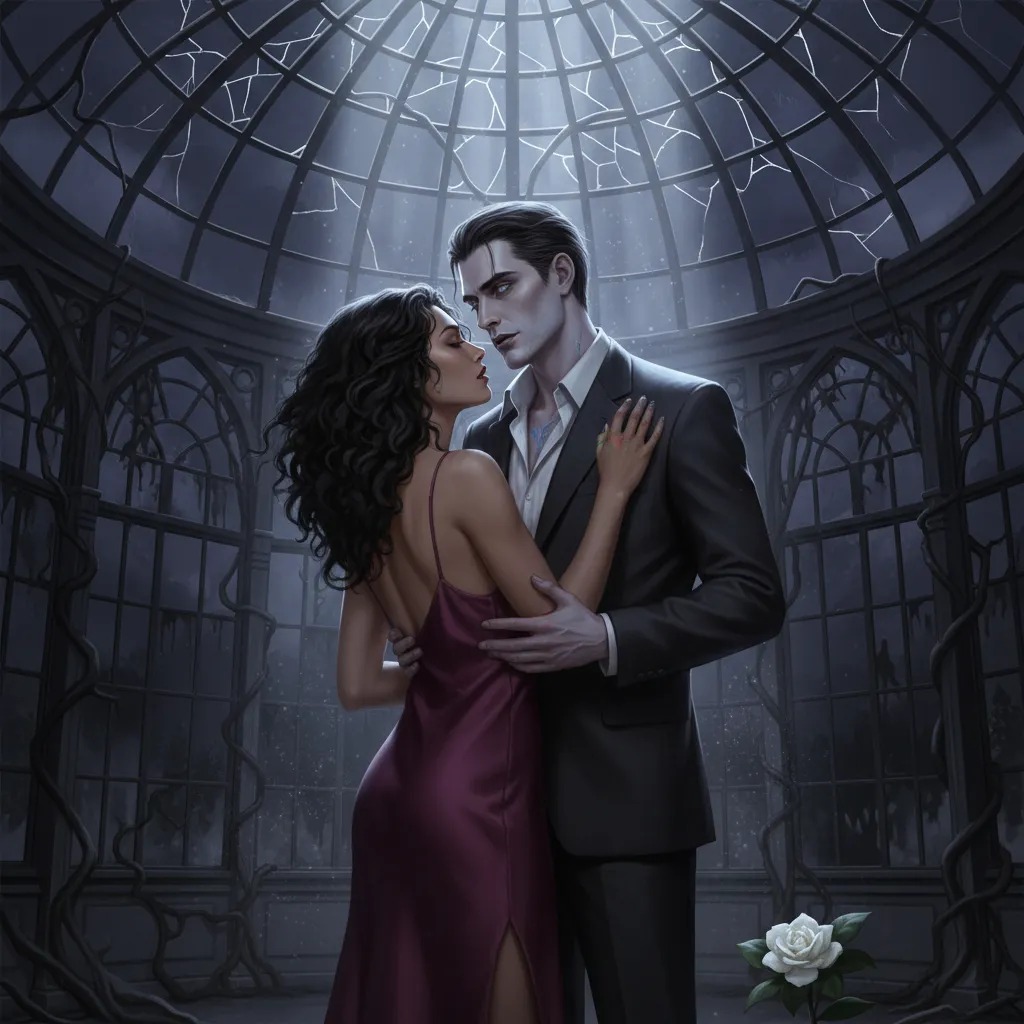
Luna’s studio was a riot of color and light. Ezra stood on the threshold, his hand still in hers from the rooftop, and felt the world tilt on its axis. This was not his domain of shadow and silence. Morning sun streamed through tall, paint-splattered windows, illuminating dust motes dancing over canvases stacked against walls, over jars bristling with brushes, over a chaos of pigment that seemed to pulse with a life of its own. The air was thick, warm, and smelled profoundly of her—linseed oil, turpentine, the chalky scent of pastels, and beneath it all, the jasmine and warm skin that was uniquely Luna.
“Welcome to my mess,” she said, her voice bright with pride. She released his hand and moved into the room, her bare feet silent on the stained wooden floor. She was a creature transformed here, no longer the woman in his dark library or his sterile bedroom. Here, she was sovereign. “It’s the only place that ever really felt like mine.”
Ezra took a careful step inside. The sunlight fell across the toes of his black shoes, and he instinctively hesitated, a centuries-old reflex. But the light here was filtered, softened by the haze and the grime on the windows. It held no burn, only a gentle, overwhelming warmth. He felt exposed, not by brightness, but by the sheer, vibrant evidence of her existence. Every splash of color was a testament to a life lived passionately, messily, fully.
“It suits you,” he said, his low voice almost swallowed by the room’s expansive energy. His eyes tracked her as she moved to a large easel near the center, where a half-finished canvas swirled with abstract forms in gold and crimson. “It is… unabashedly alive.”
“That’s the idea.” She turned to him, her curls a wild halo in the backlight. Her gaze was assessing, not with fear or pity, but with the focused curiosity of an artist. “I want to paint you.”
The statement landed in the quiet between them. Not a question. An invitation, or perhaps a command from the queen of this sunlit realm.
Ezra went very still. “You have seen me,” he said carefully.
“I’ve seen the vampire in his castle,” she countered, wiping her hands on a rag already stained a rainbow of hues. “I’ve seen the man in his bed. I want to see the person in my light. And I want to keep him.” She pointed to a worn velvet armchair tucked into the room’s only dim corner, where the shadow of a large bookshelf fell. “Sit there.”
He obeyed, moving with his usual silent grace through the clutter. The chair was soft, engulfing. From this vantage point, the studio unfolded before him like a cathedral dedicated to creation. Luna bustled, selecting a fresh, medium-sized canvas and setting it on the easel with a firm thump. She began mixing colors on a large wooden palette, her movements quick and sure. The scrape of the palette knife, the clink of glass jars, the wet slide of pigment—it was a symphony of making.
She looked at him, then back at her palette, squeezing a dollop of titanium white. “Stop being so still.”
“I am still,” he said.
“No. You’re holding your breath. You’re posing. I don’t want the statue, Ezra. I want the man who watched the sunrise with me.” She picked up a brush, tapping the handle against her lips. “What are you thinking about, right now?”
He hadn’t prepared for this. Combat, seduction, centuries of philosophical debate—these were languages he knew. This quiet, sustained observation was a new kind of dissection. “I am thinking,” he began, the words slow to form, “that this light should hurt. And it does not.”
“Good.” She made a few bold, sweeping strokes on the canvas, blocking in shapes he couldn’t see. “Keep talking.”
He let his gaze wander over the room, giving her something more natural than a direct stare. “I am thinking that your chaos has a order I cannot decipher. That every stain on that floor tells a story I will never know. I am thinking that I have lived three hundred years and never left a mark so honest as the paint under your fingernails.”
Luna paused, her brush hovering. She looked from him to the canvas, her eyes narrowing. “You feel like a contradiction,” she murmured, more to herself than to him. “Sharp lines and impossible softness.” She selected a new brush, a thinner one, and approached her palette again. “Your eyes. They’re not just gray. There’s blue in there, where the light hits. And a little green, like moss on stone.”
He felt her gaze like a physical touch, tracing the lines of his face, the set of his jaw, the hollows of his cheeks. It was more intimate than undressing. She was cataloging him, translating him into a language of color and form. The vulnerability was profound, a stripping away of all defenses. There was no hunger to hide behind here, only the naked fact of being seen.
“You look tired,” she said softly, her voice losing its artistic clip.
“I am ancient, Luna. Weariness is the foundation.”
“No.” She dipped her brush into a mix of gray and a touch of violet. “Not that kind of tired. This is new. It’s the tired that comes after a long fight, when you finally put the weapon down.” She painted in swift, sure strokes. “It’s in the way your shoulders aren’t pulled back like a soldier’s right now. It’s in the way you’re letting the chair hold you up.”
Her perception was a lance, finding the chink in his armor he hadn’t known was there. He had carried the tension of his own existence for so long it felt like bone. Until her. Until this chair, in this sunlit room.
“What do you see when you look at me?” he asked, the question leaving him before he could cage it.
She didn’t answer immediately. She worked, her brow furrowed in concentration, adding depth to the shadow she was crafting on the canvas—his shadow. “I see a man who built a library to remember what it was to think, and a bedroom to forget what it was to feel. I see centuries of solitude in the way you hold your own hands.” She mixed a new color, a daring, fragile streak of pale yellow into a field of gray. “And I see the hope, Ezra. It’s the scariest thing on your face. It’s so… small. And so bright.”
The words unraveled something deep in his chest. He had confessed hunger, fear, desire. But this—this observation of a hope he dared not name—was the most terrifying exposure of all. His throat tightened. He looked away, out the window to where a pigeon landed on the rusted fire escape.
“Don’t look away,” she whispered. “Please. Let me see it.”
He forced his eyes back to her. The sunlight caught the tears she was too focused to notice welling in her own eyes. She was painting his pain, his hope, and feeling it with him. The connection was not of blood or body, but of soul, and it shook him to his silent core.
“I am afraid,” he said, the admission a raw scrape in the quiet room.
Her brush stilled. “Of what?”
“That I am no longer the monster in the dark.” He held her gaze, letting her see the storm in his. “And I am not yet a man who can stand in your light. I am something in-between. A ghost learning to cast a shadow. And I fear… I fear that shadow will never be enough for you. That when you finish your painting, you will look at it and see only the absence of color where a real man should be.”
Luna put her brush down. She walked around the easel, her paint-stained smock whispering as she moved, and came to stand before him. She didn’t touch him. She just looked down at him, sitting in the shadowed chair, her face full of a fierce, aching tenderness.
“You are so wrong,” she said, her voice thick. “You are all I see.” She reached out, her fingers stopping just short of his cheek. “The color isn’t in the light, Ezra. It’s in the contrast. The deepest blue exists because of the orange beside it. The most vibrant gold shines against the darkest gray. You are my deepest blue. You are my most vibrant gold. You are not an absence. You are the thing that makes all the other colors sing.”
She knelt then, there on the paint-spattered floor, and took his cold hands in her warm, stained ones. “Let me paint the in-between. Let me paint the ghost and the shadow and the hope. That is the man I see. That is the man I want.”
Ezra looked at their joined hands, her vibrant life clasping his eternal stillness. He saw a smudge of the yellow paint from days ago, still lingering in the crease of her palm. He saw the future she was offering, not in a sun-drenched field, but here, in the beautiful, messy contrast of her world and his. He brought her hand to his lips and kissed that faint, stubborn yellow.
“Then paint,” he whispered against her skin.
She returned to her easel, wiping her cheeks with the back of her wrist, leaving a streak of gray and yellow. She worked with a new intensity, her movements less tentative, more profound. Ezra sat back, and this time, he did not hold his breath. He let himself be seen—the weariness, the fear, the fragile, stubborn hope taking root in the cracked foundation of his centuries. He let her translate it all into something permanent. Into her truth.
The morning stretched on, filled with the sound of her creation. And for the first time in three hundred years, Ezra Blackwood did not feel like a relic in the light. He felt like a subject. He felt like a man, being painted by the woman who loved him.